

Japan’s immigration policy has become one of the most important and widely debated issues shaping the country’s future. As Japan faces a rapidly aging population, record-low birth rates, and a shrinking workforce, policymakers, economists, and business leaders are increasingly asking the same question: Can Japan maintain its economy and social systems without significantly increasing the number of foreign workers?
The challenge is substantial. According to government projections, Japan’s working-age population is expected to decline sharply over the coming decades, creating labor shortages across industries ranging from healthcare and elder care to construction, agriculture, hospitality, transportation, and technology. Many employers already report difficulties finding enough workers, particularly in rural areas and sectors that rely on physically demanding labor.
For decades, Japan attempted to address these demographic challenges through automation, productivity improvements, robotics, and policies designed to encourage higher birth rates. While these measures have helped in certain areas, they have not been sufficient to offset the scale of population decline. As a result, foreign labor has become an increasingly important part of Japan’s workforce strategy.
In recent years, the Japanese government has introduced new visa categories, expanded opportunities for skilled and semi-skilled workers, and created faster pathways to long-term residency for highly qualified professionals. These changes represent a significant shift from Japan’s historically cautious approach toward immigration. While Japan still does not operate a large-scale immigration system comparable to those of countries such as Canada or Australia, its policies have gradually evolved to attract the workers needed to sustain economic growth and essential public services.
At the same time, immigration remains a sensitive topic in public discourse. Discussions often involve concerns about cultural integration, social cohesion, economic competition, and national identity. These debates are further amplified by political rhetoric, media coverage, and online discussions that sometimes obscure the underlying demographic realities facing the country.
This guide examines Japan’s immigration policy, the country’s growing reliance on foreign workers, and the economic and demographic forces driving policy changes. Drawing on government data, demographic research, labor market trends, and firsthand observations from living in Japan, we explore why immigration has become increasingly important, which industries depend most heavily on foreign labor, how current visa programs operate, and what the future may hold for one of the world’s fastest-aging societies.
Whether you are considering working in Japan, researching Japan’s demographic challenges, or simply trying to understand how the country is adapting to population decline, this article provides a comprehensive overview of the facts, policies, and realities shaping Japan’s evolving approach to immigration.
Why Japan Needs Foreign Workers More Than Ever

Japan’s demographic crisis is no longer a future concern. It is already reshaping the country’s economy, labor market, and long-term sustainability. For decades, policymakers hoped that a combination of automation, productivity gains, and family support measures would slow the effects of population decline. While these efforts have delivered some results, they have not reversed the underlying trend: Japan’s workforce is shrinking faster than it can be replaced.
The core problem is simple. Fewer people are entering the workforce each year while a growing number are reaching retirement age. According to projections from government agencies and labor market researchers, Japan could face a labor shortage exceeding 11 million workers by 2040 if current demographic trends continue. This raises an important question that many people search for today: Why does Japan need immigrants?
The answer lies in the structure of the economy itself. Modern societies depend on a steady supply of workers to maintain healthcare systems, public transportation, food production, construction projects, logistics networks, technology infrastructure, and elder care services. As Japan’s population ages, demand for many of these services is increasing at exactly the same time that the available workforce is decreasing.
Is Japan Running Out of Workers?
In many sectors, labor shortages are already visible. Restaurants struggle to hire staff. Construction companies report difficulties finding workers for major infrastructure projects. Nursing homes and healthcare providers face increasing pressure as the elderly population grows. Agriculture, which plays a critical role in Japan’s food security, is also experiencing a rapid aging of its workforce.
Travelers visiting Japan often notice the country’s remarkable efficiency, from its railway network to its convenience stores and hospitality industry. However, behind this efficiency is a growing dependence on foreign labor. Workers from countries such as Vietnam, China, Nepal, Indonesia, the Philippines, and Myanmar have become increasingly important in keeping essential industries functioning.
This trend is particularly visible in sectors facing chronic labor shortages, including caregiving, hospitality, manufacturing, agriculture, and construction. Anyone interested in modern Japanese society should also understand how these demographic changes affect daily life, from rural communities experiencing population decline to major cities adapting to an increasingly international workforce.
Why Tokyo Also Faces a Labor Crisis
Many people assume that Tokyo is protected from Japan’s demographic challenges because it continues to attract young people from across the country. While the capital remains Japan’s economic center, demographic experts warn that Tokyo is not immune to population aging and workforce decline.
Foreign residents currently represent only a relatively small percentage of Tokyo’s total population. Yet multiple studies suggest that significantly more international workers will be needed in the coming decades if the city hopes to maintain its transportation systems, healthcare services, hospitality sector, construction industry, and technology ecosystem.
This reality challenges a common misconception that immigration is only necessary in rural Japan. In practice, both urban and rural areas increasingly rely on foreign workers, although the specific industries and labor demands differ.
Can Technology Solve Japan’s Labor Shortage?
Japan is often viewed as a global leader in robotics, automation, and artificial intelligence. This leads many observers to ask another common question: Can robots replace workers in Japan?
The short answer is no.
Automation can improve productivity and reduce labor requirements in certain industries, but it cannot fully replace human workers in many critical sectors. Elder care, healthcare, hospitality, education, childcare, and customer-facing service industries all depend heavily on human interaction, communication, empathy, and adaptability.
Robots may help support caregivers, but they cannot replace nurses. Self-checkout systems may reduce staffing requirements, but they cannot fully replace restaurant workers, hotel employees, or transportation personnel. Even the most optimistic projections for artificial intelligence still assume a substantial need for human labor.
As a result, most economists view immigration, workforce participation reforms, and productivity improvements as complementary solutions rather than competing alternatives.
The Reality Facing Japan’s Future
The debate surrounding Japan’s immigration policy is often framed as a cultural or political issue. In reality, it is increasingly becoming an economic necessity. The central question is no longer whether Japan will need foreign workers. The evidence strongly suggests that it already does.
The more relevant questions are how many workers will be required, which industries will depend on them most heavily, and how Japan can successfully integrate a larger international population while maintaining social cohesion and economic stability.
Understanding these realities is essential for anyone interested in Japan’s future, whether they are considering moving to Japan, studying demographic change, researching Japanese society, or simply trying to understand one of the most significant challenges facing the world’s third-largest economy.
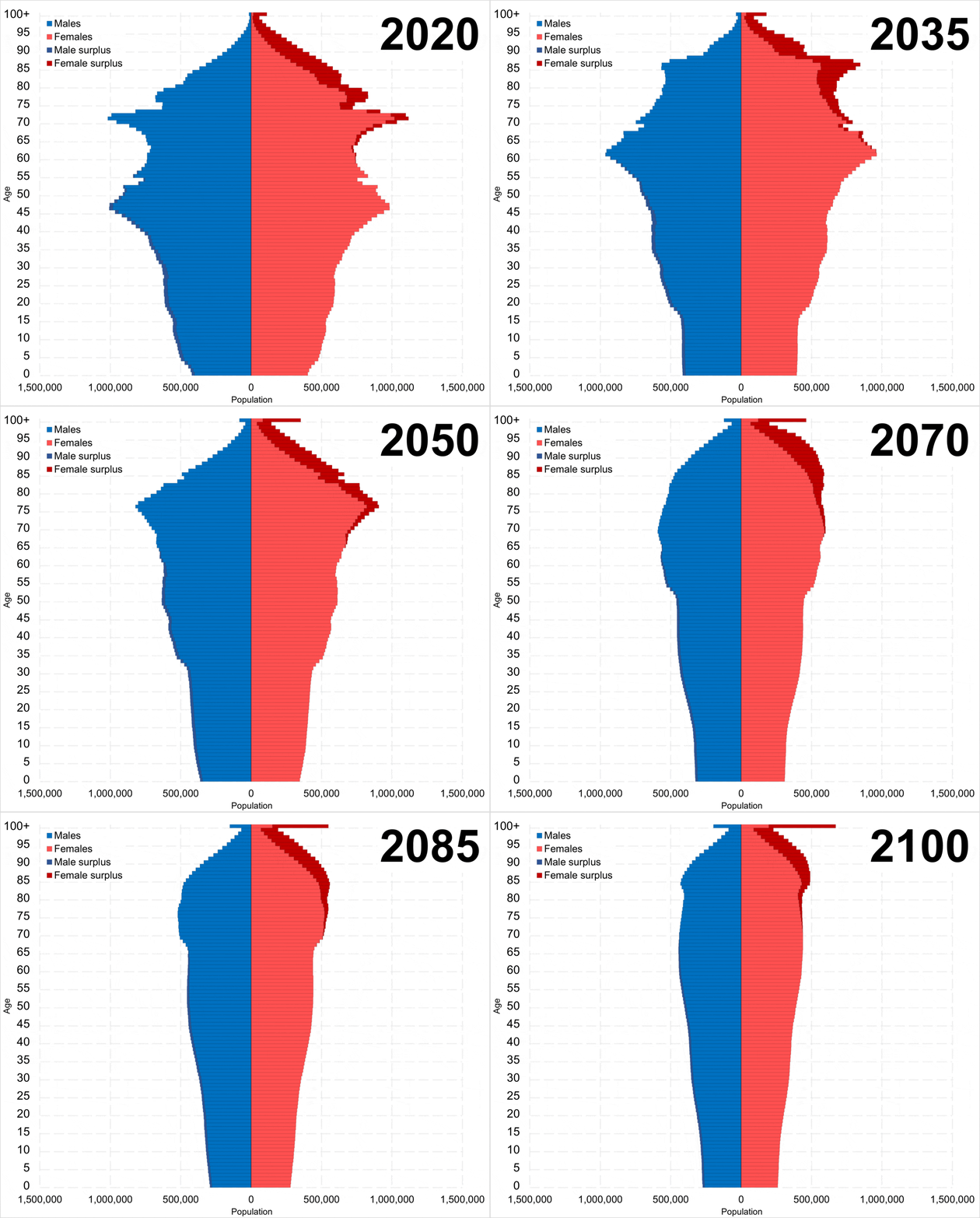
Why Higher Birth Rates Cannot Solve Japan’s Immediate Labor Shortage
A common argument in discussions about Japan’s demographic crisis is that the country should focus on increasing birth rates instead of relying on immigration. While encouraging more births would certainly help improve Japan’s long-term population outlook, it does little to address the labor shortages that are already emerging today.
The reason is simple: demographic change takes time. According to demographic and labor force calculations, it takes approximately 23.6 years for a newborn to grow up, complete their education, and enter the workforce as a productive employee. This means that even if Japan experienced a significant baby boom tomorrow, those children would not begin filling labor shortages until nearly a quarter-century later.
By that point, the workforce challenges projected for the 2030s and 2040s will already have arrived. Millions of workers are expected to retire during this period, while demand for healthcare, elder care, transportation, construction, logistics, hospitality, and technology services continues to rise.
Why the Timing Matters
Japan’s labor shortage is not a distant problem. It is unfolding now. Businesses across the country already report difficulties recruiting workers, particularly in sectors that rely on physically demanding labor or around-the-clock staffing.
The demographic reality creates a significant timing mismatch. New births can strengthen the labor force of the 2050s, but they cannot provide the nurses, caregivers, construction workers, truck drivers, engineers, or hospitality staff that Japan needs during the next two decades.
Can Higher Birth Rates Still Help?
Absolutely. A sustainable increase in fertility would improve Japan’s long-term demographic stability and reduce future population decline. This is why governments continue investing in childcare support, parental leave policies, housing assistance, and other family-friendly initiatives.
However, these measures should be viewed as long-term investments rather than immediate solutions. Even under optimistic scenarios, children born today will require roughly 23.6 years before they can meaningfully contribute to the labor market.
The Workforce Challenge Requires Multiple Solutions
Because of this demographic lag, most economists believe Japan cannot rely solely on higher birth rates to address its labor shortages. Instead, the country will likely need a combination of policies, including greater workforce participation among women and older adults, technological innovation, productivity improvements, and a continued expansion of foreign labor programs.
The central challenge is not simply increasing the population. It is ensuring that enough working-age people are available to support Japan’s economy during the decades before today’s newborns reach adulthood. That is why immigration, unlike higher birth rates, has the ability to affect labor supply almost immediately and remains a central part of discussions surrounding Japan’s future workforce.
Quietly Opening the Door
Is Japan Becoming More Open to Immigration?
One of the most common misconceptions about Japan is that the country remains completely closed to immigration. While Japan still maintains stricter immigration controls than many Western countries, the reality is that immigration policy has gradually become more welcoming over the past decade.
The shift is not always obvious because public discussions often focus on border control, national identity, and cultural integration. However, when examining the actual policies implemented by the government, a different picture emerges. Japan has introduced multiple programs designed to attract foreign talent, fill labor shortages, and encourage skilled workers to build long-term careers in the country.
How Japan Is Expanding Opportunities for Foreign Workers
Several immigration reforms have significantly increased opportunities for foreigners seeking to live and work in Japan.
Fast-Track Permanent Residency for Highly Skilled Professionals
Japan’s Highly Skilled Professional program uses a points-based system that evaluates applicants based on factors such as education, professional experience, annual income, research achievements, and age.
One of the most attractive features of the program is the accelerated path to permanent residency. Highly qualified individuals who meet specific point thresholds may become eligible for permanent residency in as little as one year, one of the fastest pathways available among developed economies.
Specified Skilled Worker (SSW) Visa
The Specified Skilled Worker (SSW) visa was introduced to address severe labor shortages in industries where Japanese employers struggle to recruit sufficient staff.
These sectors include:
- Elder care and caregiving
- Agriculture
- Construction
- Hospitality
- Food service
- Manufacturing
- Transportation and logistics
The program allows foreign workers to fill essential positions that are increasingly difficult to staff due to Japan’s aging population and shrinking workforce.
Retaining International Students
Japan hosts hundreds of thousands of international students each year. Rather than encouraging graduates to leave after completing their studies, policymakers increasingly view these students as a valuable source of future talent.
As a result, graduates of Japanese universities often have pathways to transition into employment visas, allowing them to remain in Japan and contribute to the economy after graduation.
Does Japan Need More Immigrants?
From an economic perspective, many experts believe the answer is yes.
Japan faces one of the world’s fastest-aging populations and one of the lowest birth rates among developed nations. Labor shortages are already affecting healthcare, elder care, transportation, hospitality, construction, agriculture, and other critical industries.
These demographic pressures explain why immigration reforms continue to expand despite political debates surrounding the issue. While government officials may avoid describing Japan as an immigration country, many of the policies being implemented increasingly support the recruitment and retention of foreign workers.
The evidence suggests that Japan’s immigration policy is evolving not because of ideology, but because demographic and economic realities are making foreign labor an increasingly important part of the country’s future.
Public Concerns, Immigration Debates, and Economic Reality
Immigration remains one of the most debated policy issues in modern Japan. While economists, business organizations, and labor market experts frequently emphasize the need for additional workers, public opinion is often more complex.
Many concerns raised during immigration debates focus on cultural integration, language barriers, housing, wages, social cohesion, and public safety. Similar discussions can be found in many developed countries facing demographic decline and labor shortages. As Japan becomes increasingly dependent on foreign workers, these conversations are likely to remain an important part of public policy.
At the same time, Japan’s economic realities are becoming increasingly difficult to ignore. The country faces one of the world’s fastest-aging populations, a shrinking workforce, and growing labor shortages across healthcare, elder care, construction, hospitality, transportation, agriculture, and technology. These challenges exist regardless of political ideology and must be addressed through practical policy solutions.
Where Will Japan Find Future Workers?
One of the most important questions facing policymakers is where future workers will come from.
In recent decades, foreign residents from across Asia have become an increasingly important part of Japan’s economy. Workers and students from countries such as China, Vietnam, Nepal, the Philippines, Indonesia, South Korea, and others contribute to industries experiencing labor shortages and help support sectors that struggle to recruit sufficient domestic workers.
Geographic proximity, existing educational exchange programs, cultural familiarity, and established migrant communities make many neighboring Asian countries natural partners in addressing Japan’s workforce challenges.
Does Immigration Increase Crime in Japan?
Do Foreigners Commit More Crimes in Japan?
One of the most persistent arguments raised during immigration debates is the claim that increased immigration inevitably leads to higher crime rates. In Japan, however, the available data does not support this assumption.
Foreign residents account for a growing share of Japan’s population, yet crime statistics do not show that foreigners commit crimes at a higher rate than Japanese citizens. While individual cases often receive significant media attention, broader crime data paints a much more nuanced picture. Like any population group, foreign residents include students, professionals, business owners, skilled workers, family members, and long-term residents who contribute to Japanese society in a wide variety of ways.
It is important to examine crime rates on a per-capita basis rather than focusing on raw numbers alone. As the foreign population grows, the total number of incidents involving foreign nationals may also increase simply because there are more foreign residents living in Japan. This does not necessarily mean that foreigners are more likely to commit crimes.
The evidence suggests that concerns about immigration and crime are often driven more by perception than by statistics. Anyone interested in the actual numbers can read our detailed analysis of crime rates among foreign residents in Japan, where we break down the official data and common misconceptions surrounding this topic.
More importantly, Japan’s immigration debate should focus on the country’s demographic and economic challenges. With labor shortages expected to worsen over the coming decades, the key question is not whether foreign workers increase crime, but how Japan can successfully attract, integrate, and retain the workforce needed to support its economy and aging population.
Why the Debate Will Continue
The challenge for Japan is balancing legitimate public concerns with demographic and economic realities.
Businesses need workers. Hospitals need nurses and caregivers. Construction companies need employees to build and maintain infrastructure. Rural communities need residents to sustain local economies and public services. Universities increasingly rely on international students, many of whom later join Japan’s workforce.
As labor shortages become more severe, policymakers will likely continue expanding pathways for foreign workers while also addressing concerns related to integration, language education, housing, and long-term residency.
The central question is no longer whether foreign workers play an important role in Japan’s future. In many sectors, they already do. The more important discussion is how Japan can successfully attract, integrate, and retain the talent needed to support its economy and society in the decades ahead.
Public Perception and Immigration Misinformation
Immigration debates are often influenced not only by economic data and government policy but also by information shared online. Social media platforms, anonymous forums, and online communities can amplify concerns about immigration, sometimes spreading claims that are unsupported by evidence or taken out of context.
In Japan, as in many other countries, discussions about immigration frequently focus on topics such as crime, cultural integration, employment opportunities, and national identity. While these are legitimate subjects for public debate, they are often accompanied by misinformation, sensational headlines, and emotional arguments that can overshadow demographic and economic realities.
Why Public Opinion Matters
Public support plays an important role in determining how immigration policies evolve. Governments are generally more willing to expand visa programs, residency pathways, and labor migration schemes when the public understands the economic reasons behind those policies.
Japan’s workforce challenges are largely driven by measurable demographic trends. Population decline, low birth rates, and a rapidly aging society are creating labor shortages across healthcare, elder care, transportation, agriculture, hospitality, construction, and technology. These challenges exist regardless of political ideology and will continue to require practical solutions.
The Importance of Evidence-Based Discussion
For immigration policy to succeed, public discussions should be grounded in reliable data rather than assumptions or stereotypes. Questions about labor shortages, economic growth, social integration, public safety, and long-term population trends deserve careful analysis based on evidence.
This is particularly important because immigration is increasingly becoming an economic issue rather than a theoretical policy debate. Businesses need workers, hospitals need staff, and local communities need residents to sustain essential services. Immigration decisions, therefore, have direct consequences for Japan’s future economic stability and quality of life.
As Japan continues adapting to demographic change, the most productive discussions will be those focused on facts, workforce needs, and practical policy solutions rather than fear-driven narratives. A well-informed public debate is essential if Japan hopes to balance economic necessity, social cohesion, and long-term national interests.
Can Robots Solve Japan’s Labor Shortage?

Japan is often presented as a country that can solve demographic decline through technology. From humanoid robots and AI-powered customer service systems to automated factories and self-checkout machines, Japan has invested heavily in automation for decades. This has led many observers to ask a simple question: Can robots replace workers in Japan?
The evidence suggests that technology can help, but it is unlikely to solve the country’s labor shortage on its own.
Research examining automation and labor shortages in Japan has found that many of the occupations experiencing the most severe worker shortages depend heavily on human interaction, physical presence, and interpersonal skills. These include elder care, nursing, hospitality, agriculture, construction, childcare, transportation, and numerous service-sector roles.
While artificial intelligence can improve productivity and automate repetitive administrative tasks, many essential jobs still require people rather than machines. A caregiving robot may assist an elderly resident with certain activities, but it cannot fully replace a trained caregiver. Similarly, self-checkout systems can reduce staffing requirements in retail environments, but they often transfer some work to customers rather than eliminating the need for employees altogether.
Research examining the impact of artificial intelligence on Japan’s labor shortage found that many automation initiatives focus on office-based and highly skilled tasks. However, the sectors experiencing the most severe worker shortages, including elder care, agriculture, construction, transportation, and hospitality, depend heavily on physical presence, adaptability, and interpersonal skills. These are areas where current AI and robotics technologies still face significant limitations.
What Jobs Cannot Easily Be Automated?
Many of Japan’s fastest-growing labor shortages occur in industries where automation faces significant limitations.
These include:
- Healthcare and elder care
- Hospitality and tourism
- Agriculture
- Construction
- Childcare and education
- Transportation and logistics
As Japan’s population continues to age, demand for many of these services is expected to increase, creating additional pressure on an already shrinking workforce.
Why Foreign Workers Remain Important
Because automation alone is unlikely to fill every labor gap, policymakers increasingly view immigration as one component of a broader workforce strategy.
Foreign workers already play important roles across Japan’s economy, particularly in industries experiencing chronic labor shortages. Programs such as the Specified Skilled Worker (SSW) visa and expanded residency pathways reflect the government’s recognition that international talent can help address workforce challenges while supporting economic growth.
This does not mean that immigration and automation are competing solutions. In practice, most experts view them as complementary. Productivity improvements, robotics, artificial intelligence, higher workforce participation, and immigration all contribute to addressing labor shortages, but none are likely to be sufficient on their own.
Demographic researchers and labor market experts increasingly argue that Japan will need a substantially larger foreign workforce to offset population decline and support economic growth. Various projections suggest that maintaining essential services, sustaining economic output, and supporting an aging population may require a significant increase in the share of foreign residents over the coming decades. Without additional workers, industries such as healthcare, elder care, transportation, construction, retail, and hospitality are likely to face growing staffing shortages.
The Future of Japan’s Workforce
The debate is often framed as a choice between robots and immigrants. In reality, Japan will likely need both.
Technology can help businesses become more efficient and reduce labor requirements in some sectors. However, many industries that are central to Japan’s future, particularly healthcare, elder care, hospitality, and community services, will continue to depend heavily on human workers.
As a result, discussions about Japan’s immigration policy increasingly focus not on whether foreign workers are needed, but on how Japan can successfully attract, integrate, and retain the workforce required to support a rapidly aging society. The country’s long-term economic stability will likely depend on a combination of technological innovation, labor market reforms, and carefully managed immigration policies rather than any single solution alone.
The Economic Impact of Population Decline in Japan
Japan’s immigration debate is ultimately tied to a much larger economic question: what happens when a country has fewer workers, fewer taxpayers, and a rapidly aging population?
Economists have long warned that demographic decline can create significant challenges for economic growth. As the working-age population shrinks, businesses may struggle to find employees, labor costs can rise, and economic output may grow more slowly. At the same time, governments face increasing pressure to fund pensions, healthcare systems, and social services for an aging population.
These demographic pressures are already influencing discussions about Japan’s long-term economic future. Labor shortages have become a recurring concern across healthcare, elder care, construction, transportation, agriculture, hospitality, and other industries that play essential roles in the economy.
Why Workforce Size Matters
A country’s workforce is one of its most important economic resources.
Workers produce goods and services, pay taxes, create businesses, develop new technologies, and support consumer spending. When the number of working-age residents declines over an extended period, maintaining economic growth becomes increasingly challenging.
This is one reason why many economists closely monitor Japan’s population decline, Japan’s labor shortage, and the country’s changing demographic structure. These trends influence everything from government finances and housing markets to consumer demand and business investment.
Internal link opportunity: Link “Japan’s population decline” to your demographic crisis article.
What Other Countries Can Teach Japan
Several developed countries have used immigration as one tool for addressing workforce shortages and supporting economic growth. Countries such as Canada and Australia have implemented immigration systems designed to attract skilled workers, entrepreneurs, students, and professionals who can contribute to their economies.
While every country faces unique circumstances, these examples demonstrate how immigration can help offset demographic pressures by increasing the number of working-age residents and expanding the labor force.
At the same time, immigration is most effective when paired with policies that support language education, workforce integration, housing access, skills recognition, and long-term community participation.
Immigration as Part of a Broader Economic Strategy
Most experts do not view immigration as a complete solution to demographic decline. Instead, it is generally considered one component of a broader strategy that also includes higher productivity, technological innovation, workforce participation reforms, family support policies, and education investment.
However, given the scale of Japan’s projected labor shortages, immigration is increasingly viewed as an important policy tool for helping businesses find workers and maintaining essential services.
The central challenge for policymakers is not simply attracting more foreign workers. It is creating a sustainable system that allows newcomers to contribute economically while successfully integrating into Japanese society.
As Japan looks toward the coming decades, discussions about immigration will likely remain closely connected to questions about economic growth, labor supply, and the long-term sustainability of one of the world’s oldest populations.
Final Thoughts: Can Japan Solve Its Labor Shortage?
Japan’s immigration debate is ultimately about more than visas, border policy, or politics. It is about how a country with one of the world’s oldest populations can maintain economic growth, support essential services, and preserve its quality of life as its workforce continues to shrink.
The demographic challenge is difficult to ignore. Japan faces a combination of low birth rates, population decline, and rapid aging that few developed nations have experienced on the same scale. At the same time, labor shortages are already affecting industries ranging from healthcare and elder care to construction, hospitality, transportation, agriculture, and technology.
Throughout this article, we have examined some of the most common questions surrounding Japan’s immigration policy, including whether higher birth rates can solve the problem, whether robots can replace workers, and whether foreign labor is becoming increasingly important to the economy. While there is no single solution, the evidence suggests that immigration will likely play a growing role alongside automation, productivity improvements, and workforce reforms.
Japan has already begun adapting through programs such as the Specified Skilled Worker visa, pathways for highly skilled professionals, and policies designed to retain international graduates. These changes reflect a broader recognition that attracting and retaining talent will become increasingly important in the coming decades.
The challenge now is ensuring that immigration policies are effective not only in bringing workers to Japan but also in helping them build successful long-term lives. Language education, housing access, labor protections, community integration, and clear residency pathways will all play important roles in determining whether future policies succeed.
For anyone interested in Japan’s future, the question is no longer whether demographic change is occurring. It is how the country chooses to respond.
If you would like to better understand the broader forces shaping modern Japan, you may also enjoy our guides on Japan’s aging population, foreign workers in Japan, working in Japan, and Japanese society and culture, where we explore many of the issues discussed in this article in greater detail.
Japan’s future will likely be shaped by a combination of innovation, adaptation, and people. How effectively the country balances these factors may determine its economic and social trajectory for decades to come.