Most people who visit Japan never leave Tokyo and Kyoto, and for a long time I did the same. It took me a few trips before I finally started taking the slow trains out into the countryside, and honestly, that is where Japan opened up for me. The villages, the mountain onsen, the tiny stations where nobody speaks English and the last bus leaves at five, those are the days I remember most, far more than any city checklist.
The countryside is also nothing like one single place. Up north, Hokkaido gives you volcanic lakes and the kind of powder snow people fly across the world for. In the Japanese Alps, we wandered through the preserved Edo-era streets of Takayama and stood in front of the thatched farmhouses of Shirakawa-go that look exactly like the postcards, only quieter than you expect. If you want a base for the mountains, our 3-day Matsumoto itinerary pairs well with this region, and the Tateyama Kurobe Alpine Route is one of the most dramatic ways to cross the Alps. Over on the west coast of Honshu there are actual sand dunes and sleepy fishing towns, and far to the south, Okinawa’s outer islands feel like a different country entirely, all turquoise water and a culture that has little to do with the mainland. I have tried to write up each of these places properly in its own guide, and I will link them as we go so you can dig into wherever pulls you.
And here is the thing: almost nobody does this. Most travelers skip the countryside completely, which is exactly why it is still worth going now, before it changes.
This guide is the overview I wish I’d had when I started. It covers the rural destinations I think are actually worth the trip, how to get around when you don’t have a car (which was us, every time), where to stay, what to eat, and which season to pick for each region. Whether you have a single free day and want a countryside escape from Tokyo, or you’re building a full two-week rural route, use this as your map and follow the links into the detailed guides for each spot.
Why Visit the Japanese Countryside
Almost everyone we’ve met who actually made it out to rural Japan says the same thing afterward: the countryside was the best part of the whole trip. Here is why I’d tell you to give it real space in your itinerary, not just an afternoon.
The culture is still lived in, not performed. In the countryside, the crafts, the festivals, and the little shrine rituals aren’t put on for tourists, they’re just what people do. Walking through Takayama early in the morning before the shops opened, we watched an old man sweep the step of a sake brewery his family had probably run for generations, and it didn’t feel like a set piece. Towns like Takayama, Aizu-Wakamatsu, and Tono have held onto their Edo-era character in a way that Kyoto, for all its fame, mostly can’t anymore.
Every season is a different trip. We’ve now been up in the Alps in spring with cherry blossoms hanging over the rice terraces, and again in autumn when the whole valley turned red and gold. Summer fills the mountains with hiking trails and fireflies, and winter buries villages like Shirakawa-go under meters of snow until they genuinely look painted. If you can only pick one, autumn in the mountains is the one I’d send you toward.
The food doesn’t travel. This is the part I wasn’t ready for. The Hida beef we had in Takayama, grilled on a little magnolia-leaf miso, was better than anything I’d eaten in Tokyo, and it barely exists outside the region. Same with the crab on the Tottori coast, soba made from Nagano buckwheat, citrus from Shikoku. Countryside food is hyper-local by design, and it’s some of the best eating in the country.
It costs a fraction of the cities. This surprised us the most. A ryokan that runs around 40,000 yen a night in Hakone we found for under 15,000 deeper in the mountains, often with dinner and breakfast included. And even over Golden Week, when Tokyo and Kyoto were shoulder to shoulder, the places we went were quiet.
The welcome feels real. Out here tourism is still newer, and you can feel the difference. Omotenashi, Japan’s idea of wholehearted hospitality, lands differently when it’s a guesthouse owner drawing you a map by hand rather than a front desk running a script. More than once someone walked us halfway to where we were going rather than just pointing.
Is the Japanese Countryside Easy to Visit Now
Getting to the countryside is also easier than it used to be. Over the last few years a lot of rural areas have added English signage, tourist information counters, and rail passes aimed at foreign visitors, and several regions that used to need a car are now reachable on seasonal buses or tourist rail routes. I’ll cover the exact passes and connections for each destination in the sections below, since what works for the Alps is different from what works for, say, Tottori or Kyushu. If you want the deep dives, our Tateyama Kurobe Alpine Route guide is a good example of how far you can get on tourist transport alone, no car needed.
Lesser Known Countryside Destinations in Japan Worth Visiting
Most rural Japan lists recycle the same three names: Takayama, Hakone, Shirakawa-go. They’re all worth going to, and I’ve written full guides on Takayama, Shirakawa-go and Hakone if those are where you’re starting. But none of them are hidden anymore. If you want places that still feel genuinely off the radar, these are the corners of the countryside I’d point a second-time visitor toward, and the ones we’ve actually spent time in.
The Nagano highlands. Beyond the famous post towns, Nagano is where we keep going back. Our Nagano itinerary covers the region properly, and if you only do one thing, make it the snow monkeys at Jigokudani, where wild macaques sit in a steaming hot spring while it snows around them. It’s as strange and wonderful as it sounds.
Aizu-Wakamatsu, Fukushima. A castle town most foreign visitors never reach, still carrying its samurai history in a way the big cities have paved over. We put together a 3-day Aizu itinerary because it deserves more than a rushed stop.
Tottori, San’in coast. Yes, Japan has real sand dunes, and almost no Western traveler makes it out here. The Tottori guide has the details, but the short version is: dramatic coastline, fresh crab, and a fraction of the crowds you’ll fight anywhere on the Golden Route.
Rural Kyushu. The southern island is a country of its own, all volcanoes and onsen towns. Our Kyushu countryside itinerary runs the route we took, and Beppu’s onsen alone is worth the flight south.
Naoshima, the art island. Not a village in the traditional sense, but few places feel further from Tokyo. An entire island turned into contemporary art museums and installations, set among fishing hamlets. The full story is in our Naoshima guide.
What to Know Before Visiting the Japanese Countryside
A few honest practicalities, because the countryside asks a bit more of you than Tokyo does.
English drops off fast outside the big cities. Signage, menus, and train timetables are often Japanese only, and in rural areas most staff don’t speak conversational English. It’s completely manageable, though. Google Translate’s camera feature reads most signs and menus instantly, and we’ve leaned on it more times than I can count, once to work out which of two nearly identical buses actually went to our village. Download offline maps for the area before you leave your accommodation and most of the navigation stress disappears.
Transport takes real planning. This is the big one. Some places are only reachable by local buses that run a handful of times a day, and miss the last one and you’re genuinely stuck. Before you book a night somewhere, check whether it has reliable public transport or whether renting a car is the smarter call. It varies enormously by region, so I’ve broken down the specific options, passes, and where a car actually pays off, in the transport section further down.
Cash is still king. Plenty of rural restaurants, guesthouses, and temples are cash only, and we’ve been caught out by this more than once. ATMs get scarce the deeper you go, and not all of them take foreign cards anyway. The rule we follow now: pull out more yen than you think you’ll need at the last convenience store or 7-Eleven in the nearest city, because 7-Bank ATMs are the most reliable for foreign cards and they thin out quickly once you’re in the mountains.
Getting Around Rural Japan (With or Without a Car)
This is the part that trips people up. Japan’s rail network is famously good, but that reputation is built on the corridors between big cities. Out in the countryside the rules change, and planning transport badly is the single fastest way to lose a day of your trip.
The JR Pass is not the automatic answer it used to be. Since the big price rise a couple of years ago, it only pays off if you’re covering serious long-distance ground, so run the numbers against individual tickets before you buy. More importantly for this guide: a lot of the lines you’ll actually need out here aren’t JR at all. The Nankai line up to Koyasan, the Nagano Dentetsu to the snow monkeys, the Toyama Chiho Railway to Tateyama, the Fujikyu to Kawaguchiko, the Wakayama Electric Railway with its cat stationmaster, none of these are covered. Even the Azusa limited express to Matsumoto isn’t fully covered. Check line by line for your specific route rather than assuming the pass handles it. If you’re new to booking bullet trains at all, we walk through the process in how to book shinkansen tickets, and for longer hops it’s worth comparing shinkansen versus flying.
Regional passes usually beat the national one. For a countryside trip, the area passes are the better value nearly every time. The Hakone Free Pass covers the ropeway, buses, lake boats and local trains in one ticket. There are equivalents for the Alps, the Kansai region, and Kyushu. Buy the pass that matches where you’re actually going, not the biggest one available.
Where buses replace trains, plan around the timetable. Shirakawa-go, Kamikochi, and the Kumano Kodo trailheads are all bus-only. Rural buses often run a handful of times a day, and in some cases the last one back leaves mid-afternoon. Photograph the timetable at the stop when you arrive, because you won’t always have signal to look it up later, and build in more buffer than feels necessary.
When a car is the right call. There are regions where public transport simply doesn’t reach the good parts, and Kyushu is the clearest example, along with the Fuji Five Lakes, Tottori’s coast, and the smaller Kumano trailheads. If you’re going to those, rent. You’ll need an International Driving Permit issued in your home country before you leave, and a few things about driving in Japan catch people out, so we put the practical detail in how to rent a car in Japan.
Two small things that save real hassle. Get an IC card (Suica, Pasmo, Icoca) even for the countryside, since many rural buses now accept them and it saves fumbling for exact change. And use takkyubin, the luggage forwarding service, to send your big bag ahead to your next city hotel. Dragging a suitcase onto a rural bus or up a village lane is miserable, and forwarding usually costs around 2,000 yen per bag.
Where to Stay in Rural Japan
Accommodation is where the countryside really pulls ahead of the cities, both on price and on experience. You’ll pay a fraction of Tokyo rates, and the places themselves become part of the trip rather than just somewhere to sleep. These are the four types worth knowing.
Ryokan. The traditional inn, and the one to splurge on at least once. Tatami rooms, futons laid out while you’re at dinner, yukata to wear around the building, and usually an onsen attached. Rates are typically per person and include dinner and breakfast, which makes the sticker price look higher than it is until you realise two elaborate meals are baked in. A ryokan that runs 40,000 yen a night in Hakone can be found for under 15,000 deeper in the mountains. We’ve written up the whole thing in our onsen and ryokan guide, and if you want a sense of what a really good one feels like, there’s our stay at Ueyama Ryokan. Dinner is usually kaiseki, a multi-course seasonal meal that’s an experience in its own right, and we broke down what kaiseki actually is separately.
Minshuku and farmhouse guesthouses. The family-run version: simpler rooms, home-cooked food, and far more contact with the people running it. This is what you want in Shirakawa-go, where staying in a gasshō-zukuri farmhouse after the day buses leave is the single best thing you can do in the village. Cheaper than ryokan, and often the more memorable night.
Shukubo, temple lodging. Mostly at Koyasan, where over 100 temples take overnight guests. You get a room in a working monastery, vegetarian shojin ryori meals, and the option of joining the morning prayer ceremony. It’s not luxury, and the walls are thin, but sleeping inside a religious community that’s operated for 1,200 years isn’t something you can replicate.
Business hotels. Unglamorous but genuinely useful. Small, clean, cheap, and reliable, and in a rural town they’re often the only option that takes a same-night booking. Worth knowing how hotels are ranked in Japan before you book, because the star system doesn’t work the way you’d expect.
Two practical notes. Book earlier than you would in a city. Rural properties are small, sometimes six or eight rooms total, and they fill months ahead for autumn foliage, Golden Week, and the Shirakawa-go illumination nights. And before your first onsen, read up on onsen etiquette, because the rules are strict and getting them wrong is awkward for everyone. If you have ink, check the property’s policy first, since tattoos are still an issue at many onsen, though rural places are often more relaxed and private baths are a easy workaround.
What to Eat in the Japanese Countryside
Countryside food is hyper-local by design, and it’s the thing that surprised us most about leaving the cities. Most of what you’ll eat out here genuinely doesn’t travel, not because it can’t, but because the regions are proud of it and it’s best where it’s made. Our broader Japanese food guide covers the national basics, so here’s what’s worth planning a meal around region by region.
The Alps: Hida beef and soba. Hida beef in Takayama is the headline, a wagyu raised in Gifu’s mountain valleys, served as street skewers, as nigiri, and as full teppanyaki courses in the ryokans. It’s rated among the best beef in Japan outside Kobe, and worth knowing that the Kobe beef name gets faked constantly, which makes regional wagyu like Hida the safer and often better bet. Nagano is soba country, buckwheat grown in the highlands and served cold with dipping sauce in summer.
The Sea of Japan coast: crab and seafood. Winter on the Tottori and Toyama side is crab season, and it’s some of the best seafood eating in the country. Toyama Bay in particular is rated by Japanese chefs among the finest sources anywhere in Japan, producing white shrimp, firefly squid, and yellowtail, and the waterfront restaurants serve the morning catch at a fraction of Tokyo prices.
Hokkaido: lamb and dairy. The north does things no other part of Japan does. Jingisukan, the grilled lamb barbecue named after Genghis Khan, is the Sapporo classic and one of our favourite meals in the country, which we wrote up in Jingisukan in Sapporo.
Shikoku: udon. Kagawa is the udon prefecture, and the noodles here are a different animal from what you get elsewhere. We took a udon cooking class in Kochi, which is honestly one of the best things we’ve done in rural Japan, and yes, it converted us from ramen.
Kyushu and Okinawa: the outliers. Kyushu leans into pork and strong flavours, and Fukuoka has the shirouo tradition if you want something genuinely unusual. Okinawan cooking barely overlaps with the mainland at all: goya champuru, the bitter melon stir fry, rafute braised pork belly, and awamori, the rice spirit distilled only there.
Ryokan dinners. Wherever you are, if you’re staying in a ryokan, dinner is usually kaiseki, a multi-course seasonal meal built around whatever the region grows and catches. It’s often the single best meal of a countryside trip. We explained what kaiseki actually involves if you want to know what you’re sitting down to.
Local sake. Almost every rural region brews its own, and Aizu is one of the most respected, with breweries in the city centre running tours and tastings. If a local pours yours until it overflows the cup, that’s on purpose, and we explained why they overfill the masu box.
One practical note. Rural restaurants keep short hours and often close between lunch and dinner, and in small towns the kitchen can shut by 8pm. Eat earlier than you would in a city, and if you’re staying somewhere with dinner included, take it, because there may be nothing else open.
Best Countryside Towns to Visit in Japan
Matsumoto: Castle Town Gateway to the Japanese Alps

Matsumoto is one of the countryside bases we keep recommending to first-timers, because it packs a feudal castle, real alpine scenery, and its own food culture into a spot you can reach from Tokyo in an afternoon. We’ve laid out the full version in our 3-day Matsumoto itinerary, but here’s why it earns a place on this list.
Matsumoto Castle is the centrepiece, and one of only twelve original castles left in Japan. Built in the late 16th century, its black exterior earned it the nickname Crow Castle, and unlike the concrete reconstructions you’ll find elsewhere, the inside is entirely original, steep wooden staircases, gun ports and all. Climbing those near-vertical stairs in socks is a small adventure in itself.
About 90 minutes by bus from Matsumoto Station is Kamikochi, a protected alpine valley at 1,500 metres in the Northern Alps. Private cars aren’t allowed in, which keeps it genuinely quiet, and the easy walk between Kappa Bridge and Myojin Pond is one of the prettiest low-effort hikes in the country. Go in late September and the larches turn gold along the whole valley.
For something completely different, the Daio Wasabi Farm out in the Azumino valley is Japan’s largest wasabi plantation, laid out across clear spring-fed streams. Entry is free, it’s quietly beautiful, and you can eat fresh wasabi in forms you won’t have met before, wasabi ice cream included.
Getting there: Matsumoto is about 2.5 hours from Shinjuku on the Azusa limited express. Note that a Japan Rail Pass doesn’t cover the full fare on this line, so check before you travel.
Best time to visit: May for fresh green in Kamikochi, late September to mid-October for autumn colour in the Alps.
Tottori: Sand Dunes, Coastal Scenery and the Sea of Japan

Tottori is one of the least-visited prefectures in Japan for foreign tourists, and honestly that’s exactly what makes it worth the detour. It sits on the western coast of Honshu facing the Sea of Japan, and the mix of dramatic landscapes and slightly offbeat attractions makes it feel unlike anywhere else in the countryside. We covered the whole prefecture, and how to do it by car, in our Tottori travel guide.
The Tottori Sand Dunes are the obvious starting point, and they genuinely surprised us. Stretching nearly 16 kilometres along the coast and rising up to 47 metres, they’re Japan’s only large-scale dune system, which is not a sentence you expect to write about Japan. You can ride camels, sandboard down the slopes, or just climb to the ridge and look out over the sea. Go early, before the tour buses roll in, the light is better and you’ll have the ridge almost to yourself.
Just outside the city, the Eshima Ohashi Bridge crosses Lake Nakaumi into Shimane Prefecture. Its steep gradient, built that way so ships can pass underneath, creates an optical illusion from certain angles that makes the bridge look almost vertical. It’s become one of the most photographed pieces of engineering in western Japan, and it’s a quick, free stop.
If you grew up on manga, keep going to Hokuei Town, the birthplace of Gosho Aoyama, creator of Detective Conan. The town has leaned all the way into it, with bronze statues of the characters lining the streets and the Gosho Aoyama Manga Factory pulling fans from across the country. We wrote up the full real-life Conan town in its own guide if you’re a fan.
Getting there: Tottori is roughly 2.5 hours from Osaka on the Super Hakuto limited express, or reachable by cheaper highway bus from Kyoto and Osaka.
Best time to visit: Spring and autumn for comfortable dune walking. Winter brings rough Sea of Japan weather but dramatic coastline and crab season, which is some of the best seafood eating anywhere in Japan.
Takayama: Edo-Era Mountain Town in the Japanese Alps
Dieser Abschnitt ist einer deiner besten: sehr konkret, faktenreich, mit echtem Ortswissen (die Zedernbälle über den Brauereien, die Öffnungszeiten der Märkte). Ich lasse fast alles stehen und bringe nur deine Stimme rein plus ein, zwei erlebte Details. Der interne Takayama-Link ist verifiziert und bleibt. Ich verlinke zusätzlich Shirakawa-go und Hida beef, wo es echte Zielseiten gibt. Keine Gedankenstriche.
Ein Vorab-Hinweis zum Link: Du hast den Ankertext auf “Takayama” gesetzt, Ziel ist takayama-and-the-hie-shrine. Das passt, aber die Zielseite ist speziell über den Hie-Schrein, nicht über Takayama allgemein. Ich baue den Link an eine passendere Stelle ein.
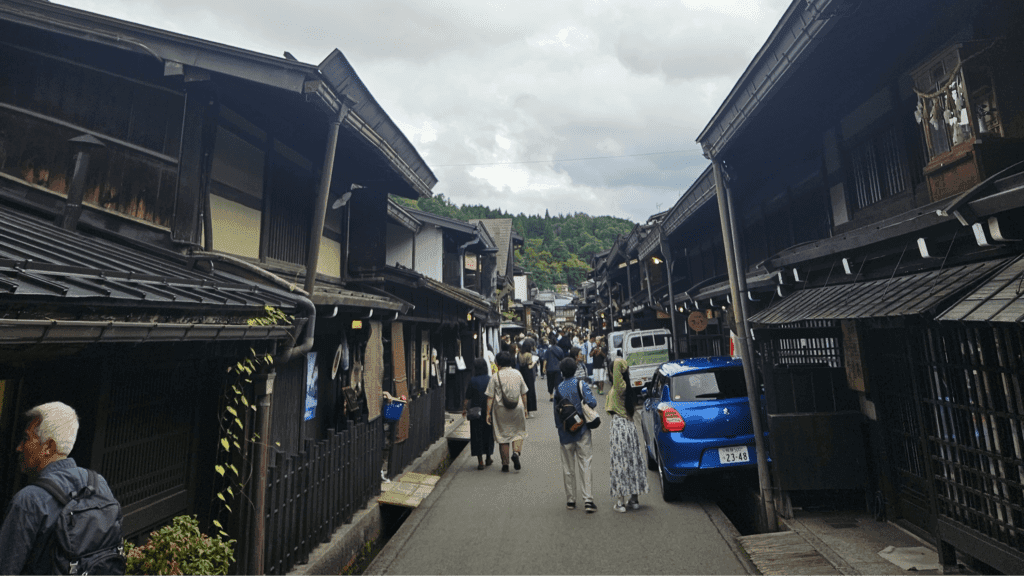
Takayama sits in a high valley in Gifu, ringed by the Alps on every side, and that isolation is exactly why it’s so special. Cut off through the Edo period, the town developed its own crafts, food, and building style, and remarkably, most of it survived. It’s one of the best preserved historic towns anywhere in Japan, and it was the place on our first countryside trip that made us realise how much we’d been missing by sticking to the cities.
Sanmachi Suji, the old merchant quarter, is the heart of it. Three narrow streets of dark wooden sake breweries, craft shops, and merchant houses from the 17th and 18th centuries. Most of the breweries still brew Hida sake on site, and you can spot which ones by the cedar balls (sugidama) hanging above their doors. You can walk the district in under an hour, but we ended up spending a whole morning ducking in and out of the shops. It’s also an easy walk from here up to the Hie Shrine if you want a quieter corner of town.
The Takayama Morning Markets run daily along the Miyagawa River and outside the Jinya government house. Farmers sell pickled vegetables, mountain herbs, crafts, and fresh produce, roughly 7am until noon. They’re a genuinely good reason to stay the night rather than day-trip, because by the time the first coaches arrive the best of it is winding down.
Hida beef is the town’s signature, a wagyu raised in Gifu’s mountain valleys, and it lived up to the hype. You’ll find it as skewers at market stalls, as nigiri in small spots along Sanmachi Suji, and as full teppanyaki courses in the ryokans. It’s widely rated among the best beef in Japan outside Kobe, and the skewer we ate standing in the street is still one of my favourite food memories from the country.
A short bus ride out, the Hida Folk Village is an open-air museum of more than 30 traditional farmhouses moved here from surrounding villages, including several gasshō-zukuri thatched roofs like the ones in Shirakawa-go. It’s genuinely useful context before you visit the real villages, so it works well as a first stop.
Getting there: Takayama is 2.5 hours from Nagoya on the Hida limited express, or about 3 hours from Osaka. It sits naturally between the two, which makes it an easy overnight.
Best time to visit: Late April for the Takayama Spring Festival, one of Japan’s three great festivals, with its elaborate mechanical floats. Mid-October for the autumn festival and peak foliage.
Shirakawa-go: UNESCO Thatched Roof Village in the Mountains of Gifu
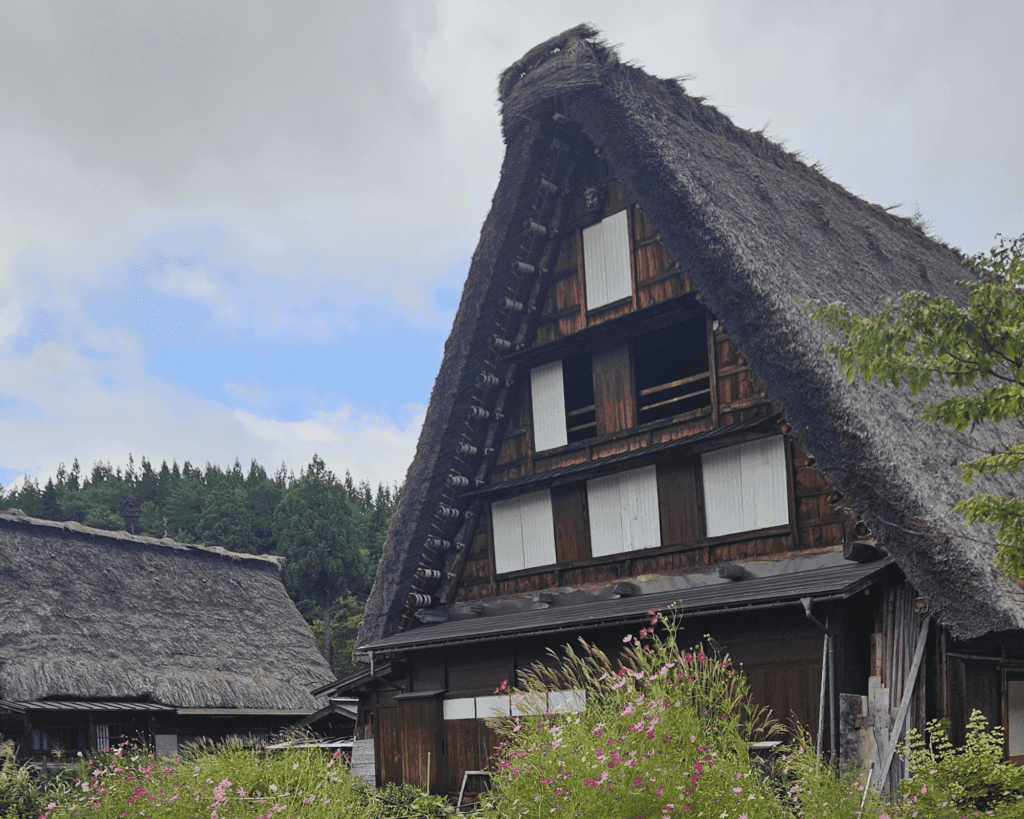
Shirakawa-go is one of the few famous rural spots that completely lives up to the hype, and we’d tell anyone it’s worth the effort to reach. Tucked into a narrow mountain valley in Gifu, the village is a UNESCO World Heritage Site and home to the largest surviving collection of gasshō-zukuri farmhouses in Japan. The name means roughly “hands in prayer,” describing the steep A-frame roofs, which were built that way to shed the valley’s heavy snowfall instead of buckling under it.
The main village, Ogimachi, has around 60 surviving farmhouses, nine of them open as museums or guesthouses. A relaxed walk through takes about two hours. The Wada House is the largest one open to visitors, its original furniture and farming tools spread across three floors, and the upper levels let you see the roof construction from the inside, which is worth the small entry fee on its own.
If you can, stay overnight rather than day-tripping. This is the tip we push hardest. Once the afternoon buses pull out, the village goes completely still, the evening light on the thatched roofs is something else, and waking up to breakfast in a working farmhouse was one of the moments that stuck with us most from the whole trip.
Winter is the most photographed season, especially during the illumination evenings held on select nights in January and February, when the farmhouses are lit from below against the snow. Be warned: tickets for the illumination viewpoint go by lottery and sell out fast, so apply through the Shirakawa-go tourism office website several months ahead. It’s the kind of thing people don’t realise until they arrive and find they’ve missed it.
Getting there: Shirakawa-go is usually reached by highway bus from Takayama in about 50 minutes, or from Kanazawa in around 75. There’s no train access. A combined Takayama and Shirakawa-go trip of two to three nights covers both comfortably.
Best time to visit: January and February for snow and illuminations. Late November for early snow with autumn colour still on the hillsides. Summer is the quietest, most peaceful season.
Shikotsu-Toya: Volcanic Lakes and Hot Springs in Southern Hokkaido

Shikotsu-Toya National Park covers a dramatic stretch of southern Hokkaido between two of Japan’s most striking lakes, and it’s one of the easiest pieces of real wilderness to reach up north, only about 60 kilometres southwest of Sapporo. It pairs active volcanic scenery with some of the best onsen towns in northern Japan.
Lake Shikotsu is the deeper and quieter of the two. At 363 metres it’s Japan’s second deepest lake, and its clarity gives the water a blue that shifts with the light and the season. It sits in a volcanic caldera with no major rivers running in or out, which keeps it unusually pure. Kayaking here early, before the wind gets up, is one of the calmer and more rewarding mornings you can have in Hokkaido.
Lake Toya is more developed and, in its own way, more dramatic. It also fills a caldera, with Nakajima Island rising from the middle and Mount Usu looming over the southern shore. Usu is one of Japan’s most active volcanoes, having erupted four times in the 20th century, most recently in 2000. The Usu Ropeway carries you up the slope to viewpoints over the hardened lava flows and crater damage, much of it deliberately left unrestored as a record of what happened.
The Toyako Onsen strip along the southern shore is the main base. It’s a traditional resort town of large lakeside hotels with outdoor baths facing the water, though standards vary a lot between properties, so it’s worth reading recent reviews before you book.
For a quieter onsen alternative, Noboribetsu sits just outside the park and is one of Hokkaido’s most famous hot spring towns. Its Jigokudani, or Hell Valley, is a steaming volcanic crater feeding nine different types of mineral water to the bathhouses below. It’s walkable, dramatic, and unlike any other onsen town we’ve been to.
Getting there: Highway buses run regularly from Sapporo to both Lake Toya and Noboribetsu, roughly 90 minutes to two hours depending on where you’re headed. A rental car is worth it if you want to link both lakes and Noboribetsu in one trip without juggling bus times.
Best time to visit: Late April to October for hiking and kayaking. Winter brings heavy Hokkaido snow that transforms the lakeside but limits access to the volcanic trails. The Toyako Onsen fireworks run nightly from late April to October, visible straight from the shore.
Hakone: Onsen Towns and Mount Fuji Views from Tokyo

Hakone is the easiest countryside escape from Tokyo, and one of the most complete short trips in the country. About 90 minutes from Shinjuku in Kanagawa, it packs onsen ryokans, volcanic scenery, open-air art, and the best easily reachable views of Mount Fuji anywhere near Tokyo into one valley. It’s busy, no question, but it’s big enough that a little planning buys you the quiet corners. We’ve written up the Mount Fuji views from Hakone in their own guide, since that’s the main reason most people come.
The Hakone Ropeway is the practical spine of the area, running from Sounzan to Togendai across the ridge above Owakudani. On a clear day the Fuji views from the gondolas are the kind of thing you stop talking mid-sentence for. The ropeway passes right over Owakudani, an active volcanic valley where sulphur vents crack through the hillside and vendors sell kuro-tamago, eggs boiled in the volcanic springs until the shells turn black. Local legend says each one adds seven years to your life. We ate one. We’re counting on it.
Lake Ashi sits at the southern end and is Hakone’s centrepiece. The pirate-themed sightseeing boats are gloriously silly, and on a clear morning the northern shore gives you a straight line to Fuji rising above the water. The red torii of Hakone Shrine standing at the lake’s edge is one of the most photographed spots in the whole Kanto region, and for once the photos don’t oversell it.
Hakone has more ryokan than almost anywhere near Tokyo, from big resort hotels with private open-air baths to small family-run guesthouses. The Hakone Yumoto area at the valley entrance has the highest concentration of mid-range options. For weekend stays, book at least two months ahead, and more than that for the November foliage season.
The Hakone Open-Air Museum is worth half a day even if contemporary art isn’t usually your thing. Set across landscaped hillside grounds, it holds Henry Moore sculptures, Picasso ceramics, and a Yayoi Kusama infinity room, and the mix of the art with the mountain backdrop genuinely works better than it has any right to.
Getting there: The Romancecar limited express from Shinjuku reaches Hakone Yumoto in about 85 minutes and is the most comfortable way in. The Hakone Free Pass covers the Romancecar fare plus unlimited ropeway, buses, lake boats, and local trains in the area, which works out far better value than buying tickets one by one.
Best time to visit: Mid-October to late November for autumn foliage with Fuji. January and February for the clearest winter air and sharpest Fuji visibility. If you want another Fuji base to pair with this, our Lake Kawaguchiko itinerary covers the other classic side. Avoid Golden Week and summer weekends, when prices and crowds peak.
Lake Kawaguchiko: Mount Fuji Views Without the Hakone Price Tag

Lake Kawaguchiko is the most visited of the five Fuji lakes and the easiest to reach from Tokyo, sitting right on the northern flank of Mount Fuji in Yamanashi. Where Hakone gives you a polished resort experience, Kawaguchiko is simpler and a lot cheaper, which makes it the better pick if you’d rather spend your money on time in front of the mountain than on facilities around it. Our full Kawaguchiko itinerary has the day-by-day version.
The direct highway bus from Shinjuku reaches Kawaguchiko in about 115 minutes for around 1,800 yen each way, a fraction of the Romancecar fare to Hakone. Buses run often through the day and don’t need a reservation outside peak season, though for autumn foliage weekends in late October and early November you’ll want to book ahead.
Renting a car at Kawaguchiko Station is the most effective way to get around. The northern shore road has unobstructed Fuji views at several pull-offs, and a car frees you from the local buses, which get painfully crowded in peak season. Most rental offices at the station open from 8am, with compact cars from around 6,000 yen a day.
Oishi Park on the northern shore is the best free viewpoint on the lake, with wide lawns looking straight across the water to Fuji. The lavender in early July and the kochia bushes turning red in mid-October make it one of the most seasonal photo spots in the whole Fuji Five Lakes area.
On accommodation, budget-friendly rooms with real Fuji views are far easier to find here than in Hakone. Places like Hotel Kainosato offer clean, mountain-facing rooms with self check-in at prices that regularly undercut comparable Hakone ryokans by half or more.
With a car, Saiko Iyashi no Sato Nenba is worth the 20-minute drive west along the lake. This reconstructed thatched-roof village sits in a quiet valley where the original hamlet of Nenba was destroyed by a typhoon-triggered landslide in 1966, and it reopened as an open-air museum after restoration in 2012. It sees far fewer people than the main waterfront, and on a clear day the thatched roofs with Fuji behind them are as good as any view in the area.
Getting there: Direct highway buses run from Shinjuku Bus Terminal to Kawaguchiko Station through the day, about 115 minutes. The Fujikyu Railway links Kawaguchiko to Otsuki, where it joins the JR Chuo Line back to Tokyo, which makes a handy loop rather than backtracking.
Best time to visit: Late October to early November for autumn colour reflected in the lake with Fuji behind. Early January to mid-February for winter clarity and the sharpest Fuji views of the year. For cherry blossom season in late March to early April, pair it with the Chureito Pagoda trail above Fujiyoshida for the classic pagoda-and-Fuji shot.
Ishigaki and Miyakojima: Tropical Islands at the Southern Edge of Japan
Ishigaki and Miyakojima sit in the Yaeyama Islands at the far southwestern tip of Japan, closer to Taiwan than to Tokyo, and they feel like it. Subtropical climate, coral reefs, Ryukyu heritage, and a pace of life with almost nothing in common with the mainland. If you’ve already done Tokyo and Kyoto, these islands read as an entirely separate country, and they were the part of Japan that surprised us most. The full trip is in our Ishigaki and Miyakojima guide.
Ishigaki is the larger, more developed island and the transport hub for the archipelago. The town centre has a solid spread of restaurants, dive shops, and places to stay, while the coastline around it swings between coral beaches and mangrove rivers. Kabira Bay on the northwest coast is the most photographed spot, all shallow turquoise water over white sand and living coral. You can’t swim there, partly to protect the black pearl cultivation beds and partly because of the currents, but glass-bottomed boats run regularly and show you the reef below.
From Ishigaki, ferries reach several smaller islands worth a day. Taketomi is 15 minutes out and preserves a traditional Ryukyu village of white coral walls, red-tiled roofs, and water-buffalo carts plodding along sand-covered lanes. Iriomote, 40 minutes by ferry, is 90 percent jungle and holds some of the most biodiverse wilderness in Japan, including the critically endangered Iriomote cat, with fewer than 100 left.
Miyakojima lies about 300 kilometres northeast of Ishigaki and is reached by direct flights from Tokyo, Osaka, and Naha rather than ferry. It’s flatter and less dramatic than Ishigaki, but the water is widely rated the best in Japan. Yonaha Maehama on the southwest coast is a seven-kilometre run of fine white sand regularly named the finest beach in the country, and the shallow gradient keeps the water warm and clear a long way out.
The Irabu Bridge, finished in 2015, links Miyakojima to smaller Irabu Island and is the longest toll-free bridge in Japan at just under four kilometres. The drive across gives you open ocean on both sides and leads to quieter beaches and snorkelling spots that see a fraction of Miyakojima’s main coast.
Ryukyu culture on both islands is its own thing, distinct in language, food, music, and craft. Okinawan cooking uses ingredients you rarely meet elsewhere in Japan: goya champuru, the bitter-melon stir fry, rafute braised pork belly, and awamori, a rice spirit distilled only in Okinawa. Eat at small local places rather than resort dining rooms and the whole experience shifts. If you want the mainland Okinawan side too, we covered Shuri Castle in Naha, and for the more offbeat end, there’s the local habu snake sake.
Getting there: Direct flights connect Ishigaki to Tokyo Haneda in about three hours and to Naha in one. Miyakojima has direct flights from Tokyo, Osaka, and Nagoya. Inter-island ferries link Ishigaki to Taketomi, Iriomote, Kohama, and the other Yaeyama islands through the day.
Best time to visit: March to May for warm weather before the humid summer and typhoon season. October and November bring stable weather, clear water for diving, and noticeably lower accommodation prices than summer peak. Typhoon season runs June through September and can disrupt flights and ferries with little warning.
Naoshima: Japan’s Art Island in the Seto Inland Sea
Naoshima is one of the strangest and most rewarding places in rural Japan, if you’re willing to make the trip out to it. A small fishing island in the Seto Inland Sea between Honshu and Shikoku, it was turned over about three decades from a declining industrial community into an internationally known centre for contemporary art, through investment by the Benesse Corporation and the architecture of Tadao Ando. What you get is an island where world-class museums, site-specific installations, and ordinary fishing-village life sit right next to each other. Our full Naoshima art island guide has the practical planning.
The Chichu Art Museum is the centrepiece and one of the most remarkable museum buildings in the country. Ando designed the whole thing and buried it almost entirely underground so it wouldn’t disrupt the landscape, and it holds a permanent collection of just five works: three of Monet’s large Water Lilies paintings, two James Turrell installations, and one Walter De Maria. Showing so few pieces in such a deliberate space makes each one land in a way big collections rarely manage. Natural light falls through skylights cut into the concrete and shifts the works through the day, so the same visit at 10am and 3pm is genuinely two different experiences.
Benesse House combines an art museum with hotel rooms, again Ando, set into the hillside above the southern coast. The permanent collection includes works commissioned for the building from artists like Bruce Nauman, Richard Long, and Hiroshi Sugimoto. If you stay overnight as a hotel guest you get into the museum after public hours, when it’s nearly empty, and the mix of art, architecture, and sea views after dark is the thing we’d tell you to spend the money on.
The Art House Project scatters installations through seven historic buildings in Honmura, the island’s traditional village. Houses, a shrine, a former dentist’s office, and a temple have each been converted by a different artist into a permanent work. Wandering between them takes two to three hours and gives you a real sense of art woven into daily island life rather than walled off from it.
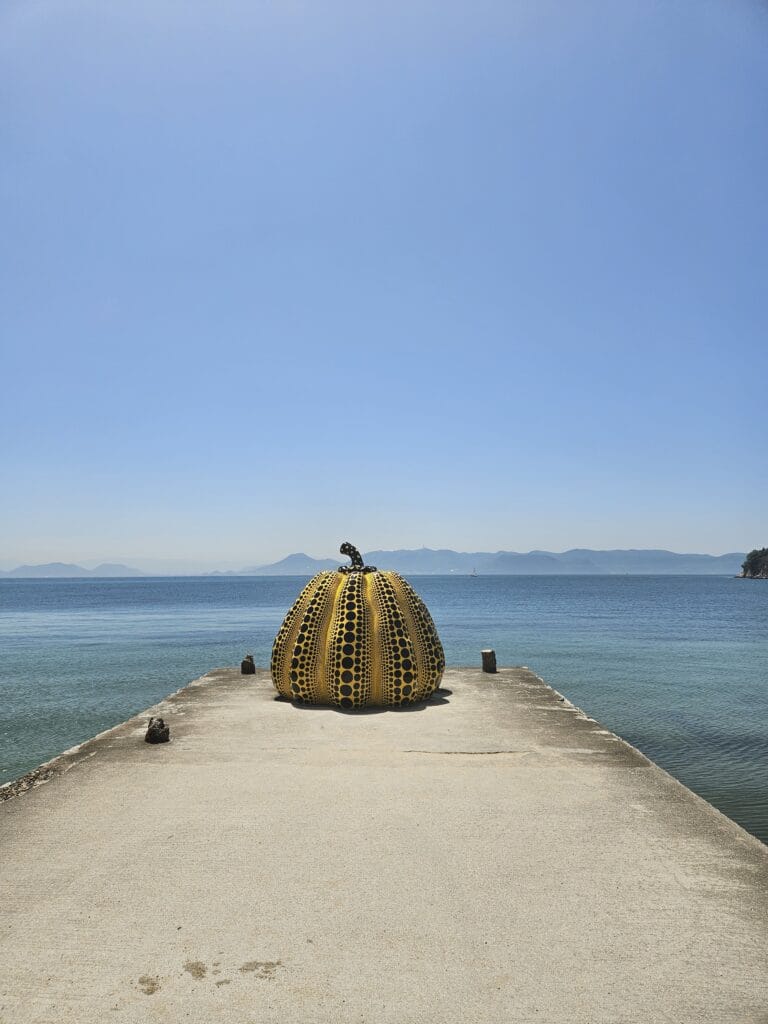
Yayoi Kusama’s yellow pumpkin on the pier at Gotanji is the island’s most photographed landmark. The original was damaged by a typhoon in 2021 and removed for a while before being restored and returned. It’s still the instinctive first stop for most people stepping off the ferry, us included.
The island also has cycling routes linking the main museums and villages. Rental bikes are available near both ferry terminals, and cycling is the most practical way to cover everything in a single day, though staying overnight gives you a lot more room to breathe.
Getting there: Naoshima is reached by ferry from Uno Port in Okayama, about a 20-minute crossing, or from Takamatsu on Shikoku, about 60 minutes. Uno is an hour by train from Okayama Station. The island fits naturally into a route between Hiroshima or Okayama and Takamatsu or Matsuyama.
Best time to visit: Spring and autumn for comfortable temperatures and the clear Inland Sea light, which genuinely changes the experience inside the Chichu museum. The Setouchi Triennale, an international art festival spread across several Inland Sea islands, runs roughly every three years and brings extra temporary installations to Naoshima and its neighbours.
Wakayama: Koyasan, Kumano Kodo and the Cat Stationmaster
Wakayama Prefecture sits on the Kii Peninsula south of Osaka and packs three of Japan’s most significant spiritual sites into one prefecture. It’s consistently overlooked by foreign visitors relative to what’s there, which makes it the strongest argument I know for pushing a Kansai trip past Kyoto and Nara.
Koyasan is the main reason to come. Founded in 816 by the monk Kukai, better known as Kobo Daishi, it sits at 800 metres in a mountain valley you reach by steep cable car from Gokurakubashi Station. The town holds over 100 Buddhist temples, and many offer shukubo, temple lodging for overnight guests. Staying in one gets you vegetarian shojin ryori meals, access to the morning prayer ceremony, and a night inside a religious community that has run without a break for more than 1,200 years. Then there’s Okunoin Cemetery, a two-kilometre moss-covered path through ancient cedars leading to Kukai’s mausoleum. Go after dark. The stone lanterns light the way between the graves of feudal lords, samurai, and ordinary people buried across twelve centuries, and it’s the most atmospheric walk I’ve taken anywhere in Japan.
The Kumano Kodo is a network of pilgrimage trails crossing the Kii Peninsula, a UNESCO World Heritage Site and one of only two pilgrimage routes in the world with that status, alongside the Camino de Santiago in Spain. The trails link three grand shrines: Kumano Hongu Taisha, Kumano Nachi Taisha, and Kumano Hayatama Taisha. Most visitors walk the Nakahechi route between Takijiri-oji and Kumano Hongu Taisha, two to three days through mountain forest with simple guesthouses spaced along the way. Nachi Falls, right beside Kumano Nachi Taisha, drops 133 metres in one unbroken cascade and is the tallest single-drop waterfall in the country.
The Shirahama coast on Wakayama’s western shore is a completely different mood. The white sand beach is one of the best on Honshu, and the area is thick with onsen, including Saki no Yu (崎の湯), an outdoor rock bath sitting directly above the ocean that goes back over 1,300 years and counts among Japan’s oldest.
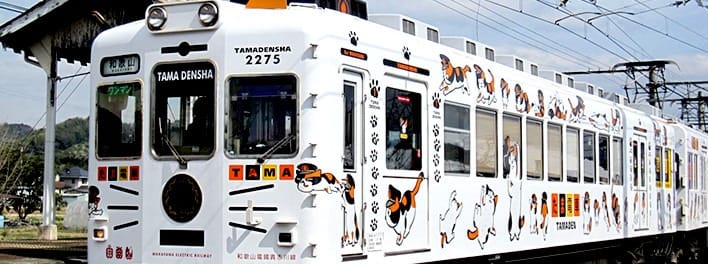
And then there’s the cat. At Kishi Station on the Wakayama Electric Railway’s Kishigawa Line, the stationmaster tradition started in 2007 when a stray tortoiseshell named Tama was formally appointed to the post to help save the struggling rural line from closure. It worked. National coverage followed, passenger numbers jumped, and the station eventually got its own Tama Museum. Tama died in 2015 and was enshrined as a goddess at the station shrine. Her successor Nitama holds the job now and can usually be found on duty on weekdays, which is the most Japanese sentence in this entire guide.
Getting there: Koyasan is about 90 minutes from Osaka Namba on the Nankai Railway to Gokurakubashi, then the cable car up. The Kumano Kodo trailheads are easiest by bus from Shirahama, or via the Kintetsu and JR lines to Shingu on the eastern Kii coast. A rental car opens up the smaller trailheads and coastal spots considerably.
Best time to visit: Spring and autumn for Koyasan’s forest atmosphere and comfortable walking on the Kumano Kodo. Summer is lush and green but humid at lower elevations. Winter at Koyasan, snow on the cedars and lantern-lit cemetery paths, is exceptional if you can handle the cold.
Snow Monkey Onsen: Wild Japanese Macaques in Nagano’s Mountain Hot Springs

Jigokudani Monkey Park in northern Nagano is one of the strangest and best wildlife experiences in Japan, and as far as anyone knows the only place in the world where wild monkeys regularly bathe in hot springs. The name translates as Hell Valley, after the steam rising off the ground and the boiling water bubbling up through the rocks. The macaques are entirely wild and free to come and go, so sightings are never guaranteed, but through winter they’re close to reliable, because the cold pushes the troop down from the forest to the warmth of the pools. The full practical rundown is in our snow monkey onsen guide.
The park sits at around 850 metres and you reach it on a two-kilometre forest trail from the car park at Kanbayashi Onsen, about 30 minutes each way through cedar and oak. It’s easy going in dry conditions. In winter the path ices over and proper footwear stops being optional. There are no fences between you and the macaques inside the park, and although they’re used to people, they’re still wild animals. The rules are no touching, no feeding, and no direct eye contact, and they’re worth taking seriously.
The troop runs to about 160 monkeys, and the bathing started when a single young female climbed into the water back in the 1960s, with the habit spreading through the group over the generations since. The younger ones use the pools most; adult males often sit at the edge instead. The real reward is staying an hour rather than the 15 minutes most people give it, because once you settle in, the social dynamics of the troop are the most interesting part of the whole thing.
Winter mornings between December and February give you the shot everyone comes for: steam off the water, snow in the trees, the monkeys packed in. Get there for the 9am opening and you’ll be ahead of the tour groups that roll in mid-morning, which changes the experience completely.
Jigokudani pairs naturally with Yamanouchi Onsen, the small hot spring town at the bottom of the valley, where a handful of traditional ryokans take overnight guests. A ryokan dinner, an evening soak, and then the walk up early before anyone else arrives is far and away the best way to do this. If you’re building out the wider region, our Nagano itinerary covers what else is worth your time up there.
Getting there: The nearest station is Yudanaka on the Nagano Dentetsu Line, about 45 minutes from Nagano Station, then a bus to the Kanbayashi Onsen car park where the trail starts. Nagano is 80 minutes from Tokyo on the Hokuriku Shinkansen, so a day trip is doable, though staying the night is much better. If you haven’t booked a bullet train before, we walk through it in how to book shinkansen tickets.
Best time to visit: December through February for snow and peak bathing. The park is open year round and summer shows the monkeys in green forest, but winter is the iconic season and the reason most people make the trip.
Aizu-Wakamatsu: Samurai History and Sake Country in Fukushima

Aizu-Wakamatsu sits in the inland basin of Fukushima in the Tohoku region, roughly three hours from Tokyo by train. It’s one of the most historically significant castle towns in northern Japan and one of the least visited by foreign travellers, which makes it the place we’d send anyone who wants real samurai history without the crowds that come with Kyoto or Nikko. Our full 3-day Aizu itinerary has the day-by-day version.
Tsuruga Castle is the centrepiece, and the only castle in Japan with a red-tiled roof, a deliberate choice made when it was rebuilt in 1965 based on records of how it originally looked. The castle’s defining moment came in the 1868 Boshin War, when Aizu forces loyal to the Tokugawa shogunate held out against imperial troops through a month-long siege before surrendering. The museum inside covers that period in real depth, and it’s essential context for why the city’s samurai identity is still so visible today.
The story that sits at the heart of Aizu is the Byakkotai, the White Tiger Brigade, a unit of teenage samurai. Twenty of them, aged between roughly 14 and 17, got cut off from their forces during the fighting and made it to Iimori Hill. Looking down at smoke rising over the town, they concluded the castle had fallen and chose to take their own lives rather than surrender. Nineteen died. One, Iinuma Sadakichi, was found and rescued by a local woman and lived until 1931, which is the only reason we know the story at all. And the castle had not fallen. Their graves on Iimori Hill are among the most visited sites in the city, and the story is still taught in local schools.
Nanokamachi-dori is a short preserved shopping street from the Taisho era near the centre, still holding its early 20th-century shopfronts and now filled with craft shops, sake tasting rooms, and small restaurants. It’s quiet and unhurried in a way preserved streets in busier cities almost never are.
Aizu is also one of Japan’s most respected sake regions, thanks to cold winters, clean mountain water, and rice grown in the surrounding basin. The Suehiro Brewery in the city centre runs tours and tastings and has been making sake without a break since 1850. Several others operate the same way, and you can comfortably do two or three in an afternoon on foot. (If you’ve ever wondered why they overfill the cup, we wrote about the masu box tradition separately.)
Higashiyama Onsen sits in a narrow valley three kilometres east of the centre and is one of Tohoku’s oldest hot spring towns, with records of the baths going back over 1,300 years. A handful of traditional ryokans line the valley road, and it sees far fewer visitors than comparable towns near Nikko or in Nagano, so it stays quiet even on weekends.
The Tadami Line, running west from Aizu-Wakamatsu through the Oku-Aizu mountains, is one of the most scenic rural rail journeys in the country. It threads through remote mountain villages, crosses river bridge after river bridge, and reaches parts of Fukushima that see almost no visitors. The full run to Tadami takes about three hours one way, and it’s much better as an overnight into Oku-Aizu than a there-and-back day trip.
Getting there: From Tokyo, take the Tohoku Shinkansen to Koriyama, then the Banetsu West Line to Aizu-Wakamatsu, around two hours 45 minutes in total. Direct express buses also run from Asakusa in about four hours and cost considerably less than the shinkansen combination. If you’re new to booking bullet trains, we cover it in how to book shinkansen tickets.
Best time to visit: Late October to early November for autumn colour around Tsuruga Castle and along the Tadami Line valley. Winter brings heavy snow over the castle grounds and the surrounding countryside, which gets you closer to the conditions of the siege than any other season.
Toyama and the Tateyama Kurobe Alpine Route: Japan’s Snow Wall Mountain Journey

Toyama faces the Sea of Japan on Honshu’s northwestern coast and gets some of the heaviest snowfall of any inhabited region on earth. That snow is the entire reason the Tateyama Kurobe Alpine Route exists, and the reason people come from across Japan and abroad every spring, when the route reopens and you can finally see what a winter’s worth of snow actually looks like.
The route is a 37-kilometre mountain crossing linking Toyama City on the western side of the Northern Alps to Omachi in Nagano on the eastern side, and you can’t drive it. The crossing strings together seven different forms of transport in sequence, cable cars, ropeways, electric trolley buses, and mountain buses, climbing to 2,450 metres at Murodo, the high point. End to end it takes five to six hours at an unhurried pace, and it works far better as a one-way journey between the two prefectures than as a return trip.
The Yuki no Otani snow corridor at Murodo is the centrepiece. After the route opens in mid-April, the road runs between walls of compacted snow that regularly top 15 metres and occasionally push close to 20 in a big snow year. They’re cut vertically by machinery, and no photo really prepares you for standing at the bottom of one and looking up. The corridor stays open until mid-June as the walls melt down, with the greatest heights in late April and early May.
Murodo itself sits on an alpine plateau at 2,450 metres, looking across the Tateyama range including Oyama, a sacred peak that has drawn Shinto pilgrims since the 8th century. On a clear day the view stretches all the way to the silhouette of Mount Fuji. Hiking trails open from late July once the snow clears off the higher paths, and the volcanic Jigokudani at Murodo (a different valley from the Nagano one with the same name) sends up steam vents and sulphur formations right beside the walking path.
Kurobe Dam, near the Nagano end, is the tallest dam in Japan at 186 metres. Building it between 1956 and 1963 in a place with no road access meant tunnelling through the mountains, and it cost the lives of 171 workers. In summer the dam’s water release creates one of the largest artificial waterfalls in the country, and the viewing platforms above the reservoir give you a proper sense of the scale of what was built here.
Beyond the alpine route, Toyama itself is quietly worth your time. Toyama Bay is rated by Japanese chefs among the best seafood sources in the country, producing exceptional white shrimp, firefly squid, and yellowtail. The bay drops to over 1,000 metres surprisingly close to shore, which concentrates marine life in a way shallower coastal water doesn’t, and the restaurants along the Toyama waterfront serve the morning catch at prices well below what the same quality costs in Tokyo.
Gokayama is the one most people miss. It’s Shirakawa-go’s lesser-known sister UNESCO village, sitting in the Toyama end of the same mountain valley with a smaller but just as well preserved cluster of gasshō-zukuri farmhouses. It gets a fraction of Shirakawa-go’s visitors, which makes it noticeably quieter and more lived-in, and doing both on one trip out of Toyama gives an Alps itinerary real depth.
Getting there: The alpine route starts at Tateyama Station, about an hour from Toyama Station on the Toyama Chiho Railway. Toyama is served by the Hokuriku Shinkansen, two hours from Tokyo and just 20 minutes from Kanazawa. Important: the route closes completely from late November to mid-April, so check the opening dates before you plan anything around it.
Best time to visit: Late April to mid-May for the tallest snow walls at Yuki no Otani. Late July to August for alpine flowers and clear hiking at Murodo. Autumn colour on the lower sections in late September and early October is superb, though the highest elevations shut earlier in the season.
Kyushu Countryside: Hita, Mount Yufu and the Birthplace of One Piece

Kyushu is the most overlooked of Japan’s four main islands for rural travel, and that’s exactly what makes it good. The countryside here is volcanic, green, and largely free of the tourist infrastructure that has smoothed the edges off more visited regions. Get a rental car. Public transport links the main towns fine, but the best of Kyushu sits in between them, along mountain roads and river valleys the buses never touch. Our Kyushu countryside itinerary has the route we drove.
Hita is a small castle town in the mountains of Oita, built along the Mikuma River and left much as it was in the Edo period, when it was administered directly by the Tokugawa shogunate. The Mameda-machi district holds the best surviving run of merchant townhouses, white walls and dark timber frames reflecting in the river on a still morning. Hita is also the town that inspired the mountain village in Attack on Titan. Creator Hajime Isayama was born and raised here, and once you see the steep hillsides ringing the town you understand where the walled village came from. There’s a bronze statue of Eren Yeager near the river district. If that’s your thing, we’ve collected more real-life anime locations in Japan in a separate guide.
Mount Yufu rises to 1,583 metres above the Yufuin basin in central Oita, its twin volcanic peaks visible across most of the surrounding countryside on a clear day. It’s a straightforward climb from the trailhead above town, about two hours to the summit, with views right across Kyushu at the top. Yufuin itself is one of Kyushu’s most popular onsen towns, packed with ryokans, small galleries, and craft shops along the Yunotsubo Kaido leading from the station toward the lake. It’s busier than its rural reputation suggests, but having a car lets you stay at smaller places outside the main tourist strip, where it’s much quieter.
Beppu is 30 minutes east of Yufuin by car and one of the most geothermally active places on earth, producing more hot spring water than anywhere in Japan. Steam rises out of drains, roadsides, and open vents all over town, which gives the whole place a genuinely odd, otherworldly feel. The Beppu Hells are eight dramatically coloured hot spring pools in the northern Kannawa district, including a blood-red iron pool, a cobalt blue one, and a grey mud pool that burps slowly to itself. You can’t bathe in them, but the two-hour walking circuit between them is worth doing.
Saiki City in southern Oita is the birthplace of Eiichiro Oda, creator of One Piece, the best-selling manga series in history. The city has leaned into it with murals, a dedicated museum section, and seasonal events. It also sits on a quiet stretch of coast that looks uncannily like the East Blue sea towns from the early arcs, and for fans that combination is worth the drive south from Beppu.
A sensible driving loop links all four in two to three days: fly into Oita Airport or come across from Fukuoka by highway bus, pick up a car, drive west to Hita for a night, north through the mountain roads to Yufuin for a second, then east to Beppu, and south along the coast to Saiki if the One Piece connection matters to you.
Getting there: Fukuoka is the main gateway to this part of Kyushu, with international flights and the Shinkansen from Tokyo in about five hours. Beppu and Oita connect to Fukuoka by limited express in roughly two hours. Rental cars are available at Oita Station, Beppu Station, and Oita Airport, and I’d call them close to essential for the Hita and Yufuin sections.
Best time to visit: Late October to mid-November for autumn colour along the Hita river valley and on the slopes of Mount Yufu, which is some of the best in Kyushu. Late March to early April turns the Mameda-machi riverside into cherry blossom. Summer is lush and green but humid down low.
Is the Japanese Countryside Worth It?
Short answer: it’s the part of Japan we’d fight hardest to keep in an itinerary. The cities are extraordinary and you shouldn’t skip them, but Tokyo and Kyoto are also the parts of the country everyone else is seeing. Out here you get the mountain onsen with three other guests, the morning market where you’re the only foreigner, the last bus you nearly missed and the guesthouse owner who waited up. Those are the days that stick.
You don’t need to overhaul your trip to do it. Even two or three nights out of a two-week itinerary changes the whole shape of it. If you’re short on time, take Hakone or Kawaguchiko from Tokyo. If you have a week, run the Alps loop through Matsumoto, Takayama and Shirakawa-go. If you’ve already done the classics, go further out to Tottori, Aizu, or Kyushu, where you’ll barely see another foreign traveller.
Whatever you pick, book the accommodation early, check the bus times twice, and carry more cash than feels sensible.
Where to go next
If you want to go deeper on anything in this guide, these are the pages to read next:
Plan a specific region. Our Nagano itinerary, 3-day Aizu itinerary, and Kyushu countryside itinerary are full route plans you can follow as they are.
Get the accommodation right. The onsen and ryokan guide covers how ryokan work, what you’re paying for, and how to behave in the baths.
Eat better. Our Japanese food guide is the wider picture beyond regional specialities.
Understand what you’re looking at. The Japan culture guide covers the customs, festivals and etiquette that make more sense once you’ve seen them in a village rather than a museum.
Balance it with the cities. If you’re building a full trip, pair this with our things to do in Tokyo guide, and the Japan insider guide for everything else.
Been to any of these places, or found somewhere rural we’ve missed? Tell us in the comments, we read all of them and we’re always looking for the next valley to disappear into.