Tokyo Tower is the landmark that everyone says is outdated, and then they see it lit up in orange on a cold night and change their mind. It is shorter than Tokyo Skytree, older, and has no glass skyscraper glamour. But it has something Skytree will never have: it looks good from almost everywhere in the city, and it sits right in the middle of Tokyo instead of out east. If you only have time for one tower in Tokyo, this guide will help you decide whether it should be this one, which ticket to buy and, most importantly, when to look at it.
The official site is en.tokyotower.co.jp, and it is worth bookmarking, because the light-up schedule changes often.
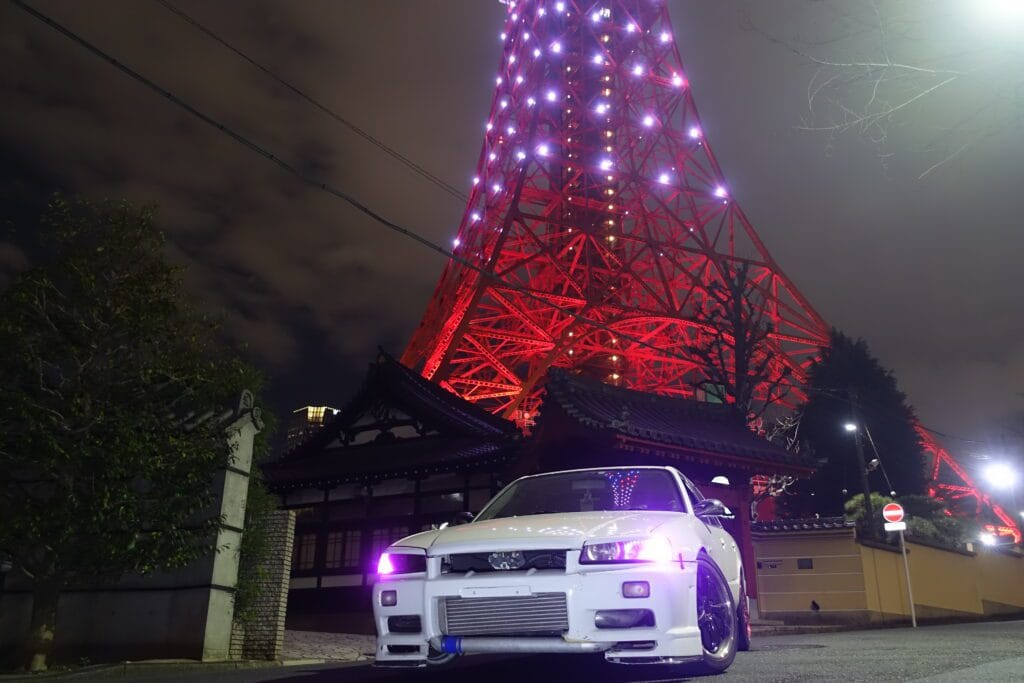
My favourite Tokyo Tower night was a photo shoot with a group of JDM car friends. We parked the cars on the small street in front of the tower, and that evening it was lit in the colours of the Korean flag. If you are into Japanese car culture, read my article on Daikoku PA and Tokyo’s JDM scene.
Why a red copy of the Eiffel Tower became Tokyo’s symbol
Tokyo Tower opened in December 1958. It was not built as a tourist attraction but as a broadcasting tower. NHK had started television broadcasts in 1953, private TV stations followed, and every one of them was putting up its own antenna. The city needed one tall tower that could send signals across the whole Kanto plain. The result was 333 metres tall, a little higher than the Eiffel Tower, and for more than 50 years it was the tallest structure in Japan, until Tokyo Skytree took over in 2012.
Yes, it does look like the Eiffel Tower. Lattice steel, four legs, tapering to a point. The design was by Tachu Naito, an architect known for earthquake-resistant towers, and the resemblance was not an accident: in the late 1950s Japan was rebuilding after the war, and a tower that could stand next to Paris in the record books was a statement.
The colours are less romantic than they look. The white and “International Orange” stripes are there because aviation law required tall structures to be clearly visible to pilots. Keeping that paint fresh is a huge job. For decades the tower was repainted every five years, by hand, and after a more durable coating was used in 2019, the interval became longer.
Today, digital broadcasting has largely moved to Skytree, but Tokyo Tower still carries some radio and backup signals. More importantly, it has become something you cannot replace with a newer building: the image of postwar Tokyo, in films, anime and on postcards.
Main Deck or Top Deck: which ticket is worth it
There are two observation levels, and the ticket choice confuses many people.
| Main Deck | Top Deck Tour | |
|---|---|---|
| Height | 150 m | 250 m (includes Main Deck) |
| Adult price (Nov 2026) | 1,500 yen | 3,300 yen online, 3,500 yen at the counter |
| Booking | Walk in is usually fine | Timed tour, booking online recommended |
| Atmosphere | Wide, two floors, café, “look down window” | Small, mirrored, geometric interior, audio guide |
The Main Deck at 150 metres is the classic. You get the 360 degree view, a café, souvenir shops and glass floor panels where you can look straight down the steel legs. At night it is a good height, because 150 metres is the height where the city still looks like a city. You see streets, cars, the lights of Roppongi Hills and Shiba Park below you, not just a carpet of tiny dots.
The Top Deck Tour takes you up to 250 metres in a separate lift. The room itself is designed with mirrors and geometric lighting, so it feels more like an art installation than an observation deck. It is a timed tour with limited places, and it can be cancelled in strong wind or bad weather. If you want to see Mount Fuji on a clear winter morning, this is the level to be on.
Children pay less: on the Main Deck 900 yen for elementary and junior high school students and 600 yen from age 4, and on the Top Deck Tour 2,100 and 1,500 yen online. High school students pay 1,200 yen for the Main Deck. These are the prices on the official fee page in November 2026, so check it again before you go.
My own choice is always the Top Deck, and that is what I tell friends too. If you go up Tokyo Tower at all, go all the way. The Main Deck only makes sense if you are short on time or on a tight budget.
The light-ups: Landmark Light, Diamond Veil and special colours
This is the part that makes Tokyo Tower special, and it is why the official light-up page is the link I would bookmark.
Landmark Light
The standard lighting is called Landmark Light. It was designed by the lighting designer Motoko Ishii and introduced in 1989. Instead of outlining the tower with bulbs, it lights the steel structure from inside with floodlights, which is why Tokyo Tower seems to glow rather than sparkle. It changes with the season: warm orange in winter and a cooler white silver in summer. The summer version starts every year on 7 July (Tanabata), the winter version in early October. The light usually runs from sunset until midnight.

Diamond Veil
The second lighting is Diamond Veil, first introduced in 2008 for the tower’s 50th anniversary. It wraps the tower in layers of coloured LEDs, and the current version, called Infinity Diamond Veil, can display different colour patterns. At the time of writing it runs on Monday and Thursday evenings from 20:00 to 22:00. Two designs alternate every 30 minutes, and each month has its own colour. It also lights up on special event dates. The schedule can change at short notice, so check it on the official page.
Special light-ups
Tokyo Tower is also used as a giant message board. It turns pink for breast cancer awareness in October, shows team or national colours for big sports events, gets special Christmas and New Year lighting, and sometimes lights up in the colours of a country for diplomatic anniversaries. These are announced on the light-up page, often only a few days in advance.
There is also a well-known romantic legend: if you watch the Landmark Light switch off at midnight together with your partner, you will be happy together. It is the kind of story that every Tokyo couple knows, and it explains why you sometimes see people staring at the tower at 23:59.
The best places to see Tokyo Tower from outside
Honestly, Tokyo Tower might be better from outside than from inside. My favourite spot is not a famous viewpoint at all: it is the streets right in front of the tower. From there you get the tower and a piece of Tokyo in one photo. Do not go too close, though. Right below it you only see steel, and the photos do not turn out well. Here are the classic viewpoints too.
- Zojoji Temple: the big Buddhist temple next to the tower. The main hall in front and the orange tower behind it is the most typical Tokyo photo there is. Walking through the temple grounds is free.
- Shiba Park: the park around the tower has several spots where you can see it framed by trees. In late March, cherry blossoms in front of Tokyo Tower are a classic shot.
- Roppongi Hills, Tokyo City View: the observation deck in Mori Tower looks straight at Tokyo Tower, and at night this is maybe the most beautiful view of it.
- Azabudai Hills: the newer high-rise district right next to the tower has public spaces and restaurants with close views.
- Roppongi streets: from some streets around Roppongi, especially at Christmas, you can see the tower at the end of an avenue of lights. I wrote about that in my article on Christmas in Roppongi.

Tokyo Tower or Skytree?
This is the question everybody asks, so here is a fair answer.
Skytree is much higher (its decks are at 350 and 450 metres), more modern and in Oshiage, close to Asakusa. Its strength is height: on clear days you see very far, and Fuji looks bigger. Tokyo Tower is lower but central. From Tokyo Tower you actually see Tokyo landmarks in detail, including Skytree itself in the distance, and the tower is close to Roppongi, Shimbashi and Ginza, so it fits easily into an evening.
My suggestion for most first-time visitors: go up Skytree during the day if you combine it with Asakusa, and see Tokyo Tower at night, either from its Top Deck or from a viewpoint like Zojoji or Roppongi Hills. Tokyo Tower looks better from outside, Skytree is the better view from inside. If you want a free alternative with a good view, I like the rooftop of Ginza Six in Ginza.
That is also my own view: for going up, Skytree is better. For looking at a tower from below, Tokyo Tower wins every time.
Inside and around the tower: stairs, RED° and food
Below the observation decks is the building at the foot of the tower, called Foot Town. A large part of it is now RED° TOKYO TOWER, a digital games and esports entertainment area that opened in 2022. It is popular with teenagers and families, less essential for everyone else.
One fun option is the outdoor staircase. On certain days, usually weekends and holidays, you can walk up to the Main Deck using the open-air stairs, about 600 steps. You still need a Main Deck ticket, but you get the climb, the wind and the steel up close. Climbers have traditionally been given a small certificate at the top, a nice souvenir if it is still offered when you go. Check the official site for the current days and hours, as it depends on the weather.
For food, the area around the tower is quiet compared to Shibuya or Shinjuku, but Shiba and Hamamatsucho have good lunch places, and Roppongi is a short taxi or 15 to 20 minute walk away. If you want a special evening nearby, I wrote about dinner at Roppongi Fukuzushi.
How to get there and when to go
- Akabanebashi station (Toei Oedo Line): about 5 minutes on foot, the closest.
- Kamiyacho station (Tokyo Metro Hibiya Line): about 7 minutes.
- Onarimon station (Toei Mita Line): about 6 minutes, and you pass Zojoji on the way.
- Hamamatsucho station (JR Yamanote Line): about 15 minutes on foot through Shiba Park, nice walk.
All of these work with a normal IC card. If you do not have one yet, read my guide to the Suica IC card.
The Main Deck is usually open from about 9:00 to 23:00, with last entry at 22:30. The last Top Deck Tour starts at 22:15, and the Top Deck can close in bad weather. The best timing is about 30 minutes before sunset. You get the city in daylight, watch the colours change, and see the lights come on. In winter that means arriving around 16:00, in summer around 18:30. Weekday evenings are calmer than weekends, and on clear winter days the chance of seeing Fuji is highest in the morning.

Frequently Asked Questions
How much does Tokyo Tower cost?
In November 2026 the Main Deck costs 1,500 yen for adults. The Top Deck Tour, which includes the Main Deck, costs 3,300 yen online and 3,500 yen at the counter.
Is the Top Deck worth it?
I think so. I always go to the Top Deck: at 250 metres the view is much wider, and the mirrored room is unlike any other observation deck in Tokyo. Book online, it is cheaper and the tours are timed.
What time does Tokyo Tower light up?
The Landmark Light comes on at sunset. The Infinity Diamond Veil runs on Monday and Thursday evenings from 20:00 to 22:00, plus special dates. The schedule can change, so check the official light-up page.
Why is Tokyo Tower orange and white?
Because aviation safety rules required tall structures to be clearly visible to aircraft. The orange is officially called International Orange.
Is Tokyo Tower taller than the Eiffel Tower?
Yes, slightly. Tokyo Tower is 333 metres, while the Eiffel Tower is around 330 metres including its antennas today.
Should I visit Tokyo Tower or Skytree?
For going up, Skytree is better: it is higher and the view is wider. Tokyo Tower is the one to look at from below, and it is more central. Many people go up one and photograph the other.
Where is the best place to photograph Tokyo Tower?
The streets in front of the tower, where you get the tower and the city in one frame. Zojoji Temple, Shiba Park and Roppongi Hills are the classic viewpoints. Do not stand too close, or you only get steel in the picture.
Can you walk up Tokyo Tower?
Yes, on certain days, usually weekends and holidays, you can use the outdoor stairs to the Main Deck, about 600 steps. A Main Deck ticket is still needed.
Tokyo Tower is not the highest, the newest or the most high tech, and that is exactly why it works. It is a piece of 1950s Tokyo that still glows orange over the city every night. For the rest of your trip, have a look at my things to do in Tokyo guide and my favourite spots for Tokyo at night.
Author

Get My Personal Travel Maps


Leave a Reply