
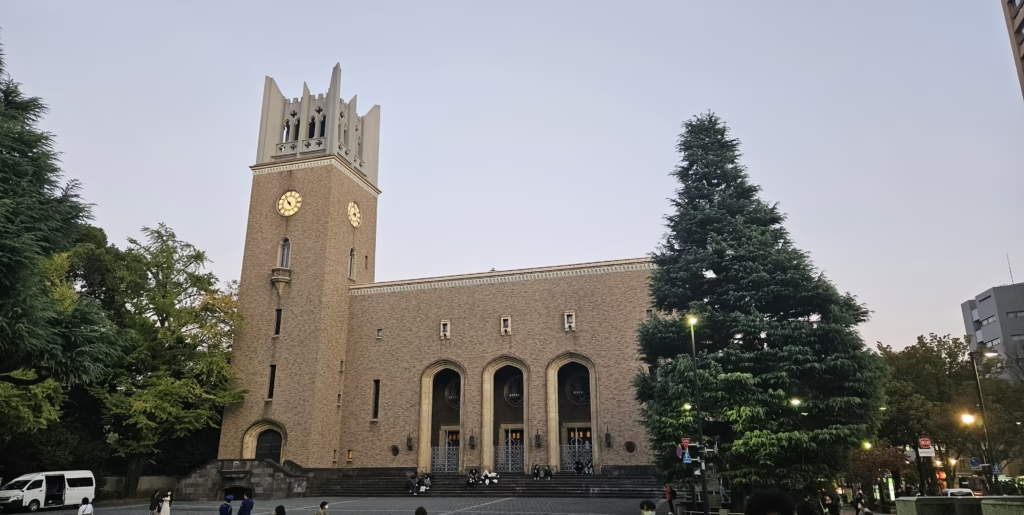
Applying for a Master’s degree in Japan was one of the most frustrating and educational experiences of my life. Coming from Switzerland, I assumed the process would be similar to European universities: upload your documents, wait for a decision, and prepare for enrollment. I quickly discovered that Japan operates very differently.
My journey involved contacting professors months before the application deadline, mailing physical documents across continents, navigating requirements that were only partially explained in English, and learning firsthand that seemingly minor details can determine whether your application is accepted or rejected. In my case, one application was rejected because I submitted a digital signature where a handwritten signature was required. After spending weeks preparing documents, that small mistake cost me an entire application cycle.
Eventually, I was accepted to Waseda University’s Graduate School of Fundamental Science and Engineering and moved to Tokyo to begin my studies. Looking back, I realized that most online guides only explain the official procedure. Very few discuss the practical realities international students actually face: how to approach professors, what admissions committees are really looking for, how long international document delivery takes, which documents cause the most problems, and how to avoid costly mistakes.
This guide combines the official requirements with my personal experience as an international applicant. It is written for students who are serious about pursuing graduate studies in Japan and want a realistic understanding of what the process looks like from the first email to a professor all the way to receiving an acceptance letter.
Whether you are applying to Waseda University, the University of Tokyo, Kyoto University, Osaka University, or another Japanese institution, many of the lessons I learned apply across the Japanese graduate admissions system. My goal is simple: to help you avoid the mistakes I made and maximize your chances of receiving an acceptance letter from a Japanese university.
What Is AO Admission at Waseda University?
AO admission stands for Admissions Office admission. Instead of ranking applicants by a single written entrance exam, it screens you on the whole picture: your research plan, your fit with a potential supervisor, your supporting documents and a short interview. For international students applying to English-taught graduate programs at Waseda, it is usually the main route in.
In practice that makes the process relationship-driven and document-heavy rather than exam-driven. You find a professor whose research matches yours, make contact months in advance, and build the application around a clear research plan. The rest of this guide walks through each step in the order I tackled them, including the mistakes that cost me time.
1. Public vs. Private Universities: The Most Important Decision You’ll Make
The first step is deciding where to apply, and this choice will shape almost every aspect of your application journey. Before I started researching Japanese graduate schools, I assumed all universities followed a similar admissions process. I quickly learned that the reality is very different.
In Japan, the application culture differs significantly between public and private universities.
Public Universities
Many national and public universities place a strong emphasis on entrance examinations. While requirements vary by institution and department, applicants are often expected to sit written exams, technical assessments, or interviews that may require traveling to Japan before receiving an admission offer.
For international students, this can create additional challenges. Besides preparing application documents, you may need to budget for international flights, accommodation, transportation, and potentially multiple visits. For students applying from Europe, North America, or other distant regions, the cost can easily reach thousands of dollars before admission is even guaranteed.
Several universities I researched required far more direct interaction with laboratories and professors than I initially expected. In some cases, applicants were strongly encouraged to establish a relationship with a professor before formally applying.
Private Universities
Private universities such as Waseda University or Doshisha University often offer what is commonly known as AO Admissions (Admissions Office Admissions). While the exact procedures differ by institution, these admissions pathways are generally much more accessible for international students.
Instead of relying primarily on a written entrance examination, the evaluation focuses on documents such as:
- Academic transcripts
- Research plans or statements of purpose
- Letters of recommendation
- Language proficiency certificates
- Previous research experience
- Interviews conducted online or in person
This was one of the main reasons I ultimately focused on Waseda University. As an applicant living abroad, the ability to complete most of the process remotely significantly reduced both costs and uncertainty. Rather than preparing for an entrance examination in Japan, I could dedicate my time to building a strong application package and demonstrating why I was a good fit for the program.
My Recommendation
For most international applicants, private universities provide a smoother entry point into Japanese higher education. That does not mean they are easier to get into. Waseda remains highly competitive, and admission standards are rigorous. However, the process is often more practical for students applying from overseas.
If your goal is to study in Japan without making multiple trips before enrollment, researching universities that offer document-based admissions should be one of your first priorities.
Pro Tip: Every university has different quirks. Always check the specific “Admissions” page for your target year. This guide specifically follows the Waseda Faculty of Science and Engineering workflow.
2. The “First Contact” Email
Before you spend a single yen on application fees, document translations, or international postage, you need to verify that you are actually eligible for the intake you are targeting. This is one of the most overlooked steps in the entire application process, yet it can save you a significant amount of time, money, and frustration.
Japanese university administration offices are generally professional, responsive, and helpful when answering questions from prospective students. However, they are also extremely strict when it comes to eligibility requirements. Unlike some Western universities that may evaluate borderline cases individually, Japanese institutions often follow the written regulations very closely. If a requirement states that applicants must possess a specific degree, minimum number of years of education, or language qualification by a certain date, exceptions are uncommon.
I strongly recommend contacting the admissions office before beginning your application if there is any uncertainty regarding your academic background. This is especially important if you have completed a non-traditional degree program, studied in multiple countries, transferred credits between institutions, or hold qualifications that may not fit neatly into the Japanese education system.
During my own application journey, I discovered that many assumptions made by international applicants turn out to be incorrect. Something as simple as the expected graduation date, the format of a transcript, or the wording on a diploma can determine whether an application is considered valid. Clarifying these details early can prevent weeks of wasted preparation.
The admissions office can often answer questions such as:
- Whether your degree satisfies the minimum academic requirements
- If your transcripts need certified translations
- Whether a provisional graduation certificate is accepted
- Which English language qualifications are recognized
- Whether your chosen program requires prior contact with a professor
- If you qualify for a specific admission category such as AO Admissions
Taking the time to confirm your eligibility before proceeding may not be the most exciting part of applying to graduate school, but it is one of the smartest investments you can make. A short email today can save hundreds of dollars and months of disappointment later.
Template for Admin Inquiry:
Subject: Inquiry regarding Master’s Program Intake – [Month Year] – [Your Name]
Dear Admissions Office,
I am writing to inquire about the application deadline for the Master’s degree program at your university for the [Month Year] intake. I was wondering if there is still time to submit an application.
Additionally, is it possible to submit an application online, or are all students required to send materials via post?
I appreciate your time and consideration.
Sincerely, [Your Name]
The Reality Check: You will likely learn that Japan is not fully digitized. You must send everything via physical post (DHL/FedEx). This means there is zero room for error; if a document is wrong, you can’t just “re-upload” it.
3. Recommendation Letters: The Mistake That Cost Me an Admission Opportunity
This is where I failed my first application to Doshisha University in Kyoto.
Coming from Switzerland, I assumed recommendation letters were a straightforward formality. In most European countries, digital signatures are widely accepted and official documents are routinely exchanged electronically. I had no reason to believe that a digitally signed recommendation letter would cause any problems.
I was wrong.
After spending weeks preparing my application, gathering transcripts, translating documents, and carefully completing every form, my application encountered a problem because one of my recommendation letters did not meet the university’s requirements. What would have been perfectly acceptable in many Western countries was not considered acceptable under the university’s admissions rules.
The experience taught me one of the most important lessons about applying to Japanese universities: never assume that international standards are the same as Japanese standards.
The Rules for Recommendation Letters
While requirements vary between institutions, many Japanese universities expect recommendation letters to follow a very traditional format.
Wet Ink Signature Only
The professor should physically sign the document with a pen.
Do not assume that electronic signatures, scanned signatures, digital certificates, or services such as DocuSign will be accepted. Even if these methods are legally valid in your home country, Japanese admissions offices may reject documents that do not comply with their published requirements.
The Sealed Envelope Requirement
Many universities require the recommendation letter to be placed inside an envelope that is sealed by the professor or university.
The envelope may also need:
- An official university stamp
- A faculty seal
- The professor’s signature across the flap
- Official university letterhead
Always verify the exact requirements for your target institution.
The Catch-22 Problem
The frustrating part is that once the envelope has been sealed, you are generally not supposed to open it.
That means you cannot verify:
- Whether the letter was signed correctly
- Whether the correct date was used
- Whether your name was spelled correctly
- Whether all pages were included
- Whether the required stamp was applied
If a mistake exists inside the envelope, you may not discover it until the university contacts you or, in the worst case, rejects the application.
What I Would Do Differently Today
Looking back, I would start the recommendation letter process much earlier than I did.
I would provide professors with:
- The university’s official instructions
- A checklist of requirements
- Sample recommendation letter templates
- Clear deadlines that account for international shipping
I would also politely emphasize that Japanese universities often have stricter formatting requirements than European institutions.
An Alternative Solution
If you are not particularly close with a professor, or if your professors are unfamiliar with international graduate admissions, consider contacting your university’s central administration office.
In many cases, the administration handles recommendation letters, official certifications, and document verification on a regular basis. Because they deal with international requests more frequently, they may be more familiar with requirements involving stamps, seals, signatures, and official envelopes.
In my experience, administrative offices often follow formal procedures more consistently than individual faculty members, reducing the risk of an avoidable technical rejection.
It may feel excessive to spend so much time worrying about a single recommendation letter, but when applying to Japanese graduate schools, small administrative details can determine whether your application is reviewed or rejected before anyone even reads your research proposal.
Template
Dear Admissions Committee,
It is my great pleasure to recommend [your name] for any professional or academic pursuits he may be considering. As the former Director of International Affairs at our university, I had the privilege of working closely with [your name] during his time as a student in the [your bachelor degree] program from 2018 to 2021.
Beyond his academic achievements, [your name] commitment to personal growth and cultural exchange was also evident during his time at our university. He studied abroad at [your university] in Seoul, South Korea, where he earned the Certificate of Global Competence. This experience broadened his perspective and exposed him to new ways of thinking, learning, and interacting with people from diverse backgrounds. Furthermore, [your name] actively participated in various international events and initiatives at our university, demonstrating his willingness to engage with different cultures and communities.
Based on my experiences working with [your name], I am confident that he possesses the qualities necessary to excel in any international academic or professional setting. His exceptional academic record, technical skills, and passion for personal growth make him a valuable candidate for any opportunity that he may pursue.
If you require any further information or have any questions, please do not hesitate to contact me.
Sincerely,
4. Finding and Contacting a Supervisor: The Most Important Step in the Entire Process
At Waseda University, prospective graduate students are strongly encouraged to contact a potential supervisor before submitting their application. While the exact requirements vary by department and program, this step can be the difference between a successful application and an immediate rejection.
Many international applicants spend weeks perfecting their statement of purpose while barely researching the professors they hope to work with. In reality, your relationship with a prospective supervisor is often one of the most important factors in the admissions process.
A professor is not simply evaluating whether you are a good student. They are evaluating whether your research interests fit their laboratory, whether they have the capacity to supervise you, and whether you can contribute to their research environment over the next several years.
Step 1: Find a Research Match
Do not simply contact the most famous professor in the department.
One of the biggest mistakes applicants make is choosing a supervisor based on reputation alone. Japanese professors receive numerous inquiries from prospective students every year, and generic emails are easy to spot.
Instead, spend time exploring the university’s Researcher Database and laboratory websites. Read recent publications, current projects, and descriptions of ongoing research.
Ask yourself:
- What are they researching today?
- What projects are currently active in their laboratory?
- What topics are they likely to supervise over the next two years?
- How does your background connect to their work?
For example, my interests included IoT, security, and smart city technologies. Rather than searching for a professor with the most publications, I looked for someone whose research direction aligned with the areas I wanted to explore during my Master’s degree.
Step 2: Write a Professional Introduction Email
Your first email should be concise, professional, and respectful.
A typical message should include:
- A brief self-introduction
- Your current university or employer
- Your academic background
- Your research interests
- Why you are interested in their laboratory
- A request to discuss potential supervision
I also attached:
- My CV
- My research plan
- Academic transcripts
Remember that professors are busy. A short, focused email is usually far more effective than a lengthy life story.
My Experience Contacting My Future Supervisor
For my application, I contacted a professor in the Graduate School of Fundamental Science and Engineering at Waseda University.
At the time, my primary interests were related to IoT and security. However, as I researched his laboratory more closely, I noticed that some of his focus was shifting toward blockchain technologies and related fields.
Instead of pretending that my interests perfectly matched his, I was completely honest about my background and goals. I explained what I had worked on professionally, what I hoped to study during my Master’s degree, and where I saw overlap between my interests and the laboratory’s research direction.
To my surprise, this honesty worked in my favor.
Rather than expecting a perfect research match, the professor appreciated that I had clearly researched his work and understood both the similarities and differences between our interests.
The Interview
After our initial communication, I was invited to a short interview.
Many applicants imagine lengthy technical examinations filled with difficult questions. My experience was much more relaxed.
The interview lasted approximately ten minutes and focused primarily on understanding my motivation.
The question I remember most clearly was:
Why Japan and why Waseda?
Looking back, this question was not really about Japan. It was about commitment.
The university wanted to know whether I had seriously considered my decision, whether I understood what studying abroad involved, and whether I had genuine reasons for choosing Waseda over countless other universities around the world.
What Professors Are Actually Looking For
Based on my experience, professors are often less interested in finding a perfect candidate and more interested in finding a student who is:
- Genuinely interested in research
- Well prepared
- Honest about their abilities
- Capable of completing a Master’s degree
- A good fit for the laboratory culture
A strong research fit is important, but authenticity matters just as much. Demonstrating that you understand a professor’s work and can clearly explain your own goals often creates a stronger impression than trying to force an artificial connection between unrelated research fields.
5. Writing the Research Plan: The Document That Can Make or Break Your Application
If there is one document that deserves the majority of your effort, it is the research plan.
Many applicants assume the research plan is simply a formality or a short essay describing a topic they find interesting. In reality, it is often the single most important document in the entire application package. Your transcripts show what you have done in the past. Your CV shows where you have worked. Your recommendation letters show what others think of you. The research plan is the document that demonstrates your future potential.
The admissions committee wants to see that you can identify a meaningful problem, understand existing research, and develop a realistic plan for investigating it during your Master’s degree.
My Research Plan for Waseda University
When I applied to Waseda University, I knew I needed a topic that was both academically relevant and personally meaningful.
Rather than choosing a completely theoretical subject, I decided to build upon my own background as a Swiss applicant interested in emerging technologies and urban development.
My research focused on the implementation of Internet of Things (IoT) technologies within mega-cities.
However, simply writing about IoT was not enough. Thousands of students can describe connected devices, sensors, and smart infrastructure. I needed a practical problem that connected my experiences, my interests, and Waseda’s research strengths.
Connecting Switzerland and Tokyo
One of the biggest advantages international applicants possess is their unique perspective.
While many applicants focus exclusively on Japan, I deliberately connected two very different environments: Tokyo and Switzerland.
Tokyo is one of the largest and most technologically advanced metropolitan areas in the world. The city manages enormous transportation networks, utility systems, communication infrastructure, and public services through increasingly sophisticated digital technologies.
Switzerland faces a very different challenge. Although its cities are much smaller, they must still prepare for the growing demand for smart infrastructure, connected services, and sustainable urban development.
My research question essentially became:
How can lessons learned from large-scale IoT deployments in Tokyo help support the development of future smart cities in Switzerland?
This international comparison helped demonstrate that my project had practical relevance beyond a purely academic exercise.
The Security Challenge
Another critical element of my proposal was information security.
Smart cities generate enormous amounts of data. Traffic sensors, environmental monitoring systems, connected buildings, public transportation systems, and utility networks all collect information continuously.
The more connected a city becomes, the larger the potential attack surface becomes.
Because of this, I incorporated information security as a core component of the research plan. Rather than treating security as an afterthought, I positioned it as a necessary requirement for successful IoT adoption.
During my preparation, I also researched faculty members whose expertise could complement my project, including professors working in information security and related fields. Demonstrating awareness of potential supervisors and their research interests showed that I had invested time understanding how my project could fit within Waseda’s academic environment.
What Admissions Committees Want to See
Looking back, I believe the strongest aspect of my research plan was not the technology itself.
It was the fact that the proposal answered three questions clearly:
- Why is this problem important?
- Why are you the right person to study it?
- Why is this university the right place to conduct the research?
Many applicants focus heavily on technical details while neglecting these broader questions. A successful research plan should not only describe a research topic but also explain why the project matters and why you are uniquely positioned to pursue it.
The best research plans combine academic rigor with personal motivation. When admissions committees can clearly see the connection between your background, your goals, and the university’s strengths, your application becomes far more compelling than a generic proposal written solely to satisfy a requirement.
Template
With the increasing presence of the Internet of Things (IoT) in our everyday lives, IoT will impact the way we live and work in the future. As these network devices spread, we can collect and analyze vast amounts of data in real-time. With more data, we can make more informed decisions, optimize processes, and thereby improve efficiency.
One of the best use cases of IoT devices is in smart cities. During my Bachelor’s degree at [Your University], I wrote a paper on IoT Platforms for Smart Cities and how to decide on the right platform to use. As part of my work, I participated in the Make Zurich Hackathon, which connects programmers with civil projects in the city to design IoT solutions.
For the hackathon, I wrote software for the city of Zurich, using Arduino equipped with a heat sensor to measure the use of public barbecue places. The data was stored in Amazon’s IoT solution and analyzed via a dashboard written in Angular.
Optimizing processes with data will ultimately lead to decreased energy consumption in urban cities, making them more sustainable and efficient. This is particularly relevant in large cities like Tokyo, where small improvements can lead to significant environmental benefits.
At Waseda, my research will focus on addressing privacy and security concerns related to IoT, including reducing the risk of data breaches and cyber-attacks. Additionally, I want to explore how IoT can contribute to sustainability and efficiency and improve my technical expertise in IoT programming and platform integration.
I used the same research plan when I applied to Yonsei University in Korea, and I also passed.
6. The “Waseda Checklist” for AO Admission
Once a professor says “Yes,” you must follow the official Faculty of Science and Engineering guide perfectly.
| Step | Action | Key Detail |
| 1 | Pay Screening Fee | Use the online credit card system for residents outside Japan. |
| 2 | Online Registration | Complete the web form during the specific 10:00 AM JST window. |
| 3 | Postal Submission | Send ALL documents (COE form, Transcripts, Photos) via DHL/FedEx. |
| 4 | COE Application | The “Certificate of Eligibility” must be typed, not handwritten. |
Check here the official Admission Guide from the Waseda University. This application was done in 2023, and the data can be outdated. If you find something, let me know in the comments.
Important Note on Finances
You must provide a Certificate of Deposit Balance. Japan needs proof that you (or your sponsor) have enough money to live there. This is a bank-issued document with an official seal.
Summary: Lessons Learned
- No Digital Signatures: Get everything signed by hand.
- Start Early: Contacting a professor is a 1 to 2 month process by itself.
- Physical Mail: Budget for expensive international shipping.
- Research Plan: Make it relevant to Japan.
Applying to Waseda was a challenge, but by learning from my mistakes at Doshisha, I made it through. Follow the rules, respect the “Analog” nature of the paperwork, and you’ll find your way to Tokyo!
Are you unsure if you want to go to Korea or Japan? Don’t worry, I made a guide where I compared Japan vs Korea.
If you get accepted at Waseda, you could be interested in my guide about the student budget for 2 years in Tokyo or the guide on how to arrive in Tokyo (administration guide).
And after all, you should read my Tokyo guide and be prepared for a culture shock.
Waseda AO Admissions: FAQ
Do I need to speak Japanese to apply to Waseda?
Not for English-taught programs. I applied to an English-based program at the Graduate School of Fundamental Science and Engineering. Always check the language requirements for your specific program in the official admission guide.
When should I contact a professor?
As early as possible. In my experience, finding a professor, exchanging emails and having a short interview took one to two months before I could even submit the application.
Can I apply to Waseda from abroad?
Yes. The AO process is mostly document-based: you pay the screening fee online, register on the web, send your documents by international courier, and the interview can take place online.
What is the most important part of the application?
The research plan and the fit with your future supervisor. A clear research plan that explains why the topic matters, why you are the right person and why Waseda is the right place carries more weight than a long list of achievements.
How long does the whole Waseda AO process take?
Plan for several months. Contacting a supervisor, exchanging emails and completing an interview can take one to two months on its own, and that is before document submission and screening. Starting early is the single best thing you can do.
What are the rules for recommendation letters at Waseda?
They need to be signed in wet ink rather than digitally, and submitted inside a sealed envelope signed across the flap. Arrange them well in advance, as this requirement catches a lot of applicants off guard.
Author

Get My Personal Travel Maps


Leave a Reply