
Is anime political? Many fans say no: it is just entertainment, giant robots, ninjas and pirates. But some of the most famous anime ever made are about war, empire, racism, surveillance, the environment and the question of who has the right to use violence. I lived in Tokyo for three years, and one thing I noticed is that Japanese and Western fans often read the same anime in completely different political ways.
This article looks at 13 well-known anime, including Naruto, One Piece, Princess Mononoke, Grave of the Fireflies and Attack on Titan, and explains how they can be read from the left, from the centre and from the right. The tables are not about which side is correct. They show what each side points to, so you can decide for yourself. If you are new to anime culture in Japan, my guide to anime in Japan and real-life locations is a good place to start.

Is Anime Political? The Short Answer
- Yes, often. Many classic anime deal openly with war, power and society, especially works shaped by Japan’s experience of the Second World War.
- But rarely in a party-political way. Most anime do not tell you who to vote for. They explore themes that people on the left and the right interpret differently.
- The same story can look left-wing to one fan and right-wing to another. Attack on Titan, Gundam and Code Geass are classic examples.
- Japanese and Western politics are not the same. In Japan, “left” and “right” are often about pacifism, Article 9 of the constitution, the Self-Defense Forces and how to remember the war.
What Does “Left”, “Centrist” and “Right” Mean in This Article?
Political labels change from country to country, so here is how I use them. These are broad tendencies, not party lines.
| Left-leaning | Centrist | Right-leaning | |
|---|---|---|---|
| Typical values | Equality, anti-war, anti-authoritarian, environmental protection, criticism of empire and capitalism | Balance, compromise, distrust of extremes, both sides have a point | Tradition, national identity, strong defence, order, duty, self-reliance |
| In Japan | Pacifism and Article 9, remembering Japan’s wartime aggression, anti-nuclear movements | Pragmatic support for the US alliance and limited defence reform | Constitutional revision, a stronger military role, national pride, a more positive view of Japan’s history |
| What they look for in anime | Critiques of war, state power and oppression | Moral grey areas and characters who seek peace through dialogue | Heroic sacrifice, loyalty, protecting the homeland, discipline |
There is one more important idea: what a creator intended and how an audience reads a work are two different things. A director can make an anti-war film that some viewers enjoy for its battle scenes, or a war story that others read as a warning. In the tables below I focus on readings that real fans and critics commonly make, and I mention the creator’s own view where it is well known.
Naruto: The Cycle of Hatred

Naruto looks like a fun ninja story, but at its core it is about war. The ninja villages are military states that train children as soldiers, and the story keeps returning to the “cycle of hatred”: revenge creates more revenge, generation after generation. The villain Pain, who grew up in a war-torn country, argues that only shared suffering can bring peace. Naruto’s answer is to break the cycle through understanding and forgiveness.
The Uchiha clan storyline is also political. The village leadership orders the massacre of a clan it sees as a threat to stability, and the story asks whether that was justified.
| Left-leaning reading | Centrist reading | Right-leaning reading | |
|---|---|---|---|
| Main theme | Child soldiers and state violence, the cost of war, criticism of leaders who sacrifice people for “stability” | Peace through dialogue and empathy, breaking the cycle of revenge | Loyalty to the village, the “Will of Fire”, sacrifice for the community and protecting the homeland |
| What fans point to | Pain’s speech about war, the Uchiha massacre, Danzo’s secret police | Naruto talking enemies into understanding instead of only fighting them | The Hokage as a strong leader, ninja who give their lives for the village |
| Weak point of this reading | Naruto ends up becoming the leader of the same military system | “Talking it out” can feel naive against real power | The story clearly shows the dark side of blind loyalty |
Overall lean: mostly centrist to anti-war. Naruto criticises war and revenge, but it still celebrates loyalty and community.
One Piece: Pirates Against the World Government

One Piece is one of the most openly political mainstream anime. The world is ruled by the World Government and its hereditary elite, the Celestial Dragons, who own slaves and stand above the law. The Marines enforce “Absolute Justice”, sometimes by destroying whole islands. The story also deals with racism against Fish-Men, a country that closed itself off from the world in Wano, and the erasure of history by the government.
Luffy is not a revolutionary in the political sense, as he simply wants freedom, but his father Dragon leads a Revolutionary Army, and many arcs end with Luffy freeing a country from a tyrant.
| Left-leaning reading | Centrist reading | Right-leaning reading | |
|---|---|---|---|
| Main theme | Anti-aristocracy, anti-slavery, anti-racism, the state hiding history to keep power | Freedom and friendship over ideology; different ideas of justice inside the Marines | Individual liberty and freedom from state control, self-reliance, loyalty to your crew |
| What fans point to | The Celestial Dragons, the Revolutionary Army, Fish-Man Island, Ohara and the burning of history | Characters like Garp and Fujitora who question “Absolute Justice” from inside the system | Pirates as free people who reject the government’s rules, Luffy’s refusal to rule anyone |
| Weak point of this reading | Luffy avoids political power and is not an ideological hero | The story clearly takes sides against the World Government | The heroes fight to free oppressed groups, which is a strong social justice theme |
Overall lean: clearly anti-authoritarian. Left-leaning fans see anti-elitism and anti-racism, libertarian right-leaning fans see a story about freedom from the state.
Princess Mononoke: Nature, Industry and No Pure Villains
Hayao Miyazaki’s Princess Mononoke (1997) is set in medieval Japan, where the iron-making town of Irontown cuts down a sacred forest and fights its animal gods. What makes it political is that it refuses easy answers. Lady Eboshi destroys the forest, but she also gives work and dignity to women freed from brothels and to people with leprosy whom society had rejected. San fights for the forest but hates humans. Ashitaka tries to see “with eyes unclouded by hate” and looks for a way for both sides to coexist.
Miyazaki himself is known for progressive views. He has spoken about environmental issues for decades, Studio Ghibli publicly opposed nuclear power after the Fukushima disaster in 2011, and in 2013 he wrote an essay opposing changes to Japan’s pacifist constitution.
| Left-leaning reading | Centrist reading | Right-leaning reading | |
|---|---|---|---|
| Main theme | Environmentalism, criticism of industrial exploitation, a progressive female leader who protects outcasts | Coexistence, no pure good or evil, both sides have legitimate needs | Respect for tradition and nature, scepticism of rapid modernisation and greed |
| What fans point to | Irontown’s destruction of the forest, Eboshi employing marginalised people | Ashitaka refusing to take sides, the ambiguous ending | The sacred forest and old gods as Japan’s spiritual heritage |
| Weak point of this reading | Eboshi, the “industrial” leader, is also the most socially progressive character | Some viewers see the film as clearly on the side of nature | Miyazaki’s own politics are progressive, and the film criticises warlords and samurai |
Overall lean: green and centre-left, but intentionally balanced. It is one of the best examples of a political anime without a villain.
Grave of the Fireflies: Anti-War or Something Else?
Isao Takahata’s Grave of the Fireflies (1988), produced by Studio Ghibli, follows two siblings, Seita and Setsuko, who try to survive after the firebombing of Kobe in 1945. It is based on a semi-autobiographical story by Akiyuki Nosaka. Many people consider it the most powerful anti-war film ever animated. You will not watch it twice in one week.
Interestingly, Takahata said in interviews that he did not see it simply as an anti-war film. He was also interested in a boy who cuts himself off from society and relatives out of pride. Critics outside Japan have also pointed out that, like many Japanese war stories, it focuses on Japanese civilian suffering and says little about Japan’s role as an aggressor in Asia. I write more about that history in my article on colonialism in Japan.
| Left-leaning reading | Centrist reading | Right-leaning reading | |
|---|---|---|---|
| Main theme | War destroys the most innocent; the state and adults abandon children | A human tragedy about pride, family and isolation, not a political message | The suffering of Japanese civilians under bombing, national mourning |
| What fans point to | The firebombing, starving children, adults who will not help | Seita’s choice to leave his aunt’s home, Takahata’s own comments | Japan as a victim of the war, the dignity of ordinary people |
| Weak point of this reading | It says almost nothing about why the war started | The bombing and hunger are impossible to separate from politics | Focusing only on Japanese victims can hide Japan’s wartime aggression |
Overall lean: widely seen as anti-war, but debated as a “victim narrative”. Its power is that it is personal, not ideological.
Attack on Titan: Nationalism, Genocide and Endless Debate

Attack on Titan is probably the most politically debated anime of the last decade. It starts as a story about humans hiding behind walls from man-eating giants. Later it becomes a story about ethnic persecution: the Eldians are forced to wear armbands and live in internment zones in the nation of Marley, a clear echo of 20th-century history. In the end, the hero Eren decides to destroy most of the world to protect his people.
Some critics in East Asia and the West accused the series of militarism or nationalism, especially after creator Hajime Isayama confirmed that the character Dot Pixis was modelled on Akiyama Yoshifuru, a general of the Imperial Japanese Army. Others argue the opposite: that the series is a deep critique of nationalism, propaganda and the cycle of ethnic hatred, and that Eren is a tragic warning rather than a hero. In 2015, China’s Ministry of Culture put Attack on Titan on a list of banned anime, together with titles like Death Note.
| Left-leaning reading | Centrist reading | Right-leaning reading | |
|---|---|---|---|
| Main theme | A critique of nationalism, propaganda and ethnic persecution; how oppressed people can become oppressors | No side is innocent; violence on all sides; the tragedy of a cycle with no clean solution | Survival of your people, strong military, the walls as national defence, fighting back against enemies |
| What fans point to | The Eldian armbands and internment zones, Marley’s propaganda, the horror of the Rumbling | Characters on both sides who try to understand each other, the bleak ending | The Survey Corps’ sacrifice, “fight or die”, Eren protecting Paradis at any cost |
| Weak point of this reading | Some viewers find the military heroics and enemy portrayal glorifying | The story does make moral judgements, especially on genocide | The story presents Eren’s final choice as a catastrophe |
Overall lean: genuinely contested. It is the clearest example of an anime that both the left and the right claim, and the debate is part of its success.
Mobile Suit Gundam: The Anti-War Robot Show With Fascist Uniforms
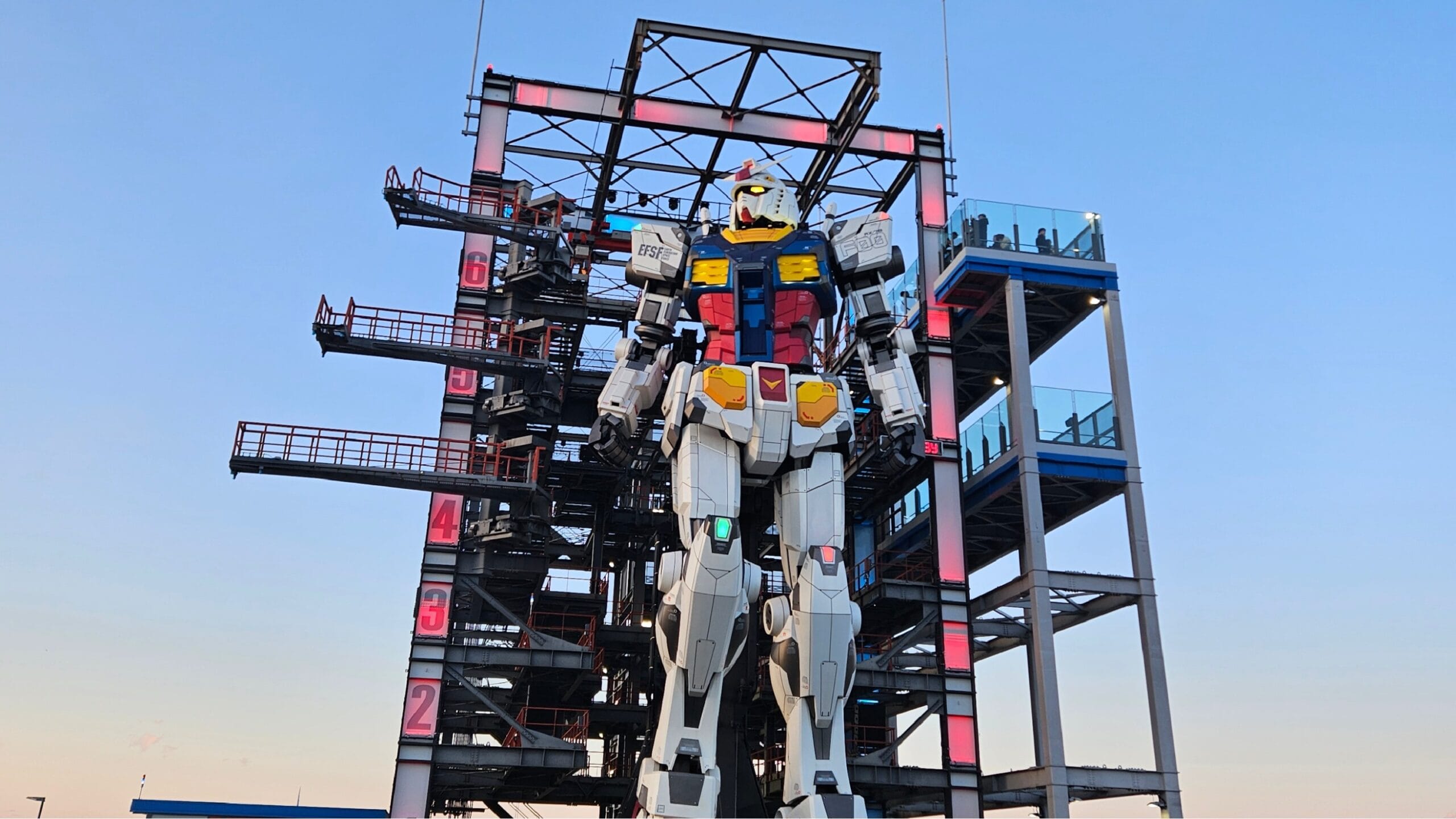
Yoshiyuki Tomino’s Mobile Suit Gundam (1979) changed robot anime forever. Instead of a hero robot fighting monsters, it showed a war between the Earth Federation and the Principality of Zeon, a group of space colonies that declared independence. Soldiers on both sides die, teenagers are drafted into combat and nobody is fully right. At the same time, Zeon’s leaders, uniforms and mass rallies with chants of “Sieg Zeon” clearly borrow from Nazi Germany, and many fans love Zeon’s aesthetic.
I visited the giant Gundam statue in Yokohama, and you can feel how much the franchise means to people in Japan. I wrote about it in my Gundam Seed Yokohama experience.
| Left-leaning reading | Centrist reading | Right-leaning reading | |
|---|---|---|---|
| Main theme | Anti-war, colonies fighting for independence from a distant, unequal Earth government | War has no heroes; both sides commit crimes and suffer | Military professionalism, honour among soldiers, admiration for charismatic commanders like Char |
| What fans point to | Child soldiers, civilian deaths, the colony drop massacre | Amuro and Char as two damaged people on opposite sides | Zeon’s uniforms, discipline and elite pilots |
| Weak point of this reading | The Federation is also an imperial power, not a good alternative | Zeon is clearly modelled on fascism | Tomino presents war as a tragedy, not glory |
Overall lean: anti-war at its core, but with a military aesthetic that many fans enjoy for very different reasons.
Akira: Protest, Power and a Military Coup
Katsuhiro Otomo’s Akira (1988) takes place in Neo-Tokyo after a third world war. The city is full of biker gangs, religious cults, student protesters and a corrupt government, while a secret military project experiments on children with psychic powers. When the government fails, a military colonel takes power in a coup. Many critics see echoes of Japan’s protest movements of the 1960s and of fears about state power and nuclear destruction.
| Left-leaning reading | Centrist reading | Right-leaning reading | |
|---|---|---|---|
| Main theme | Distrust of the state and the military, youth rebellion, secret experiments on children | Chaos when every group, from government to rebels, chases power | Fear of social breakdown, the need for order in a collapsing city |
| What fans point to | The protests, the brutal police and military, the child test subjects | No faction is shown as good, including the resistance | The Colonel’s frustration with corrupt politicians |
| Weak point of this reading | The resistance is also violent and manipulative | The film does clearly criticise military secrecy | The Colonel’s “order” is built on human experiments |
Overall lean: anti-authoritarian and pessimistic about all forms of power.
Space Battleship Yamato: Nostalgia or Peace?
Space Battleship Yamato (1974) rebuilds the famous Second World War battleship Yamato as a spaceship that must travel to a distant planet to save Earth from destruction. For some viewers, reviving the symbol of the Imperial Japanese Navy is nostalgic and nationalist. For others, the story is about sacrifice to save humanity, and the crew learns that their enemies are also people. It was a huge hit in Japan and abroad, where it was known as Star Blazers.
| Left-leaning reading | Centrist reading | Right-leaning reading | |
|---|---|---|---|
| Main theme | Uncomfortable nostalgia for the Imperial Navy and the war | A story of sacrifice and peace that reuses a powerful national symbol | National pride, rebuilding strength, defending the homeland |
| What fans point to | The Yamato itself, military ranks and ceremonies | The crew questioning war after seeing the enemy’s suffering | The heroic final voyage to save Earth |
| Weak point of this reading | The mission is to save the whole planet, not to conquer | The choice of the Yamato is never neutral in Japan | The series repeatedly shows the cost of war |
Overall lean: centre-right in its symbols, but humanitarian in its story. One of the earliest anime debated for its politics.
The Wind Rises: Criticised From Both Sides
Hayao Miyazaki’s The Wind Rises (2013) tells a fictionalised story of Jiro Horikoshi, the engineer who designed the Mitsubishi Zero fighter used by Japan in the Second World War. Miyazaki presents Jiro as a dreamer who loves beautiful airplanes while his country moves towards war. The film was criticised from two directions: some critics in Japan, South Korea and China felt it did not condemn the war machine strongly enough, while some Japanese nationalists attacked Miyazaki at the same time because of his essay opposing constitutional revision.
| Left-leaning reading | Centrist reading | Right-leaning reading | |
|---|---|---|---|
| Main theme | The tragedy of talent serving militarism; a quiet critique of Japan’s path to war | The conflict between personal dreams and historical responsibility | Respect for Japanese engineering, craftsmanship and a generation that lived through hard times |
| What fans point to | Scenes of poverty, Castorp’s warnings about where Japan and Germany are heading, the ruined planes at the end | Jiro’s ambiguous final dream and the line about dreams being “cursed” | The beauty of the planes and the dignity of the characters |
| Weak point of this reading | The film rarely shows the victims of the Zero | Some viewers want a clearer moral position | Miyazaki himself is a pacifist and the film mourns the war |
Overall lean: pacifist in intention, but its subject makes it one of the most politically sensitive anime films.
Gate: Self-Defense Forces in a Fantasy World
Gate began as a series of novels by Takumi Yanai, a former member of Japan’s Self-Defense Forces, and was adapted into an anime in 2015. A portal opens in Tokyo’s Ginza district, a fantasy empire attacks, and the Self-Defense Forces cross into the other world to respond. The soldiers are portrayed as professional, kind and technologically superior. Critics called it a promotion of the military or a colonial fantasy, while fans praise it as a realistic and positive look at Japan’s defence forces.
| Left-leaning reading | Centrist reading | Right-leaning reading | |
|---|---|---|---|
| Main theme | A fantasy that normalises Japanese troops operating in a foreign land, with colonial undertones | A fun “military meets fantasy” story with some political commentary | Pride in the Self-Defense Forces, a capable military that protects civilians |
| What fans point to | Japanese forces occupying territory, the weak “native” empire, the power imbalance | The diplomatic and political subplots in Tokyo | Disaster relief, rescues and disciplined soldiers |
| Weak point of this reading | The soldiers are shown helping refugees, not exploiting them | The politics are clearly sympathetic to the military | The story is still about Japanese troops abroad, a sensitive topic in Asia |
Overall lean: right-leaning, and one of the few anime openly sympathetic to a stronger military role for Japan.
Code Geass: Japan as a Colony
Code Geass (2006) imagines an alternative world where the Holy Britannian Empire has conquered Japan, renamed it “Area 11” and calls its people “Elevens”. The exiled prince Lelouch leads a rebellion with a mysterious power, but becomes more and more ruthless. The series reverses real history by turning Japan into a colony, which is why some viewers in other Asian countries find it interesting, and others find it uncomfortable.
| Left-leaning reading | Centrist reading | Right-leaning reading | |
|---|---|---|---|
| Main theme | Anti-imperialism, racism against colonised people, rebellion against an empire | Ends versus means: can terrible methods bring a better world? | National liberation, resistance against foreign occupation, a strong leader |
| What fans point to | Britannia’s racism towards “Numbers”, the ghettos | Lelouch’s “Zero Requiem” and its moral cost | The Black Knights fighting for Japanese independence |
| Weak point of this reading | The rebellion is led by a prince of the empire himself | The series often celebrates Lelouch’s brilliance | The story also shows the Japanese resistance as violent and divided |
Overall lean: anti-imperialist, with a strong debate about whether a revolution justifies any means.
Psycho-Pass: The Surveillance State
In Psycho-Pass (2012), the Sibyl System constantly scans citizens and measures their likelihood of committing a crime. People with a high “crime coefficient” can be arrested or killed before they do anything. Society is safe and orderly, but nobody really controls the system. The series is a classic dystopia and asks how much freedom people will give up for safety.
| Left-leaning reading | Centrist reading | Right-leaning reading | |
|---|---|---|---|
| Main theme | Critique of surveillance, algorithmic control and a society that values efficiency over people | The trade-off between security and freedom, and who watches the watchers | A warning against big government and the loss of individual responsibility |
| What fans point to | Sibyl’s secret nature, people judged by data | Akane defending the law while knowing the system is flawed | Citizens who no longer think for themselves |
| Weak point of this reading | Many characters actually value the safety Sibyl provides | The series clearly sees the system as dangerous | The alternative to Sibyl is shown as chaos and violence |
Overall lean: anti-authoritarian. It is one of the few anime both progressives and libertarians agree on.
Legend of the Galactic Heroes: Democracy Versus the Enlightened Dictator
Legend of the Galactic Heroes, based on novels by Yoshiki Tanaka, is often called the most political anime ever made. It follows a war between the autocratic Galactic Empire and the democratic Free Planets Alliance. The brilliant Reinhard rises to rule the empire and reforms it, while the reluctant admiral Yang Wen-li defends a corrupt democracy he still believes in. The whole series is a debate about whether a good dictator is better than a bad democracy.
| Left-leaning reading | Centrist reading | Right-leaning reading | |
|---|---|---|---|
| Main theme | A defence of democracy even when it is corrupt; criticism of militarism | A balanced debate about the strengths and failures of both systems | Admiration for strong, competent leadership and a meritocratic state |
| What fans point to | Yang’s speeches about the rights of citizens | Both sides showing corruption and heroism | Reinhard ending noble privilege and running an efficient empire |
| Weak point of this reading | Democracy is shown as weak and easily manipulated | The author clearly sides with democracy in the end | Reinhard’s empire still depends on one man |
Overall lean: liberal-democratic at heart, but fair enough that right-leaning fans love Reinhard.
Bonus: Detective Conan: Police, Justice and “My Lover Is This Country”

Detective Conan does not look political at first. It is a long-running mystery series by Gosho Aoyama about a teenage detective trapped in a child’s body, solving murders while hunting a secret crime syndicate. But it says a lot about how Japan sees the police, justice and the state. Many cases end with the murderer revealed as someone who was a victim first, and Conan repeatedly insists that the truth must come out and that killing is never justified.
The franchise became more openly political with the character Rei Furuya, an undercover agent of Japan’s Public Security Bureau. In the film Zero the Enforcer, he bends the law to protect the country and says the famous line “My lover is this country”. The Conan films are now among the most successful movies at the Japanese box office every year, so these ideas reach a huge audience. Gosho Aoyama’s hometown, Hokuei in Tottori, has even turned the series into a tourism and regional revival project, which I visited on my Tottori road trip.
| Left-leaning reading | Centrist reading | Right-leaning reading | |
|---|---|---|---|
| Main theme | Criminals as victims of society, critique of secret police methods that bend the law | Truth, the rule of law and individual responsibility | Respect for the police, public order and agents who serve the nation |
| What fans point to | Murderers driven by injustice, Public Security operating outside normal rules | Conan’s insistence that the truth must be revealed and that murder is never justified | Rei Furuya’s patriotism and “My lover is this country” |
| Weak point of this reading | The police are mostly shown as honest and helpful | Some films clearly celebrate state power | The series also shows the dangers of agents acting without oversight |
Overall lean: centrist and pro-rule-of-law, with a patriotic streak in the Public Security storylines.
Summary: Is Each Anime Left, Centrist or Right?
| Anime | Main political theme | Overall lean |
|---|---|---|
| Naruto | Cycle of hatred, child soldiers, loyalty | Centrist, anti-war |
| One Piece | Corrupt world government, slavery, freedom | Anti-authoritarian (left and libertarian) |
| Princess Mononoke | Nature versus industry, coexistence | Green, centre-left |
| Grave of the Fireflies | Civilian suffering in war | Anti-war, debated as a victim narrative |
| Attack on Titan | Nationalism, ethnic persecution, genocide | Contested by left and right |
| Mobile Suit Gundam | Colonial war, no heroes | Anti-war with a military aesthetic |
| Akira | State power, protest, military coup | Anti-authoritarian |
| Space Battleship Yamato | Wartime symbol, sacrifice | Centre-right symbols, humanitarian story |
| The Wind Rises | Engineering and militarism | Pacifist, criticised from both sides |
| Gate | Self-Defense Forces abroad | Right-leaning |
| Code Geass | Empire and colonised Japan | Anti-imperialist |
| Psycho-Pass | Surveillance and control | Anti-authoritarian |
| Legend of the Galactic Heroes | Democracy versus autocracy | Liberal-democratic, balanced |
| Detective Conan (bonus) | Police, justice, the rule of law | Centrist, pro-rule-of-law, patriotic subplots |
Why So Many Anime Are About War and Power
Japan’s experience of the Second World War shaped generations of creators. Many of the directors who defined anime, including Miyazaki, Takahata, Tomino and Otomo, grew up in the shadow of the war, the atomic bombings and the American occupation. After the war, Japan adopted a constitution with Article 9, which renounces war, and pacifism became a central part of public life. The debate over whether to change it continues today. I explain the wider background in my article on Japan-US relations.
Because of this history, anime often approaches war from the point of view of victims, children and soldiers who never wanted to fight. At the same time, Japan has a strong tradition of military stories, and some newer works, like Gate, show the Self-Defense Forces in a heroic light. Anime is not one political voice. It is a huge industry with thousands of creators who disagree with each other, just like any other society.
Anime, Soft Power and Censorship
- Soft power: the Japanese government has promoted anime abroad as part of its “Cool Japan” strategy, using it to build a positive image of the country.
- Anime tourism: local governments use anime to attract visitors and revive regions. The small town of Hokuei in Tottori rebuilt its identity around Detective Conan, as I describe in my article on the real-life Detective Conan town, and many towns now have anime-themed manhole covers.
- Recruitment: Japan’s Self-Defense Forces have used anime-style characters in recruitment posters and collaborations, which some people criticise and others see as normal marketing.
- Censorship abroad: in 2015, China’s Ministry of Culture banned a list of anime, including Attack on Titan and Death Note, for content it considered harmful.
- Self-censorship: streaming platforms and publishers sometimes edit symbols, flags or scenes for international markets to avoid controversy.
How Much Propaganda Is in Japanese Anime?
It is a question I hear a lot, especially from friends in Europe who see anime with lots of soldiers, flags and battleships. The honest answer: real state propaganda is rare in modern anime, but anime is full of other messages, from soft power and military nostalgia to plain commercial advertising. It helps to separate them.
Propaganda in the strict sense means messages created or commissioned by a government or organisation to shape public opinion. A creator sharing their own political view in a story is not the same thing, even if you disagree with it.
When Anime Really Was Propaganda
During the Second World War, Japan did produce real propaganda animation. The best-known example is Momotaro’s Divine Sea Warriors (1945), commissioned by the Imperial Japanese Navy and often called Japan’s first feature-length animated film. It turned the folk hero Momotaro into a commander leading animal soldiers against the Western powers. An earlier short, Momotaro’s Sea Eagles (1943), showed an attack inspired by Pearl Harbor. These films are a reminder that animation was used as a tool of the state, and they are one reason why many post-war creators became so strongly anti-war. I explain more of this history in my article on colonialism in Japan.
Anime Today: Soft Power, Not State Propaganda
Since the war, the Japanese government has not commissioned anime to push a political ideology. What it does is promote anime abroad as soft power through the “Cool Japan” strategy, using it to make Japan look creative and attractive. That is image marketing for the country, similar to how other nations promote their films, music or food.
There are grey areas. The Self-Defense Forces have used anime-style characters in recruitment campaigns. Some popular franchises turn Imperial Japanese Navy warships into cute characters, which critics see as nostalgia for the war and fans see as harmless fun with history. And works like Gate, written by a former member of the Self-Defense Forces, clearly present the military in a positive light without being government productions.
The Biggest “Propaganda” in Anime Is Commercial
If you want to find a message that anime pushes all the time, it is shopping. Many series exist partly to sell toys, games and merchandise. Gundam helped build a huge business in plastic model kits, and franchises like Pokemon are designed around collecting. You see it everywhere in Japan, from gashapon machines and crane game arcades to the anime collaborations of convenience stores and train companies.
| Type of message | Examples | How common in anime today |
|---|---|---|
| State propaganda commissioned by the government | Wartime films like Momotaro’s Divine Sea Warriors | Very rare, essentially absent since 1945 |
| Government soft power and tourism | Cool Japan campaigns, anime tourism like the Detective Conan town | Common |
| Military-friendly messages | Self-Defense Forces recruitment collaborations, Gate, warship-themed franchises | Occasional and debated |
| Creators’ own political views | Miyazaki’s pacifism, Legend of the Galactic Heroes, Psycho-Pass | Common, mostly through themes rather than slogans |
| Commercial messages | Toys, model kits, games, merchandise, brand collaborations | Very common |
My verdict: there is very little real propaganda in modern Japanese anime. There is a lot of soft power, a fair amount of nostalgia and a huge amount of marketing, and individual creators often share strong views. Knowing the difference makes you a smarter viewer, whether you love the series or not.
How to Watch Anime More Critically
- Look at who holds power in the story and how the story judges them.
- Ask whose suffering is shown and whose is missing.
- Separate the aesthetic from the message. Cool uniforms do not mean a story supports what they stand for.
- Check the creator’s own statements, but remember that your reading also matters.
- Compare Japanese and international reactions. They are often surprisingly different.
If you visit Japan as an anime fan, you can see this culture up close. Find real places from your favourite shows in my anime locations guide, visit the anime shops and cafes of Kichijoji, or hunt for Saitama’s house from One Punch Man. For a wider look at Japanese society, read my Japan culture guide.
More Anime Guides From My Time in Japan
Politics is only one side of anime. If you want to experience anime culture in Japan yourself, these are my guides from living in Tokyo and travelling around the country:
- Anime in Japan: real-life locations and insider tips, my main guide for anime fans.
- The Your Name stairs at Suga Shrine in Tokyo, and the Your Name trail at Hie Shrine in Takayama.
- How to find Saitama’s house from One Punch Man.
- Hokuei, the real-life Detective Conan town, part of my Tottori road trip.
- The Attack on Titan statues in Hita and the Suzume door on my Kyushu road trip.
- The Gundam Seed experience in Yokohama.
- An honest guide to maid cafes in Akihabara and a food and anime shopping walk to Akihabara.
- The Pokemon x Kogei exhibition, where Pokemon meets traditional Japanese crafts.
- Gashapon capsule toys and crane game arcades, where anime merchandise rules.
- The man who married Hatsune Miku, one of Japan’s most famous virtual love stories.
- Kichijoji, a neighbourhood loved by anime fans and close to the Ghibli Museum.
- Halloween in Tokyo, when the streets fill with anime cosplay.
Frequently Asked Questions About Anime and Politics
Is anime political?
Often, yes. Many famous anime deal with war, empire, racism, surveillance and the environment. But most do not promote a specific party or ideology. They explore political themes that viewers on the left, centre and right read in different ways.
Is anime left-wing or right-wing?
Neither as a whole. Many classic works, especially from Studio Ghibli and the 1970s and 80s, lean anti-war and anti-authoritarian. Others, like Gate, are sympathetic to a stronger military. Most popular anime sit somewhere in the centre and avoid taking a clear side.
Is Attack on Titan fascist?
This is one of the most debated questions in anime. Critics point to militarism, nationalism and the creator’s reference to an Imperial Japanese Army general. Many others argue the series is a critique of fascism, propaganda and ethnic hatred, and that its ending shows genocide as a catastrophe. Most careful readings see it as a warning rather than a celebration.
Is One Piece political?
Yes. It criticises a corrupt world government, a hereditary elite that owns slaves, racism and the erasure of history. Left-leaning fans see anti-elitism and anti-racism, while libertarian fans see a story about freedom from the state.
Is Naruto about war?
Yes. The ninja villages are military states, children are trained as soldiers and the story’s central idea is breaking the cycle of hatred created by war and revenge. Pain’s arc is one of the most direct anti-war messages in a mainstream shonen anime.
Is Grave of the Fireflies an anti-war film?
Most viewers see it as one of the strongest anti-war films ever made. Director Isao Takahata said he did not see it simply as an anti-war film and was also interested in a boy who isolates himself from society. Some critics note that it shows Japanese suffering without addressing Japan’s role as an aggressor.
What is the message of Princess Mononoke?
That humans and nature are in conflict, but that hatred on both sides only leads to destruction. The film has no pure villain: Lady Eboshi destroys the forest but protects society’s outcasts. Its message is coexistence, seen with “eyes unclouded by hate”.
Is Hayao Miyazaki political?
Yes. Miyazaki is known for progressive views. He has spoken about environmental protection for decades, Studio Ghibli opposed nuclear power after Fukushima, and in 2013 he wrote an essay opposing revision of Japan’s pacifist constitution. His films are political through themes, not slogans.
Why did China ban Attack on Titan?
In 2015, China’s Ministry of Culture published a list of anime it considered harmful, including Attack on Titan and Death Note. The official reasons focused on violence and content seen as unsuitable for young viewers.
Is Gundam anti-war?
The original Mobile Suit Gundam is widely seen as anti-war. It shows teenagers forced into combat, civilian deaths and moral failures on both sides. However, the Principality of Zeon’s imagery borrows heavily from Nazi Germany, and some fans admire its military aesthetic.
Which anime is the most political?
Legend of the Galactic Heroes is often called the most political, because the whole series is a debate about democracy and autocracy. Attack on Titan, Code Geass, Psycho-Pass and Gundam are also strongly political.
Is there right-wing anime?
Some anime are seen as right-leaning, such as Gate, which portrays Japan’s Self-Defense Forces heroically, and parts of Space Battleship Yamato, which revives a symbol of the Imperial Navy. Right-leaning fans also connect with themes of loyalty, sacrifice and national defence in many shonen series.
Is there left-wing anime?
Many works are read as left-leaning, including Studio Ghibli films like Princess Mononoke and Nausicaa of the Valley of the Wind, as well as Akira, Psycho-Pass and parts of One Piece, because they criticise militarism, exploitation, surveillance and elite power.
Can I enjoy anime without thinking about politics?
Of course. Most people watch anime for the characters, action and stories. Understanding the political background simply adds another layer and helps you see why certain scenes are controversial in different countries.
Why do Japanese and Western fans read anime differently?
Political debates are different in each country. In Japan, left and right are closely tied to pacifism, Article 9, the Self-Defense Forces and memory of the war. In the West, viewers often apply their own debates about race, immigration and government to the same stories.
Do anime creators include political messages on purpose?
Some do, like Miyazaki, Tomino and the author of Legend of the Galactic Heroes. Others say they simply tell stories and let viewers interpret them. Hajime Isayama of Attack on Titan has often avoided explaining his intentions in political terms.
Is anime propaganda?
Anime is not state propaganda in general, but governments do use it. Japan promotes anime as soft power, and the Self-Defense Forces have used anime-style characters in recruitment. Individual works can also be accused of promoting a viewpoint, as Gate has been.
Final Thoughts
So, is anime political? Yes, but in a more interesting way than most people expect. The best anime do not tell you what to think. They put you inside a war, an empire or a broken society and let you feel the weight of every choice. That is why a ninja story, a pirate adventure and a film about two children in 1945 can start such serious debates.
Next time you watch Naruto, One Piece or Attack on Titan, ask yourself how someone on the other side of the political spectrum would see the same scene. You might be surprised how much more you notice. And if you travel to Japan, you can explore anime culture where it was born, from real-life anime locations to the Gundam statue in Yokohama.
Author

Get My Personal Travel Maps


Leave a Reply