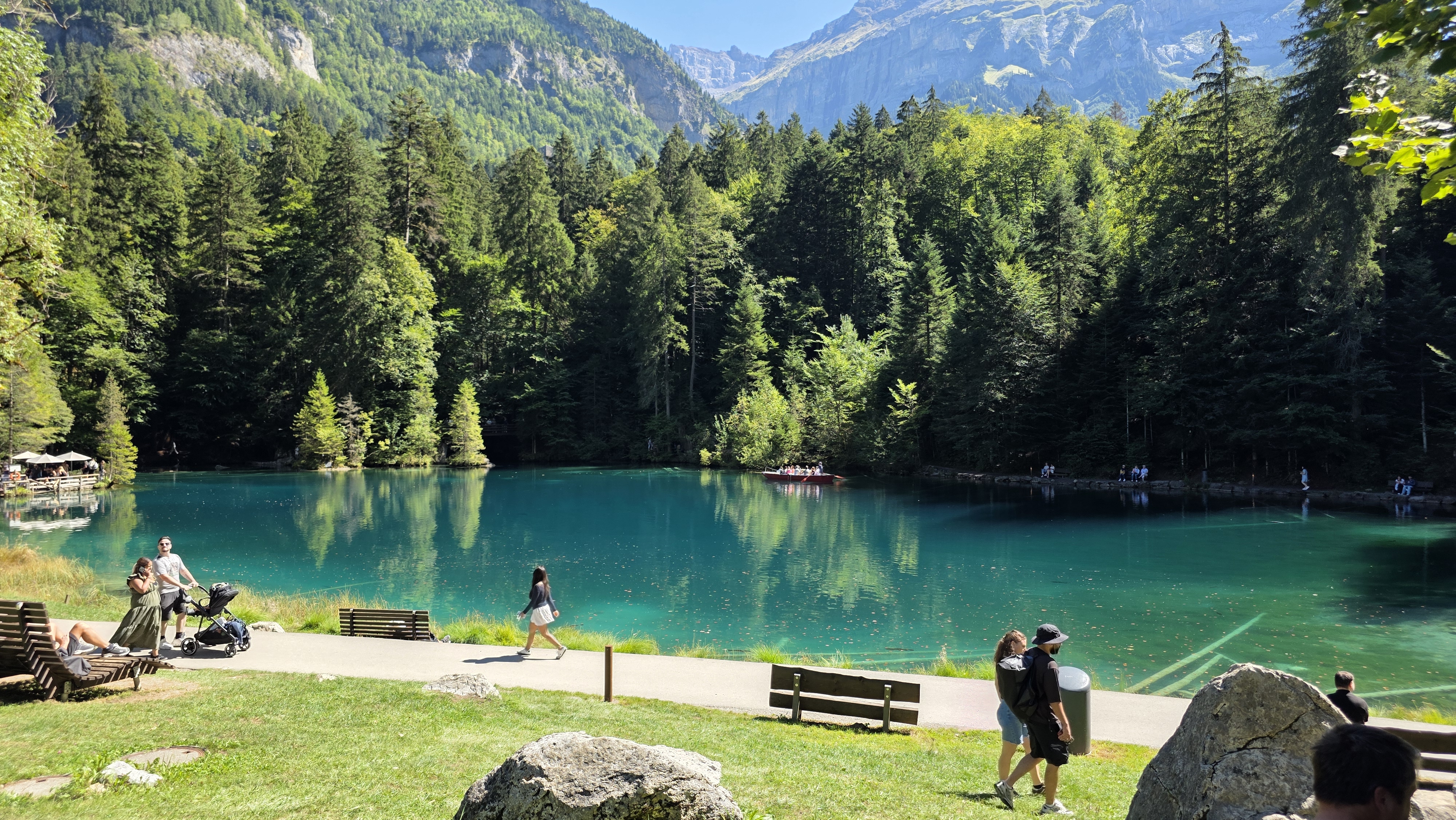
The first time I stood at the edge of Blausee, I genuinely thought someone had dyed the water. It is that specific, saturated, almost unnatural shade of blue, the kind you expect from a postcard filter rather than an actual lake sitting quietly in a Bernese forest. I have been back three times since, in three different seasons, and every single time I still catch myself doing a double take before my brain accepts that yes, this is just what the water looks like here.
Blausee sits in the Kandertal, a short hop from Kandersteg in the canton of Bern, and it is one of those places that photographs well but somehow still undersells itself in pictures. What I want to do here is walk you through everything I have learned across multiple visits: how the lake formed, why it is considered one of the clearest lakes in the world, what the trout farm and boat ride are really like, every rule you need to know before you show up, what things actually cost, the nearby Oeschinensee, and one specific safety warning about the river below the park that almost nobody mentions.
How Blausee Actually Formed
Blausee is not old in geological terms, which surprised me when I first read the information boards along the approach trail. Around 15,000 years ago, a rockslide came down off the surrounding slopes and, combined with holes left behind as the last glaciers retreated from the Kander valley, created the depression that would eventually fill with water. The lake is fed almost entirely by underground springs and groundwater seeping up through the valley floor rather than by a visible inflow stream, which is part of why it stays so cold and so still.
One of the Clearest Lakes in the World
That spring-fed water is the real explanation for the color, and it is more interesting than I expected. The water is mineral-rich and exceptionally clean, and because of how light behaves in water this pure, most of the spectrum gets absorbed and only the blue wavelengths bounce back to your eye. Blausee is regularly named among the clearest lakes anywhere in the world, and standing at the shore you understand why almost immediately. Tree trunks and boulders that sank to the lakebed decades ago, some as deep as twelve meters down, look like they are sitting just beneath the surface because the water distorts almost nothing. You can watch trout drifting over what looks like a shallow gravel bed that is actually several meters below them.
The Legend Everyone Tells You
No trip to Blausee is complete without hearing some version of the local legend, and I have heard it told slightly differently by different guides over the years, which is part of the charm. The story goes that a young shepherdess fell in love with a shepherd from the valley, and when he died, she wept for him so long and so hard that her tears filled the hollow and became the lake. Some versions add a stone figure of the grieving girl resting on the lakebed, which visitors sometimes spot from the boat if the light is right. I have never managed to see it myself, but the story sticks with you regardless, and it gives a sad little human backdrop to what is otherwise a purely geological curiosity.
The Trout Farm and Where to Eat

Blausee has run an organic trout farm on site since the late nineteenth century, and it is not a token attraction bolted on for tourists, it is genuinely central to what this place is. The farm is certified organic, and the philosophy the operators talk about is quality over quantity, with fish kept at low densities in spacious ponds fed by the same cold, mineral-rich spring water that feeds the lake itself. You can walk sections of the farm and watch rainbow and salmon trout at different growth stages, and the slow, cold-water growth is apparently what gives the fish their reputation.
That trout ends up on the menu at the on-site restaurant, and if you only do one sit-down meal at Blausee in your life, make it this one. I have had the trout there smoked, pan-fried, and once as a tartare, and it has been genuinely excellent every time. But if you don’t want the full restaurant experience or the price that comes with it, there is a much cheaper option worth knowing about: the café at the entrance sells the Bagel Blausee, smoked Lachsforelle, salmon trout, with cream cheese, horseradish, shallots, salad, and sun-dried tomatoes, for 12.50 francs. It sounds like a small thing, but it is genuinely one of the best value bites I have had anywhere in the Bernese Oberland, and it lets you try the actual local product without committing to a full restaurant bill.
The Boat Ride, and Why You Cannot Rent Your Own
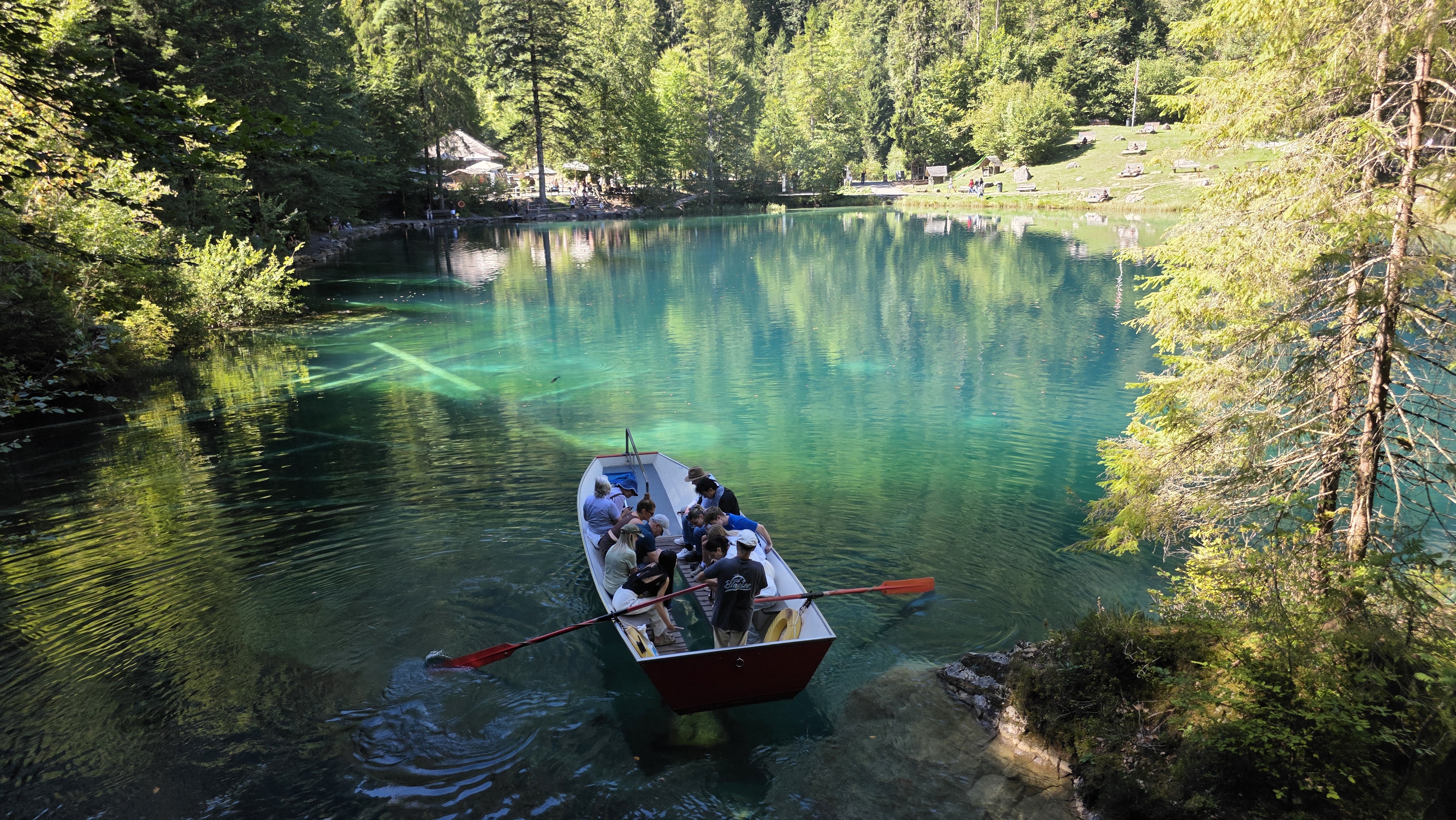
This is the one activity almost everyone does, and it is worth doing even though it only lasts a few minutes. The glass-bottom rowing boat ride is included in your entrance ticket in summer, no separate booking or extra fee required, and a park employee rows you out over the clearest part of the lake so you can look straight down through the glass panel at the trout and the sunken tree trunks below. Looking down through water this transparent, watching fish glide underneath your feet, is genuinely one of those moments that makes people go quiet for a second.
One thing worth knowing before you go: this guided glass-bottom boat is the only way onto the water. You cannot rent your own rowing boat or paddle around independently at Blausee, and swimming is not allowed either, so the guided ride really is the one and only way to actually get out onto the lake itself.
Grilling and Picnic Areas
If you want to make a full afternoon of it rather than just walking the loop, the barbecue areas are one of the best parts of the park and genuinely underused by first-time visitors. There are seven fire pits clustered around the Wasserhaus by the playground, plus two more up on the Sommerau, the forest clearing where the llamas graze in summer. All of them are free to use, and firewood is provided at no extra cost, which is a nice touch compared to most paid parks I have visited in Switzerland. The only catch is that none of them can be reserved in advance, so on a busy summer weekend you may need to wait for one to free up or come earlier in the day to secure a spot.
The Rules of the Park, All of Them
Blausee is privately owned and run as a protected nature park rather than a public lake, and the rules reflect that. It is worth knowing all of them before you go, because a few genuinely surprised me the first time.
Swimming in the lake is not permitted, for anyone, human or dog, with a single exception made once a year on the first Sunday of December for a charity swim across a short stretch of the lake. Fishing is also not allowed anywhere on the property; the trout are farmed, not caught, and you buy them in the shop or restaurant instead. Feeding the trout or the resident sturgeon is strictly forbidden, since the wrong food can genuinely harm them, and you are asked not to throw stones into the water either, since the fish sometimes mistake them for food and swallow them.
Drones are banned throughout the nature park. This is enforced for the safety of other guests and for the privacy of hotel guests staying on site, not just as a vague suggestion, so leave it packed away even if the lake looks like the perfect drone shot. Dogs are genuinely welcome throughout the park and even inside the hotel and restaurant, on a leash, though they are not allowed on the Sommerau pasture in summer while the llamas are there, and like everyone else, they are not allowed to swim in the lake, though there is a shallow watercourse near the barbecue areas where they can cool off instead.
Prices and Opening Times
Entry to the nature park is a paid ticket, and admission is what funds the entire operation, since the park receives no subsidy from the municipality, canton, or federal government. As of my last visit, adult admission runs slightly higher on weekends and public holidays than on weekdays, with a lower rate for children between six and fifteen, and free entry for children under six. If you happen to be visiting on your actual birthday, admission is free for any age, though you will need to show ID at the gate. Holders of a Bernese Oberland Pass or a guest card from the Adelboden, Lenk, or Kandersteg region get a fifty percent discount, though a Swiss Travel Pass, GA Travelcard, or Half-Fare Card will not get you a reduction here, which caught me off guard the first time I checked.
The entrance fee includes access to the playground, free use of the barbecue areas including firewood, and the glass-bottom boat ride in summer. The park is open daily, all year round, generally from nine in the morning until nine in the evening, though the restaurant kitchen runs its own shorter hours, roughly late morning through mid-afternoon and again in the evening. If you want a sit-down meal, it is worth reserving a table in advance, since a reservation gets part of your entrance fee refunded.
Hiking In From Kandersteg
My favorite way to arrive at Blausee, and the one I would recommend to almost anyone reasonably able-bodied, is to walk in from Kandersteg rather than drive straight to the parking lot. The trail follows the Kander river along part of the Lötschberger Nordrampe railway hiking route, with information boards along the way explaining the history and engineering of the historic Lötschberg mountain line that runs close to the valley floor. It is an easy, gently graded walk suitable for most fitness levels and ages, taking somewhere around ninety minutes at a relaxed pace, a little less if you are moving quickly.
What I like about arriving this way is the contrast. You start in the bustle of Kandersteg village, spend an hour and a half winding through quiet river meadows and forest, and then the trees open up and there is that impossible blue water waiting for you, which feels a lot more earned than just stepping out of a car. If you would rather not repeat the walk on the way back, there is a bus stop right at the Blausee entrance that connects back to Kandersteg and onward to Frutigen, so a one-way hike with a bus return is a very comfortable option.
Do Not Go Down to the River
This is the one warning I genuinely want people to read before they visit, because it is easy to miss and it matters. The trail and the park both run alongside the Kander river, and there is a working hydroelectric power station further down the valley near Kandergrund that draws water from the Kander and releases it again lower down the system. What that means in practice is that the water level and current in the riverbed below the park can rise suddenly and without warning when the plant adjusts its intake or discharge, even on a day with no rain at all. Sections of the Kander are considered genuinely dangerous for exactly this reason, and it is not a river you should climb down into, wade across, or let children play at the edge of, however calm it looks in the moment you are standing there. Admire it from the marked paths and bridges, and treat any sudden rise in the water as a sign to move back up the bank immediately rather than investigate.
Oeschinensee, the Other Blue Lake Nearby
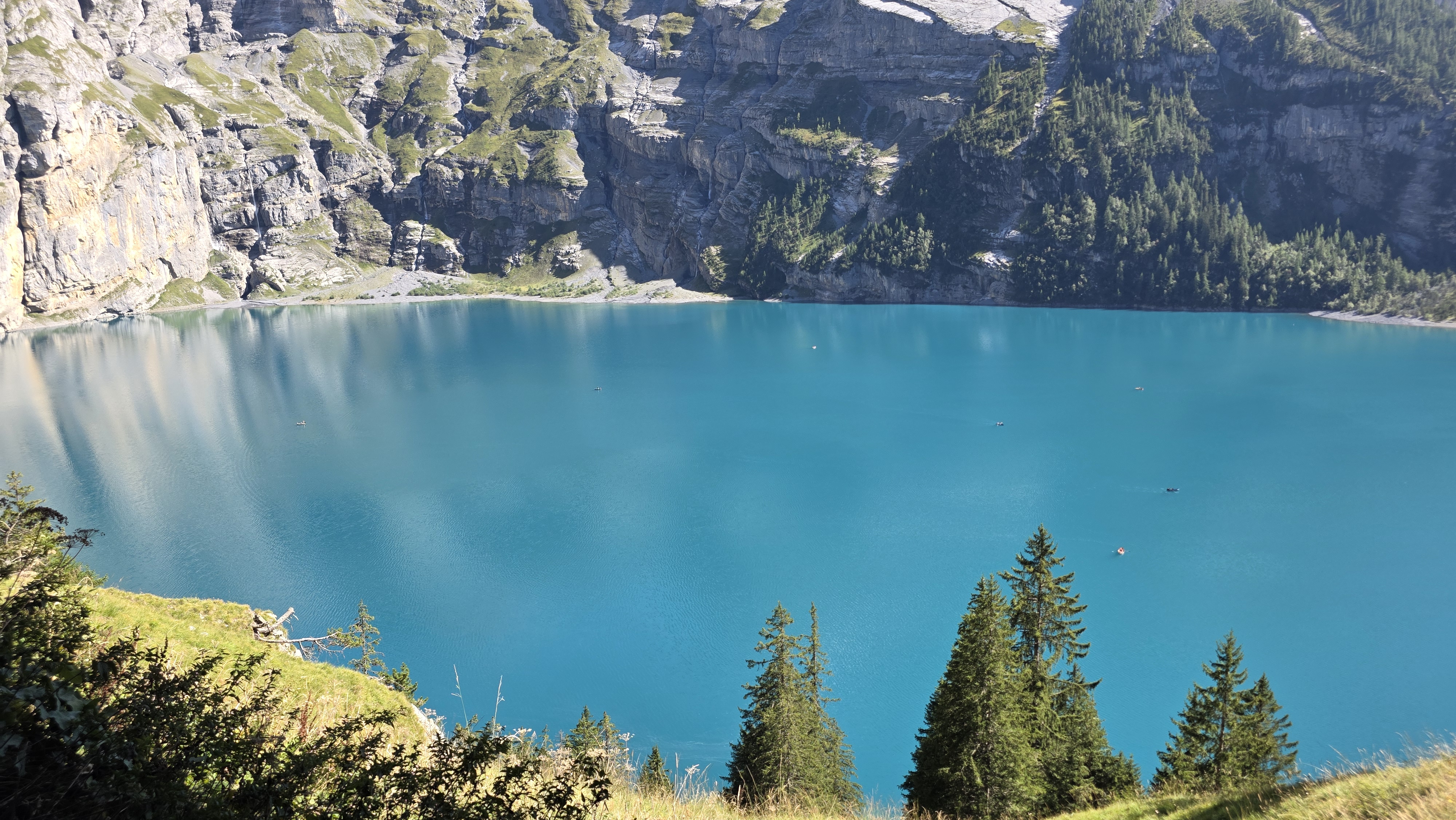
If Blausee leaves you wanting more alpine blue water, you do not have far to go. Oeschinensee sits above Kandersteg, reachable by a short cable car ride followed by a walk, or a longer hike if you want to earn the view properly, and it is a completely different experience from Blausee despite the similar color palette. Where Blausee is small, enclosed, and almost manicured, Oeschinensee is a genuinely dramatic mountain lake ringed by cliffs and the Blüemlisalp massif, with waterfalls feeding in from above. Unlike Blausee, you can actually rent your own rowing boat here and paddle out across the water yourself, and swimming is permitted in the warmer months, which makes it a good pairing if you want one lake you look at and one lake you get into. If you have a full day in the Kandertal, doing Blausee in the morning and Oeschinensee in the afternoon, or the other way around, is a genuinely great way to spend it.
Getting There
If you are coming by public transport, the standard route is a train to either Kandersteg or Frutigen, both well connected on the Bernese Oberland rail network, followed by a short postbus ride to the stop simply called Blausee, from which it is a short walk to the entrance. Both towns sit on routes easily reached from Spiez, Interlaken, or Bern, so this works well as a day trip from anywhere in the Bernese Oberland or even from Bern itself if you start early. If you are driving, the approach is via Spiez and Frutigen up the Kandertal, or from the Kandersteg side heading down the valley, and there are several paid car parks directly on the main road, a short walk from the lake itself. Parking fills up fast in high season, so public transport is genuinely the easier option on a summer weekend.
When to Visit and What to Expect
I have been to Blausee in early summer, in the height of August, and once in a light dusting of autumn snow, and each version of the place has its own personality. Summer weekends are, unsurprisingly, the busiest, with the parking lot filling and the boat queue stretching out, so if you have any flexibility I would push for a weekday morning instead. Early autumn brought out a genuinely striking contrast between the turning orange leaves and the deep blue water that I have not managed to catch again since. If you are visiting in summer, keep an eye out for the llamas that spend the season grazing on the Sommerau, which is a small surprise that catches most first-time visitors completely off guard.
However you time it, my honest advice is not to over-plan the visit itself. Blausee is not a place with a long checklist of things to do. It is a place to walk the loop slowly, take the boat ride, eat well, and sit by that unnervingly blue water for longer than you think you need to. That is exactly what keeps pulling me back.
If you want to build a longer trip around it, our Switzerland travel guide is a good starting point for planning the wider region, and if you are basing yourself nearby, our Thun guide covers the closest proper town with a train connection into the Kandertal. For another Bernese Oberland day out that pairs well with Blausee if you have more than one day in the region, I wrote about a day trip to Niederhorn and Lake Thun. And if the heat has you thinking about water in a different way, our guide to swimming in the Aare River covers a completely different, much wilder side of Bernese water.
Author

Get My Personal Travel Maps
Keep Reading: More Articles You’ll Love
 Oeschinensee Switzerland: My Complete Guide
  A Guide to Niederhorn, Beatenberg and the Caves of Lake Thun
  Thun, Switzerland: Castle, Aare Surfing, Riverside Food and How Long to Stay
  Ballenberg Open-Air Museum: A Journey Through Swiss History
  Lake Kawaguchiko Itinerary: Best Mt. Fuji Views & Hidden Gems
  Neuchâtel, Switzerland: The Complete Travel Guide to the Lake, the Castle, and the Chocolate Town
  Swimming in the Aare River: The Complete Guide to Switzerland’s Favorite Wild Swim


Leave a Reply