Planning your very first excursion to the famous Fuji Five Lakes region can quickly become overwhelming, especially when you are trying to balance the desire for iconic, postcard-perfect photography with the harsh reality of modern tourist crowds. Mount Fuji is the undisputed symbol of Japan, drawing millions of travelers from every corner of the globe each year. However, navigating the logistics, choosing the right transportation, avoiding overpriced tourist traps, and finding authentic cultural experiences requires a strategic approach.
On our recent first-time journey to the area, we discovered exactly how to navigate the region efficiently, dodge the heaviest crowds, and experience the local geography without breaking the bank. This deep, comprehensive Lake Kawaguchiko itinerary is designed to give you a realistic, boots-on-the-ground perspective from travelers who have actually walked the trails and driven the roads. We will guide you through the intricate process of booking the right highway transportation from Tokyo, securing an independent vehicle, exploring highly detailed open-air cultural landmarks, and staying at an incredible hidden gem of an onsen hotel with unforgettable, private Mount Fuji views.
Mastering the Logistics: Shinjuku to Kawaguchiko Station
Getting out of the Tokyo metropolitan sprawl efficiently is the crucial first step to a successful weekend getaway. While Japan’s rail network is world-famous, taking a direct highway bus is often the most straightforward, comfortable, and economical method for reaching the lakeside.
Why the Highway Bus Wins Over Trains
When you evaluate your transit options from Tokyo to the Fuji area, you will find options ranging from the pricey Fuji Excursion limited express train to various local train transfers. However, the Tokyo to Kawaguchiko bus remains a favorite for experienced travelers because it eliminates the hassle of transferring with luggage and drops you directly at the central hub of the lakes.
The bus route departs regularly from major transport terminals like Busta Shinjuku (located right above Shinjuku Station) or the main Tokyo Station terminal. Under normal road conditions, the total travel time takes roughly two hours. However, it is important to understand that Tokyo’s weekend traffic can be highly unpredictable. Leaving early in the morning helps mitigate potential delays so you do not lose precious daylight hours.
Key Route Milestones:
1. Departure from Busta Shinjuku or Tokyo Station
2. Scenic highway transit through the mountainous Yamanashi Prefecture
3. Arrival at Fuji-Q Highland (The famous amusement park with world-record rollercoasters)
4. Final stop: Kawaguchiko Station (Exactly one station after Fuji-Q Highland)
The Absolute Necessity of Advance Online Booking
Because this specific route is incredibly popular with international tourists, Tokyo commuters, and domestic weekend travelers alike, you cannot treat this as a spontaneous transit choice. You must reserve your Tokyo to Kawaguchiko bus tickets early online.
If you wait until the day of travel or attempt to buy a ticket at the counter on a Friday evening or Saturday morning, you will almost certainly find every prime slot completely sold out. This forces you onto much longer, crowded local train lines with multiple transfers, wasting hours of your trip. Secure your seat online several weeks in advance to guarantee a smooth, stress-free departure.
Maximizing Your Budget: Finding an Affordable Room with a True Fuji View
Many travelers fall into the trap of assuming that waking up to a pristine, unobstructed view of Mount Fuji requires staying at a five-star luxury resort or a high-end luxury ryokan charging exorbitant rates. Fortunately, this is a major misconception. It is entirely possible to find a mt fuji view hotel cheaply if you know where to look, how to compromise on unnecessary amenities, and how to structure your arrival time strategically.
💡 The Friday Night Buffer Strategy:
If you are traveling out of Tokyo on a Friday evening after a busy work week, do not waste money booking a premium, high-end resort for a night where you will arrive late. Instead, book a clean, affordable, hyper-efficient hotel nearby just to get situated. This saves money and positions you perfectly to start your sightseeing early Saturday morning.
Hotel Kainosato: Simple, Clean, and Perfectly Positioned

For our first night in the area, we stayed at Hotel Kainosato. This property is an excellent choice for budget-conscious travelers who still demand high standards of cleanliness and convenience. The hotel operates on a seamless, modern self-check-in system, allowing you to arrive late at night without worrying about staff availability or rigid front-desk hours.
Upon entering, we found everything to be exceptionally clean, well-maintained, and perfectly functional. But the real magic happened the next morning: despite being a highly affordable, cheap accommodation option, we opened our eyes to find a direct, beautiful view of Mount Fuji right from the property. Staying here on Friday night meant we avoided paying peak weekend rates for a premium room while putting ourselves right at the starting line for Saturday’s adventures before the massive day-trip tour buses could even depart from Tokyo.
Why an Independent Vehicle is Required for the Best Experience
While the Lake Kawaguchi area features a local sightseeing bus network (the Red, Green, and Blue Omni Buses), relying exclusively on public transit around the Fuji Five Lakes will severely limit your freedom, waste your time in long queues, and keep you trapped among the densest crowds of tourists.
The Limits of Public Sightseeing Buses
The local buses run on fixed schedules, can become incredibly overcrowded during peak hours, and often get stuck in the exact same traffic jams as the cars on the narrow lakeside roads. Furthermore, public transit simply does not reach some of the best, most isolated viewpoints, hidden beaches, and neighboring lakes. If you want to experience the true natural beauty of the region on your own terms, you need independent wheels.
Securing a Lake Kawaguchi Car Rental
Conveniently located right near our first hotel, Kawaguchiko Station was a local Toyota Rental Car branch. Securing a Lake Kawaguchi car rental is, in our honest opinion, practically required if you want the ultimate experience in this region.
The overall rental experience can vary significantly depending entirely on the specific store and location you choose. While some regional branches might handle the process a bit faster, many offices remain highly bureaucratic, making it easy for first-timers to get tripped up by unexpected local rules, rigid pick-up windows, or specific insurance clauses.
To ensure you don’t face any frustrating roadblocks or costly errors at the counter, make sure to read my comprehensive breakdown on How to Rent a Car in Japan Without Making Mistakes. This step-by-step walkthrough covers everything from choosing the right vehicle class to navigating complex insurance policies, ensuring your rental process goes as smoothly as possible.
Despite the administrative hurdles you might encounter at the shop, pushing through the paperwork to secure your own wheels completely changes the dynamic of your trip. It allows you to:
- Store your bags safely in the trunk while you explore viewpoints.
- Depart for early morning photo shoots before public transit even begins operating.
- Escape the rigid, repetitive paths taken by standard tour groups.
- Effortlessly drive out to the adjacent, less-developed lakes like Lake Saiko and Lake Shoji, where the real magic of the region is hidden.
With our rental car sorted and our bags packed, we set off early to hit the most talked-about, viral locations around Lake Kawaguchi. Before diving into the specific spots, it is critical to understand the mountain’s atmospheric patterns so you can manage your expectations and plan your day effectively.
The Golden Rule of Mount Fuji Visibility
Mount Fuji is notoriously shy. The mountain creates its own weather patterns, and the absolute best time for clear views is early in the morning. During the early morning hours, the air is cool and stable, offering a high probability of a crisp, unobstructed view.
As the sun rises and warms the surrounding valley, moisture evaporates from the lakes, creating a thick layer of clouds that regularly rolls in around the middle of the day, completely obscuring the peak. If you are incredibly lucky, these clouds might dissipate later in the afternoon, but you should always plan your schedule around the early morning window. If you sleep in, you risk spending your entire day looking at a wall of gray fog.
Analyzing Mount Fuji’s Seasonal “Snow Cap” Window
When most people picture Mount Fuji, they immediately visualize its iconic, flawless white snow cap symmetrical against a bright blue sky. However, the mountain does not look like this year-round. Without its snow, the giant volcanic cone can look surprisingly bare, dark, and significantly less iconic. Understanding the seasonal snow patterns is essential for alignment with your visual expectations:
Mount Fuji Seasonal Snow Visibility Timeline
| Season / Months | Snow Status | What It Looks Like |
| Peak Snow Cap Window (The photos are from the end of May) (November to May) | Pristine, heavy snow coverage | The iconic, classic Mount Fuji look. January and February offer the most dramatic, thick winter snow caps. |
| The Melting Transition (June) | Rapid melting and breaking up | The solid white cap begins to fragment and disappear quickly as summer temperatures approach. |
| The “No Snow” Window (July to early September) | Completely bare | The mountain has no snow at all during the official summer climbing season, appearing as a dark brown, volcanic rock cone. |
| The First Snowfall (Late September or October) | Fresh dusting on the summit | The very first light layer of snow appears on the peak, starting the majestic winter cycle all over again. |
If your primary goal is to capture that classic, legendary image of Mount Fuji, aim to schedule your trip during the late autumn, winter, or early spring months.
Spot 1: The “Iconic” Lawson Viewpoint

Our very first stop of the day was the world-famous Lawson convenience store located near the station. This spot became a viral sensation because, from a specific angle across the street, the massive silhouette of Mount Fuji appears to rest directly on top of the glowing blue and white Lawson roof, creating a striking contrast between modern Japanese daily life and ancient natural majesty.
Context Check: The Lawson Barrier Status
This Lawson is located farther from Mount Fuji and offers a quieter viewing experience. Unlike the famous Lawson photo spot in Fujikawaguchiko, there are no protective barriers or crowd-control measures here. Please stay aware of traffic, avoid standing on the road, and enjoy the view responsibly.
While the view is undeniably impressive for a quick photo, the overall experience can feel a bit soulless due to the sheer volume of tourists loitering on the sidewalk. Our honest take on tourism culture here is that it can sometimes feel a bit rigid, reactionary, and odd when dealing with sudden influxes of visitors. Our advice is simple: pull up in your car, safely snap your iconic photos, head inside to buy some morning drinks or snacks, and move on quickly to spots with more substance.
Spot 2: The Mt. Fuji Panoramic Ropeway

Next, we drove over to the Mount Fuji Panoramic Ropeway, which transports visitors up the side of Mount Fuji for an elevated view of Lake Kawaguchi and the mountain. Unfortunately, we ran into a classic travel disappointment: the ropeway was closed due to unannounced maintenance and construction works.
Because we still wanted to see the view from the top, we were forced to hike up the mountain trail instead. The walk takes about 30 minutes of continuous uphill hiking through the trees. While it is a perfectly manageable path for anyone with basic fitness, it is steep enough to be a challenge if you are unprepared or carrying heavy gear.
When we finally reached the summit platform, the disappointments continued. The peak features a famous “special scenic swing” designed to let you swing out over the edge toward the mountain for incredible photos. However, the staff had completely closed the swing due to ongoing construction, providing minimal advance notice to travelers at the base of the trail.
Clear, proactive communication with international tourists isn’t always a strong suit at these busy transit points, so you have to get used to being occasionally annoyed by sudden closures when traveling in highly commercialized areas of Japan. To cap it all off, because the hike took time, the midday clouds had completely rolled in by the time we reached the summit. We had essentially walked up the mountain for nothing, with Mount Fuji completely hidden behind a thick wall of white mist.
Spot 3: Kawaguchiko Music Forest Museum

Heading back down the mountain trail, we jumped into our car and began driving along the scenic northern shore of the lake, arriving at the Kawaguchiko Music Forest Museum. This attraction is designed to look like a whimsical, manicured European alpine village, complete with winding canals, European architecture, and beautiful gardens. The entire museum is dedicated to automatic musical instruments, antique pipe organs, and historical mechanical music boxes.
Admission Cost: 2,300 Yen per adult
Is it worth the steep price tag? The honest answer is: only if you plan your visit around their scheduled performance times and sit down to watch at least two of the live indoor concerts or mechanical music box demonstrations. The craftsmanship of the instruments is genuinely fascinating when you hear them play.
However, if you are simply walking through the buildings without listening to the performances, the entry fee feels quite high. On the positive side, the meticulously landscaped gardens feature beautiful ponds that offer a highly unique, elegant frame for Mount Fuji photos on a clear day. After completing our tour of the grounds, we highly recommend stopping for lunch at one of the small, independent local restaurants located right along the main road outside the museum.
Spot 4: Nagasaki Park (The Quiet, Hidden Stone Beach)

After finishing lunch, it was time to escape the main tourist traffic. We jumped into our rental car and continued driving west along the northern shore until we reached Nagasaki Park. Unlike the highly commercialized stops along the lake, Nagasaki Park is a criminally underrated gem that remains blissfully ignored by the large tour buses.
There are no souvenir shops or massive parking lots here; instead, you will find a quiet, pristine stone beach sitting right at the water’s edge. Because of its unique geographic position on the northern curve of the lake, it offers a completely wide-open, unobstructed, and direct panoramic view of Mount Fuji towering over the water. It provides a peaceful atmosphere where you can sit quietly on the rocks, listen to the gentle lapping of the lake, and take clean, crowd-free photos that capture the serene majesty of the region.
Spot 5: Oishi Park (The Tourist Hub)

A short, effortless drive further down the northern shore road brings you directly to Oishi Park. We must emphasize that this is, without a doubt, the most heavily touristy and crowded spot we include in this guide. Oishi Park is world-famous for its sweeping, manicured walking paths lined with various seasonal flowers, such as vibrant purple lavender in the summer or bright red, fluffy kochia bushes in the autumn, which create that classic “Fuji + Flowers” postcard imagery.
Because this location is a primary stop for every single tour group in the region, the large parking lot is continuously packed with massive tour buses, rental cars, and hundreds of visitors jostling one another to get the perfect selfie. The crowd density can be incredibly exhausting. We parked our car, walked through the flower paths for about 10 minutes to admire the colors, and promptly left before the crowd fatigue completely took over.
🍁 A Quick Seasonal Navigation Rule:
• If you are visiting in Autumn: You must make a quick stop at the nearby Rusugaiwa (also known as the Rusu Rock) viewpoint. It is one of the premier spots to capture Mount Fuji beautifully framed by fiery red momiji (maple) leaves.
• If you are visiting in Spring or Summer: The trees at Rusugaiwa will just be standard green foliage, so you can safely skip this spot entirely and save time.
Escaping the Crowds: Traditional Heritage at Lake Saiko
Once we had filled our camera rolls with standard lakeside photos and grown tired of the commercial chaos along the banks of Lake Kawaguchi, we decided to leverage the true power of our independent vehicle. Instead of driving further south toward the equally packed, hyper-commercialized tourist traps of Hakone, we chose to head about 25 minutes westward into the quiet, heavily forested mountains surrounding the neighboring Lake Saiko.
Drive Time from Kawaguchiko: ~25 minutes
Vibe: Peaceful, historic, deeply cultural, surrounded by dense forests
Saiko Iyashi no Sato Nemba: The Forgotten Thatched-Roof Village

Our destination was Saiko Iyashi no sato nemba, a beautifully reconstructed open-air museum sitting on the site of a traditional Japanese farming village that was tragically destroyed by a landslide during a typhoon in the 1960s. Today, local preservationists have painstakingly rebuilt over twenty traditional thatched-roof houses (kabuto-zukuri), converting the entire area into a living cultural community.
The architectural style and layout of the village feel incredibly similar to world-famous, heavily commercialized heritage sites like Shirakawa-go in Gifu Prefecture or Ouchi-juku near Aizu-Wakamatsu in Fukushima Prefecture. However, because this location sits well outside the primary Lake Kawaguchi tourist loop, it receives only a fraction of the crowds, allowing you to wander the paths in genuine peace.
Visitor Value Metrics:
• Adult Admission Fee: Only 500 Yen
• Interior House Access: Completely free once you have paid the gate admission
• Hands-On Experiences: Traditional pottery, weaving, local snacks, and historical armor rentals
Paying the modest 500 Yen entrance fee grants you complete freedom to step inside the traditional timber buildings. Each house has been repurposed to showcase different aspects of regional culture, including local art galleries, traditional toy displays, weaving workshops, and historical photography exhibits.
During our visit, which aligned with the spring season around Children’s Day, the village grounds were decorated with massive, colorful koi nobori (carp streamers Japanese koi fishes) flying high on bamboo poles against the sky, while traditional historic figures and seasonal armor displays were beautifully arranged inside the main viewing rooms.
The view of Mount Fuji rising directly behind the weathered, textured thatched roofs of these ancient houses is absolutely spectacular, a true step back in time. Best of all, because public transit to this remote hillside is infrequent and slow, experiencing the peaceful streets of saiko iyashi no sato nemba properly is something that is only genuinely feasible if you have booked a lake kawaguchi car rental.
The Ultimate Secret Tip: Serenity and Fine Dining at Lake Shoji

To wrap up an incredible journey around the Fuji Five Lakes, we chose to drive even further west, completely leaving the crowds behind as we entered the shores of Lake Shoji. Lake Shoji is the smallest, least developed, and most peaceful of all the five lakes, surrounded by rugged volcanic rocks and dense borders of the Aokigahara forest.
The Accommodations: Private Volcanic Framing
The Shoji Mount Hotel offers an incredible value proposition for budget-conscious travelers who refuse to compromise on scenery. Our room featured a beautifully maintained, traditional Japanese tatami straw-mat sitting area positioned directly next to a massive glass window.
When we drew back the curtains, we were greeted with a completely private, unobstructed, and jaw-dropping view of Mount Fuji rising majestically over the calm waters of Lake Shoji. There were no crowds, no tour buses, and no telephone wires blocking the view, just pure, silent natural majesty framed like a live painting right in our room.
The Onsen Experience: A Tale of Two Styles

After a long day of driving and hiking, winding down in the hotel’s natural hot springs (onsen) is an absolute necessity. The baths are completely gender-segregated and offer a fascinating contrast in interior design:
- The Women’s Onsen: Features a gorgeous, rustic, and deeply atmospheric design crafted from beautiful old wood, evoking a sense of ancient, traditional luxury.
- The Men’s Onsen: Features a completely modern, sleek, and minimalist tile design.
Both baths are meticulously clean and fed by soothing mineral waters, but from a purely aesthetic standpoint, the traditional woodwork means the women’s side definitely wins the design lottery here!
An Unforgettable Multi-Course Culinary Feast

While the views and the onsen were spectacular, the absolute highlight of staying at the Shoji Mount Hotel was the incredible, high-end dining included directly with our stay. The kitchen prepares traditional, multi-course meals utilizing fresh, locally sourced ingredients that rival expensive ryokans.
The Grand Dinner Menu:
• Tabletop Volcano BBQ: Sizzling strips of premium, highly marbled Wagyu beef and tender chicken cooked right at your table.
• Artisanal Appetizer: A remarkably unique, rich blue cheese tofu that blends western funk with traditional Japanese texture.
• Fresh Catch: A delicate selection of pristine, expertly sliced sashimi.
• Comfort Elements: A steaming, savory clam soup filled with local shellfish and aromatic herbs.
The culinary journey continued the next morning with an incredibly elaborate, traditional Japanese breakfast spread. The table was filled with small dishes, including a perfectly grilled piece of savory salmon, a crisp fresh salad, steaming white rice, a delicate tamagoyaki (Japanese rolled omelet), and fresh tofu.
It also included traditional natto (fermented soybeans), which is a highly polarizing, love-it-or-hate-it staple of Japanese cuisine that we personally found far too pungent to eat!
Additionally, the breakfast featured a side of tiny, whole-boiled fish. We jokingly refer to this dish as a “fish genocide” because so many individual little fish die just to provide one single, crunchy bite!
The Ultimate Value Verdict
When you calculate the total cost of the stay, the financial value is mind-blowing. The entire package, including the private room, the volcanic views, full onsen access, the multi-course Wagyu dinner, and the massive breakfast feast, came out to approximately 40,000 Yen (which translates to roughly $250–$270 USD depending on seasonal fluctuations and current currency exchange rates).
💰 Financial Reality Check:
To get a comparable private view of Fuji, an onsen, and two multi-course meals at a mainstream resort along Lake Kawaguchi, you can easily expect to pay anywhere from 80,000 to 120,000 Yen per night.
By choosing a mt fuji view hotel cheap situated on the quieter shores of Lake Shoji and using a car rental to bridge the distance, you unlock an authentic, high-end experience at a fraction of the cost.
Your Interactive Route Guide Map
To help you seamlessly visualize and replicate the exact physical flow of our journey without getting lost, you can use the structured data map layout displayed below. This mirrors the primary target locations outlined in the visual planning interface shown in:
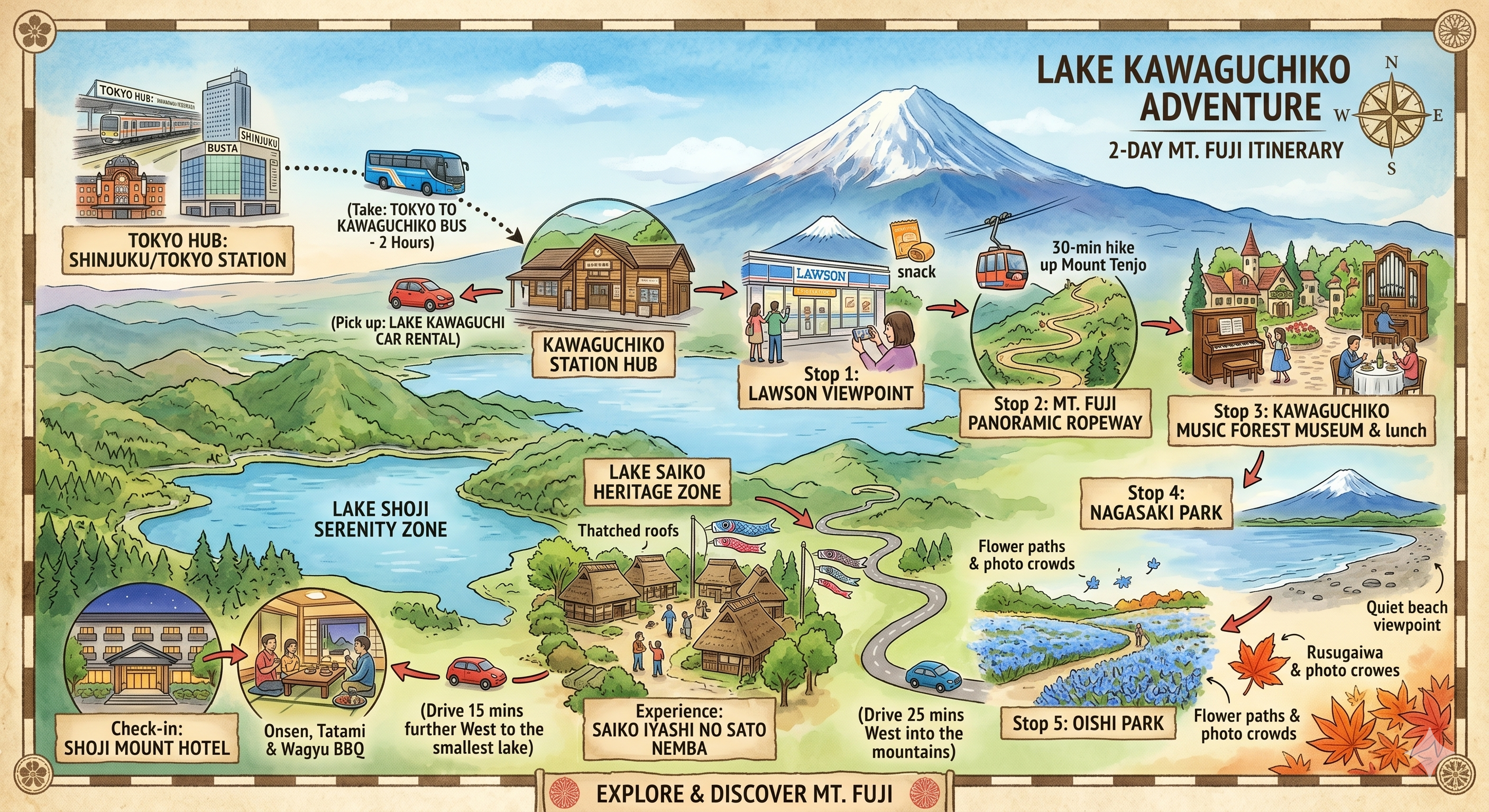
Lake Kawaguchiko to Lake Shoji 2-Day Route Map
| Stage & Location | Route Transit Details | Highlight Activities |
| Tokyo Hub (Shinjuku / Tokyo Station) | Take the Tokyo to Kawaguchiko Bus (Approx. 2 hours travel time) | Direct highway transit out of the city straight to the Fuji Five Lakes area. |
| Kawaguchiko Station Hub | Pick up your Lake Kawaguchi Car Rental | Secure independent wheels right at the station to easily escape the crowds. |
| Stop 1: Lawson Viewpoint | Drive from Kawaguchiko Station | Early morning photo stop for the iconic backdrop, grab snacks. |
| Stop 2: Mt. Fuji Panoramic Ropeway | Short drive along the lake | 30-minute uphill hike up Mount Tenjo (if ropeway or swing are closed). |
| Stop 3: Music Forest Museum | Drive along the northern shore | Explore manicured European gardens, catch a music box concert, and grab lunch. |
| Stop 4: Nagasaki Park | Continue west on northern shore | Visit the quiet, uncrowded pebble stone beach for clean, open views of Fuji. |
| Stop 5: Oishi Park | Continue west on northern shore | View sweeping flower paths. (Bonus: check out Rusugaiwa nearby if visiting in autumn for red maple leaves). |
| Lake Saiko Heritage Zone | Drive 25 minutes west into the mountains | Experience Saiko Iyashi no Sato Nemba to walk among traditional thatched-roof houses. |
| Lake Shoji Serenity Zone | Drive 15 minutes further west to the smallest lake | Check-in at the Shoji Mount Hotel for a cheap Mt. Fuji view room, onsen, and Wagyu BBQ dinner. |
📥 Unlock the Complete Interactive Map Pins! Want to take all the guesswork and planning stress out of your upcoming trip? Every single precise location, hotel, rental branch, hidden beach, and restaurant mentioned throughout this lake kawaguchiko itinerary is saved with exact, one-click GPS pins inside my Ultimate Tokyo Travel Guide. Subscribe to our free weekly travel newsletter below to have the complete interactive map folder sent straight to your inbox tonight!
Subscribe to our newsletter!
Final Summary Checklist for a Flawless Journey
- Transportation Priority: Book your tokyo to kawaguchiko bus tickets online 3 to 4 weeks prior to your trip to secure prime morning departure times out of Shinjuku.
- Arrival Strategy: Utilize a budget-friendly, cheap Friday night hotel with an efficient self-check-in system like Hotel Kainosato to maximize your early Saturday morning timeframe.
- Mobility Requirement: Do not rely on crowded public buses. Reserve a lake kawaguchi car rental to ensure you can move flexibly, carry your luggage easily, and escape the crowds.
- Visibility Planning: Always wake up early. Prioritize your most important outdoor photography stops before noon before the natural mountain clouds roll in and block the summit.
- Cultural Exploration: Make time to drive away from the commercial strip of Kawaguchiko to explore the ancient thatched houses and quiet walking paths of saiko iyashi no sato nemba.
- The Smart Stay Alternative: Search for your mt fuji view hotel cheap options away from the main tourist lake. Look to the smaller lakes like Lake Shoji for incredible ryokan-style dining, natural hot springs, and peaceful views at half the price.
Author

Get My Personal Travel Maps
Keep Reading: More Articles You'll Love
 Kawaguchiko Music Forest Museum: Alpine History, Antique Marvels, and Mount Fuji Views
  Fuji-Q Highland Guide: How to Beat the Crowd & Conquer Japan’s Craziest Coasters
  Tateyama Kurobe Alpine Route Guide: Snow Wall, Tickets & Toyama Day Trip
  A Guide to Niederhorn, Beatenberg and the Caves of Lake Thun
  Mount Fuji in Hakone: A Serene Getaway with Stunning Views of Mount Fuji
  Living in Tokyo vs Zurich – The Ultimate Expat Guide
  Why is Baumkuchen Popular in Japan? The Secret History of the “King of Cakes”