Solothurn looks like it should be a quiet town. Baroque facades, eleven church bells, a slow-moving Aare river, the kind of place you picture reading a book on a bench. And for most of the year, that picture holds up. But scattered through the calendar are pockets of time when this small city turns almost unrecognizably loud, and if you are trying to time a visit around one of them, or you simply want to know what all the fuss is about, this guide covers every major event Solothurn hosts across the year, in the order they actually happen.
January: Solothurner Filmtage
The year in Solothurn effectively starts with cinema. The Solothurner Filmtage, or Solothurn Film Festival, is the single most important event on the Swiss film calendar and one of the oldest film festivals in the country, founded in 1966. Every January, for eight days, the city’s cinemas fill with directors, actors, producers, and journalists who come to watch a curated selection of the year’s best Swiss feature films, documentaries, and shorts. The 2025 edition alone showed 91 feature films and 71 shorts across its program, and the festival regularly draws more than 60,000 admissions, a genuinely staggering number for a town Solothurn’s size.
What makes the Filmtage different from a typical red carpet festival is its role as a working meeting point for the industry rather than a glamour event. Panel discussions and public talks between filmmakers and audiences run throughout the week, the “Swiss Panorama” section showcases work from all four of the country’s linguistic regions, and the festival nominates the candidates for the Swiss Film Prize, whose ceremony now takes place separately in Lucerne. The next edition, the 62nd, runs from January 20 to 27, 2027. If you want to experience Solothurn as the Swiss film world sees it once a year, this is the week to book.
February: Solothurner Fasnacht
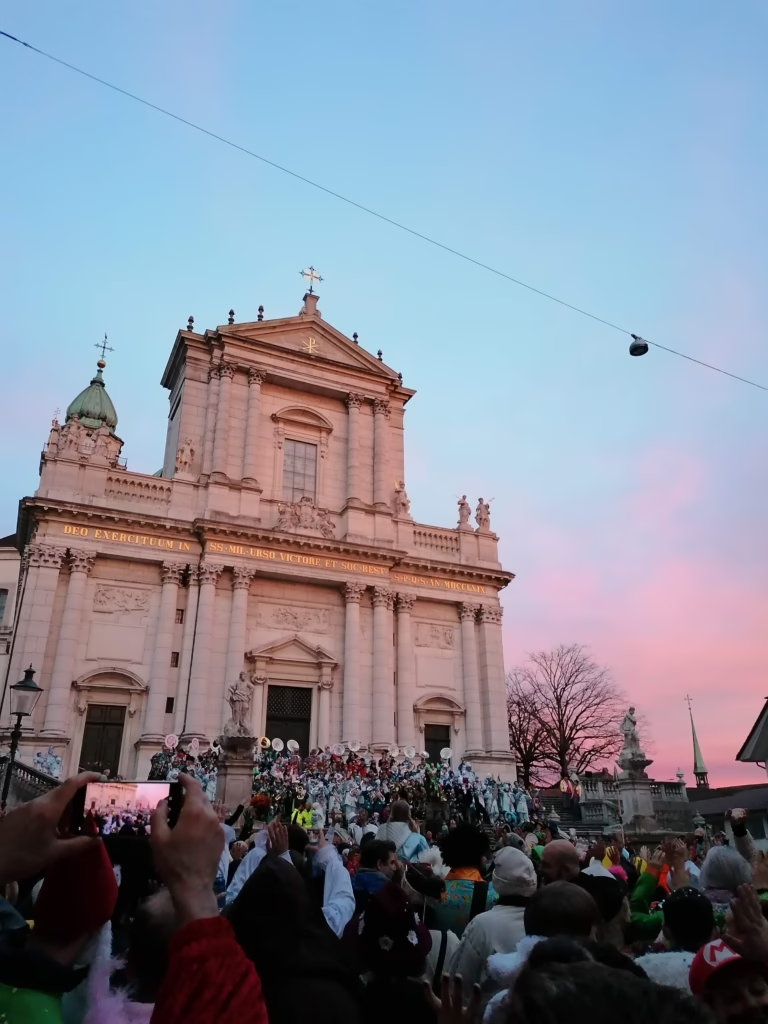
Roughly a month after the Filmtage crowd clears out, an entirely different kind of crowd takes over. Solothurn has held carnival parades since the 15th century, and the modern Fasnacht is one of the most authentic in Switzerland, built on tradition rather than tourism. It officially begins on Hilari, January 13, when members of the Narrenzunft Honolulu hold their general assembly in the Restaurant Zum alten Stephan, a custom that has run since 1888.
The week itself kicks off with the Chesslete at five in the morning, when costumed Chesslerinnen and Chessler in white nightshirts and pointed caps storm through the sleeping old town banging cowbells, rattles, and horns loudly enough to wake the entire city on purpose. From there, the week builds through a children’s parade, evening Guggenmusik concerts on the Marktplatz, packed Fasnacht balls in venues across town, and a full weekend where guest Guggen bands from outside Solothurn join the local ones for what locals simply call a “Gassenfasnacht,” a carnival that spills into every street and alley. The two big parades, the children’s parade and the Chesslete, draw around 30,000 visitors between them, with roughly 1,400 active participants marching, drumming, and driving decorated floats through the Bieltor gate and along the Hauptgasse. The 2026 edition ran February 12 to 18; the next full edition lands February 4 to 10, 2027.
March: Wyyso Wine Festival
A newer addition to Solothurn’s calendar, the Wyyso wine festival launched in 2024 and has already become a fixture. Held over four days in the Rythalle, it brings together roughly 20 to 28 wine importers, vintners, and estates from Switzerland and abroad, pouring several hundred wines for visitors to taste alongside food stands and a small stage of acoustic live music. The first edition in 2024 drew 2,500 visitors, and the festival has held that number steady since. The third Wyyso runs March 12 to 15, 2026, with the Thursday and Friday evening sessions running until 10pm and the weekend stretching later into the night.
April: Solothurner Kulturnacht
Every spring, Solothurn’s museums, galleries, theaters, churches, and smaller cultural venues throw open their doors for a single, single-ticket night of performances, exhibitions, and concerts across the entire old town. The Kulturnacht works on a simple principle: one ticket gets you into every participating venue for the night, so visitors wander between a chamber concert in one building and a gallery opening in the next. It is one of the lower-key entries on this list, but also one of the most rewarding for anyone who wants to see Solothurn’s cultural institutions, several of them centuries old, all activated on the same evening. The 10th edition took place in spring 2026, with the detailed program published shortly beforehand.
April to May: Solothurner Biertage
If Solothurn has a signature festival smell, it is hops. The Solothurner Biertage is the most traditional beer fair in Switzerland and the country’s largest, launched in 2002 and now drawing more than 40 breweries and over 200 individually brewed beers to the Rythalle grounds each spring. What sets it apart from a typical beer garden is the format: rather than a passive tasting hall, brewers staff their own stands and talk directly with visitors about their recipes, so the festival works as much as a meeting point for Switzerland’s craft beer scene as it does a public party. A day pass includes a reusable cup or the option to buy the annual festival glass, and the event now regularly runs alongside a dedicated Biernacht club night nearby. The 22nd edition ran April 30 to May 2, 2026, on the Schanzenplatz behind the Rythalle, drawing over 12,000 visitors as it does most years.
May to September: Streetfood Festival Solothurn
Solothurn is one of roughly 20 Swiss stops on the long-running Original Streetfood Festival tour, which has toured the country since 2015 and passed the 3 million visitor mark nationally by 2025. The Solothurn edition sets up on the Leporellobrücke each summer with around 45 to 50 international food trucks, a live music stage, a themed bar area, and a dedicated kids’ zone, and it has become one of the city’s most reliably well-attended free events, pulling in around 25,000 visitors across its run. Admission is free, portions are kept small and affordable so you can work through several cuisines in one evening, and the organizers have leaned increasingly into sustainability, converting festival food waste into biogas in partnership with the regional gas network. The 10th edition runs August 28 to 30, 2026, on the Leporellobrücke. A related but separate event, the Food Truck Festival, also sets up on the Schanzenplatz earlier in the summer with its own fairground rides, alpaca walks, and food trucks, most recently running June 4 to 7, 2026.
June: Stadtfest Solothurn

Every two years, Solothurn throws its biggest and most explicitly local party. Stadtfest Solothurn is the direct successor to the long-running Märetfescht, which wound down in 2019, and it launched under the motto “Üses Fescht, from Solothurn for Solothurn” with its first edition on June 28 to 30, 2024. That debut drew roughly 40,000 visitors across ten locations in the old town, with highlights including a synchronized swimming display in the Aare and rapper Manillio headlining the main stage.
The second edition ran June 26 to 28, 2026, expanding the program with a new youth zone, a performance from Eurovision 2026 Swiss representative Veronica Fusaro, a film music concert by the Stadtorchester Solothurn, pump foiling demonstrations on the river, and a 111 meter brunch table stretched across the Postplatz billed as the longest brunch the city has ever hosted. Because the festival runs free with no tickets or gates, and because it spreads across nearly the entire old town rather than a single fenced site, it doubles as the best possible introduction to Solothurn’s food and drink scene, since the city’s restaurants and cafés simply extend their tables into the festivities. The next edition is expected in 2028.
September: HESO Herbstmesse Solothurn
By early autumn, Solothurn switches from street festival mode into full trade fair mode. The HESO, short for Herbstmesse Solothurn, is the largest public trade fair in the canton and one of the biggest in the entire Espace Mittelland region, drawing around 100,000 visitors over roughly ten days each September. Nearly 300 exhibitors from trade, industry, retail, and gastronomy set up across the Schanzengraben grounds, alongside a rotating special exhibition, sports competitions, a petting zoo, and enough restaurants and bars around the fairground that the surrounding streets stay lively well into the night. Admission is completely free. The 2026 edition runs September 18 to 27.
Bike Days: Solothurn’s Festival That Moved On
If you have heard of the Bike Days and are wondering where to find them in Solothurn’s calendar, here is the honest answer: they are not there anymore. From 2009 to 2019, the Bike Days were Switzerland’s largest cycling festival, drawing over 20,000 visitors annually to the Schanzengraben and Chantierwiese grounds for mountain bike racing, BMX flatland contests, and a sprawling industry expo. After a Covid-era pause, organizers made the decision permanent in 2021, merging the Bike Days with Zurich’s Urban Bike Festival into a single new event called Cycle Week, now held each spring in Zurich. The organizers cited Zurich’s larger urban population and existing infrastructure as the deciding factors. It is a genuine loss for Solothurn’s event calendar, and locals still mention the old Schanzengraben atmosphere fondly, but if cycling culture is what you are after, Cycle Week in Zurich is now where to look instead.
Planning Your Visit Around Solothurn’s Events
A few practical notes if you are building a trip around any of these dates. Book accommodation early for Fasnacht, Stadtfest, and the Filmtage in particular, since all three fill the old town’s limited hotel rooms well in advance. Public transport is almost always the better option over driving, since the old town is largely car-free and several events, including HESO and the Biertage, are a short walk from the Baseltor stop or the main train station. Most of these events, Fasnacht, Stadtfest, the Streetfood Festival, and HESO among them, are either free or low-cost to attend, which is part of what keeps them feeling like genuine community events rather than commercial productions. And because Solothurn’s restaurant and café scene is already dense and excellent on an ordinary weekend, every one of these festivals comes with the added benefit of a city that already knows how to feed a crowd.
Which Solothurn Event Should You Plan Around?
If you only have room for one trip, let your interests decide. Film lovers should aim for the Filmtage in January, when the entire town becomes a working screening room for Swiss cinema. Anyone chasing a genuinely local, high-energy tradition should book Fasnacht in February, still one of the most authentic carnivals in the country. If a free, all-ages street party with music, food, and a Ferris wheel sounds right, wait for Stadtfest, even though it only happens every second year. Beer and wine fans have two dedicated weekends of their own each spring in the Biertage and Wyyso, and anyone who simply wants to eat their way through a lively evening should catch the Streetfood Festival in late August. Whichever weekend you choose, Solothurn’s baroque backdrop turns every one of these events into something that feels, for a few days at least, considerably bigger than its small-town size would suggest.
Author

Get My Personal Travel Maps
Keep Reading: More Articles You'll Love
 Best Restaurants in Solothurn: Why This Small Swiss Town Eats So Well
  Stadtfest Solothurn: Inside the Baroque Old Town’s Biggest Party
  Swimming in the Aare River: The Complete Guide to Switzerland’s Favorite Wild Swim
  A Magical Christmas in Switzerland: A First-time Experience with My Chinese Girlfriend
  Is Japanese Food Actually Chinese? The Surprising Origins of Japanese Cuisine
  Ballenberg Open-Air Museum: A Journey Through Swiss History
  Thun, Switzerland: Castle, Aare Surfing, Riverside Food and How Long to Stay