
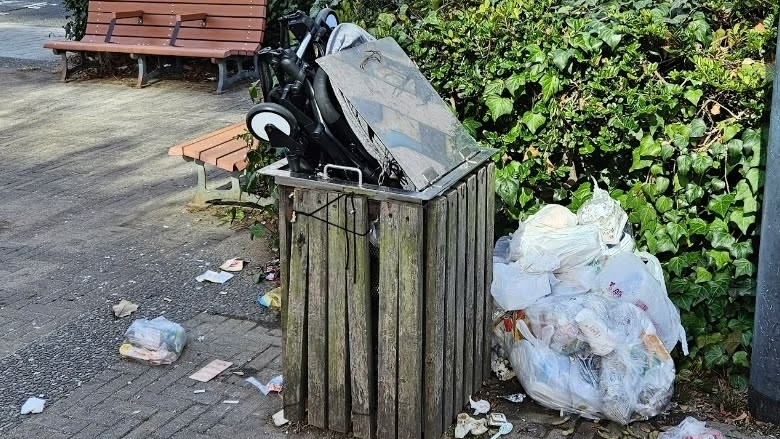
If you’ve ever visited Japan, you may have noticed something unusual: public trash cans are surprisingly difficult to find. Many travelers arrive expecting spotless streets and are then left wondering where they’re supposed to throw away an empty coffee cup, snack wrapper, or drink bottle.
The question “Why are there no public trash cans in Japan?” is one of the most common things visitors search for after arriving. The answer is rooted in a combination of history, public safety concerns, and cultural expectations surrounding personal responsibility for waste.
Japan is often praised for its clean streets, yet the reality is more nuanced. While many areas are remarkably tidy compared to cities in Europe or North America, litter can still be found, particularly around busy nightlife districts, train stations, parks, and less frequently cleaned side streets. During my own travels across Japan, I’ve occasionally seen discarded drink bottles, convenience store packaging, cigarette butts, and other waste that has not made its way into a bin.
One reason visitors notice this contradiction is that Japan removed many public trash cans during the 1990s and early 2000s. Following security concerns and changing waste management policies, local governments and transport operators significantly reduced the number of public bins available. As a result, residents and visitors are often expected to carry their trash home or dispose of it at designated locations such as convenience stores, train stations, or recycling points.
In this article, we’ll explore why public trash cans largely disappeared from Japan, whether the policy has achieved its intended goals, how it affects everyday life for residents and tourists, and what the situation looks like today.
Why Are There No Public Trash Cans in Japan?
To understand why public trash cans largely disappeared from Japan, you have to look back to one of the country’s most traumatic events. On March 20, 1995, members of the cult Aum Shinrikyo carried out a deadly sarin gas attack on Tokyo’s subway system. During the morning rush hour, attackers released the nerve agent inside crowded trains, killing 13 people and injuring thousands more. The incident shocked Japan and fundamentally changed how public safety was approached in transportation hubs and other public spaces.
In the years that followed, many train operators and local authorities removed public trash cans from stations and other high-traffic areas. The reasoning was straightforward: bins could potentially be used to conceal dangerous items or suspicious packages. By eliminating them, authorities believed they could reduce security risks and make public spaces easier to monitor.
This historical explanation is often repeated today, and many travel guides still present it as the primary reason why trash cans are difficult to find in Japan. However, the reality is more complex.
Nearly three decades have passed since the attack. Modern security technology has advanced dramatically, including surveillance cameras, improved policing, and sophisticated monitoring systems. At the same time, many other countries that have faced terrorist attacks continue to provide public waste bins while relying on modern security measures rather than removing them entirely.
As a result, a growing number of residents and visitors question whether security alone still justifies the lack of public trash cans. Critics argue that the policy shifts the burden onto individuals, leading people to carry rubbish for hours or search for convenience stores and train stations just to dispose of a drink bottle or food wrapper. Others point out that overflowing private bins and occasional littering may be unintended consequences of a system designed for a very different era.
The important distinction is that the disappearance of public trash cans is not simply a cultural tradition. It was largely a response to a specific security concern following the 1995 attack. Whether that justification remains convincing nearly thirty years later is the subject of ongoing debate among residents, travelers, and urban planners alike.
The Reality: Tokyo Is Not the Spotless City Many People Imagine
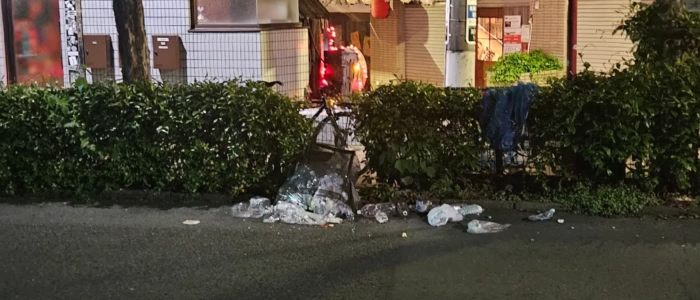

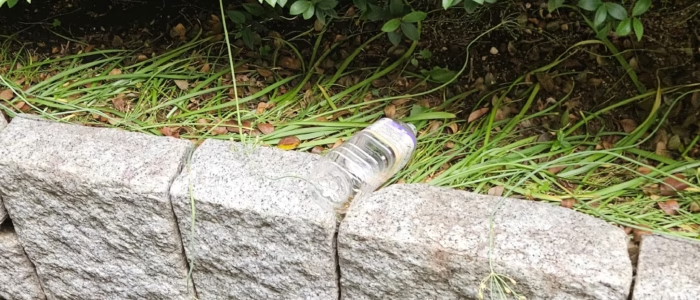
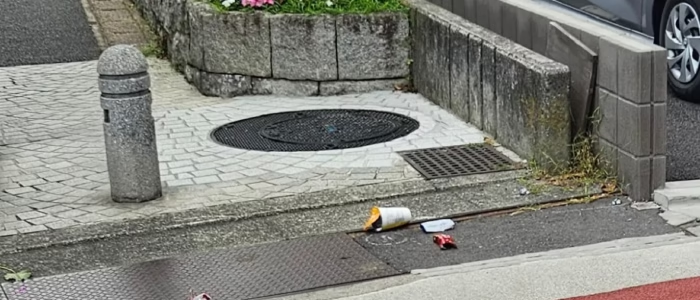
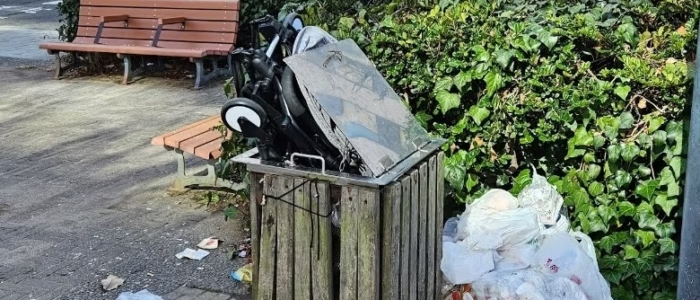
One of the most persistent travel myths about Japan is that its cities are completely free of litter. Social media often portrays Tokyo as a perfectly clean metropolis where nobody litters and public spaces remain spotless despite the near absence of public trash cans.
That image does not match my experience living in Tokyo.
The photos above were not taken in tourist nightlife districts or during special events. They were taken in ordinary neighborhoods where people live and work. During my daily walks, I regularly encounter cigarette butts, empty bottles, drink cans, convenience store packaging, disposable umbrellas, and other waste scattered along sidewalks, gutters, parking lots, and residential streets.
In fact, litter is common enough that most long-term residents stop noticing it. Once you pay attention, it becomes difficult to ignore. Empty cans beside vending machines, cigarette butts lining the curb, and discarded packaging caught in bushes are part of the everyday urban landscape in many parts of the city.
This does not mean Tokyo is a dirty city by international standards. Compared with many major cities around the world, litter levels are relatively low. However, there is a significant gap between reality and the image often presented online. Tokyo is not a spotless utopia, and the idea that Japan has somehow eliminated litter through culture alone is largely a myth.
The absence of public trash cans did not eliminate waste. People still buy drinks, snacks, cigarettes, and convenience store meals every day. Most dispose of their rubbish responsibly, but some do not. As a result, litter remains a visible part of daily life, particularly in residential neighborhoods and busy commercial areas.
The photos in this article reflect what I have personally observed while living in Tokyo. They are not rare exceptions carefully hunted down for dramatic effect. They are examples of a side of Japan that many travel influencers, tourism campaigns, and guidebooks rarely show.
Having lived in both Switzerland and Japan, I find Tokyo noticeably dirtier than most Swiss cities. While Japan is often praised online for its cleanliness, that reputation is largely relative to other large metropolitan areas. Compared to cities such as Zurich, Bern, or Lucerne, litter is more common on Tokyo’s streets, particularly in residential neighborhoods where public trash cans are almost nonexistent. The idea that Japan has solved the litter problem is a myth. It has simply chosen a different approach to managing it.
The Plastic Paradox: Japan’s Massive Consumption
One of the biggest contradictions in the debate over public trash cans is Japan’s enormous consumption of single-use plastics.
According to a widely cited 2019 report by The Guardian, Japan generates one of the highest amounts of plastic packaging waste per person in the world. Despite its reputation for environmental awareness and cleanliness, disposable packaging remains deeply embedded in everyday life.
You can see this almost everywhere. A visit to a supermarket or convenience store quickly reveals the scale of the issue. Fruits and vegetables are often sold on plastic trays wrapped in additional plastic film. Individually packaged snacks frequently come enclosed in multiple layers of packaging. Even products that appear simple at first glance may contain far more plastic than consumers expect.
This creates a striking contradiction. Japan generates enormous amounts of disposable packaging, yet offers very few public trash cans where people can dispose of it. Instead, residents and visitors are expected to carry their rubbish until they reach home, a train station, a convenience store, or another designated disposal point.
Most people follow these rules, but the system is not perfect. In my experience living in Tokyo, it is not difficult to find discarded bottles, cigarette butts, food packaging, and other litter in residential neighborhoods and commercial districts. The absence of public bins has not eliminated waste. It has simply shifted the responsibility for managing it onto individuals.
This is what makes the debate so controversial. Japan has built a society around convenience stores, vending machines, takeaway food, and heavily packaged consumer goods, while simultaneously providing very limited public infrastructure for disposing of the resulting waste. Whether that approach still makes sense nearly three decades after the removal of many public trash cans remains a question that many residents and visitors continue to ask.
Does the Terrorism Explanation Still Make Sense Today?
One of the most common explanations for the lack of public trash cans in Japan is the 1995 Tokyo subway sarin gas attack carried out by the Aum Shinrikyo cult. Following the attack, many train operators and local authorities removed public bins out of concern that they could be used to conceal dangerous items or suspicious packages.
At the time, those concerns were understandable. The attack shocked the nation and led to significant changes in how public safety was approached throughout Japan.
However, nearly three decades have passed since then, leading many residents and visitors to question whether the continued lack of public trash cans is still justified by security concerns alone.
Other countries that have experienced major terrorist attacks have generally taken a different approach. Rather than permanently removing public waste bins, many cities invested in additional security measures such as surveillance cameras, increased police presence, improved monitoring systems, and redesigned bins that are easier to inspect.
For example:
- London temporarily removed many bins after the 2005 bombings but later reintroduced them in modified forms.
- Madrid strengthened security measures following the 2004 train bombings while continuing to provide public waste infrastructure.
- Paris expanded security efforts after the 2015 terrorist attacks without permanently eliminating public bins throughout the city.
Security experts generally agree that determined attackers are not limited to a single method or location. Public bins are only one of many places where dangerous items could potentially be concealed. Modern counterterrorism strategies therefore tend to focus on surveillance, intelligence gathering, public awareness, and rapid response capabilities rather than relying solely on the removal of waste bins.
This is where the debate begins. While the 1995 attack helps explain why public trash cans disappeared in the first place, it does not necessarily answer whether their continued absence remains the best solution today.
For many visitors, the biggest surprise is that one of the world’s most densely populated and highly developed countries provides so few public places to dispose of everyday waste. As a result, the question has shifted from “Why were trash cans removed?” to “Does the original reason still justify their absence nearly thirty years later?”
The Hidden Cost of Litter
The lack of public trash cans does not simply shift the burden onto residents and visitors. It also creates costs for local governments and communities.
Even in a country known for cleanliness, litter still requires collection. Discarded drink bottles, cigarette butts, food packaging, and other waste must be removed from streets, parks, train station surroundings, and residential neighborhoods. This requires ongoing cleaning efforts, regular maintenance, and public resources.
The challenge is that waste does not disappear simply because public bins are unavailable. People continue to purchase drinks from vending machines, buy snacks from convenience stores, and consume takeaway food throughout the day. While most individuals dispose of their rubbish responsibly, some waste inevitably ends up in public spaces.
As a result, municipalities must invest in street cleaning and litter collection to maintain the clean image for which Japanese cities are known. The cleaner a city appears, the easier it becomes to overlook the amount of work taking place behind the scenes to keep it that way.
Critics of Japan’s no-trash-can policy argue that preventing litter should not rely entirely on individual behavior. Instead, they suggest that providing more public waste bins could reduce cleanup costs, improve convenience for residents and tourists, and make proper disposal easier in the first place.
This raises an important question: if cities already spend resources collecting litter and maintaining public spaces, would strategically placed public trash cans help reduce the amount of waste that ends up on streets, sidewalks, and other public areas?
What Other Countries Do Differently
One of the strongest arguments against Japan’s current approach is that other major cities have faced many of the same challenges, including terrorism, litter, tourism, and high population density, without largely eliminating public trash cans.
Instead of removing bins altogether, many cities have focused on making them safer and easier to manage.
- London reintroduced public bins after the 2005 bombings, often using transparent designs and extensive CCTV coverage.
- Paris continues to provide public waste bins throughout the city while relying on security measures, regular maintenance, and routine inspections.
- Singapore combines strict anti-littering enforcement with plentiful disposal options, making it easy for residents and visitors to throw away rubbish properly.
- Madrid maintains public waste infrastructure while using surveillance, policing, and regular collection schedules to keep public spaces clean.
These examples demonstrate that security and convenience do not have to be mutually exclusive. Modern cities around the world have shown that it is possible to provide public trash cans while still addressing safety concerns and maintaining clean streets.
This is what makes Japan’s situation unique. The question is no longer whether public bins can be operated safely. Many countries already do so successfully. The real question is whether Japan’s continued shortage of public trash cans remains the most effective solution nearly thirty years after the events that originally led to their removal.
For visitors wondering why there are no trash cans in Japan, the answer is not that alternatives do not exist. Rather, Japan has chosen a different path from most other developed countries, one that continues to spark debate among residents, tourists, and urban planners alike.
How Japan Could Fix the Problem (And Is Already Starting To)
Japan does not need to reinvent the wheel. Cities around the world have demonstrated that public safety and convenient waste disposal can coexist.
Modern solutions already exist. Transparent trash bins make suspicious items easier to identify. Smart bins equipped with sensors can alert sanitation workers when they are full. Regular collection schedules reduce overflow, while clear signage helps residents and tourists dispose of waste correctly. Combined with modern surveillance systems, these approaches allow cities to maintain both security and cleanliness.
In fact, Japan is not standing still. In recent years, local governments, train operators, and private companies have begun experimenting with new approaches to public waste management. Ahead of major international events and in response to growing tourism, some locations have reintroduced trash bins in carefully selected areas. Technology companies have also developed smart waste containers capable of monitoring fill levels and optimizing collection routes.
These efforts acknowledge an increasingly obvious reality: people generate waste wherever they live, work, travel, and consume. A modern city can encourage personal responsibility while still providing the infrastructure needed to dispose of rubbish properly.
The goal should not be to fill every street corner with trash cans. Rather, it should be to place bins strategically where people actually need them, such as near vending machines, convenience stores, parks, train stations, tourist attractions, and major pedestrian routes.
Japan has already shown that it can build some of the world’s most efficient transportation systems, safest cities, and most advanced public infrastructure. Solving the public trash can issue is not a technological challenge. The solutions already exist. The real question is whether policymakers are willing to accept that a problem created nearly thirty years ago may require a different approach today.
In practice, many people take their trash home or use the bins at convenience stores; see my Japan convenience store guide. For more surprises, read Japan travel myths vs. reality.
Trash in Japan: FAQ
Why are there no trash cans in Japan?
Most public bins were removed after the 1995 Tokyo subway sarin gas attack for security reasons, and many were never brought back. The habit of taking your rubbish home has since become the norm.
What happened in the 1995 Tokyo subway attack?
On March 20, 1995, the Aum Shinrikyo cult carried out a sarin gas attack on the Tokyo subway. In the years that followed, train operators and local authorities removed public trash cans from stations and other busy areas over fears they could hide a device.
Does the security reason still make sense today?
It is increasingly debated. Nearly three decades on, with widespread surveillance cameras and other modern security, many residents and visitors question whether the bins’ absence is still justified, especially since other countries that suffered attacks reintroduced bins with safer designs.
Where can I throw away trash in Japan as a tourist?
Look for bins next to vending machines and inside convenience stores, at train stations, and in shopping malls and department stores. Otherwise, carry a small bag and take your rubbish back to your hotel.
How do Japanese people dispose of trash without public bins?
Most people simply carry their rubbish home, which has become a social norm. In practice you can also use the bins beside vending machines and inside convenience stores, so day-to-day waste still gets disposed of, just not in street bins.
Does Japan use a lot of plastic packaging?
Yes. According to a widely cited 2019 report by The Guardian, Japan generates one of the highest amounts of plastic packaging waste per person in the world, which you notice immediately in the heavily wrapped goods at supermarkets and convenience stores.
How do other countries handle bins and security?
Many cities kept their bins but made them safer rather than removing them. London reintroduced public bins after the 2005 bombings using transparent designs and extensive CCTV, and Paris has long used transparent bag bins. It shows security and convenience can coexist.
Is Japan really as clean as people say?
Cleaner than many countries, but not spotless. As someone who has lived in Tokyo, I regularly see litter in ordinary neighborhoods. The clean image relies heavily on street cleaning and people carrying their own waste.
Conclusion: Why Japan’s Missing Trash Cans Are Becoming Harder to Justify
If you’ve ever wondered why there are no public trash cans in Japan, the answer lies in a policy that emerged after the 1995 Tokyo subway sarin gas attack. At the time, removing bins was seen as a reasonable security precaution. Nearly three decades later, however, Japan faces a very different reality.
Modern Japan is a country of convenience stores, vending machines, takeaway food, and extensive plastic packaging. Millions of residents and visitors consume products on the go every day, yet public places to dispose of waste remain surprisingly rare. As a result, people are often forced to carry their rubbish for hours, search for a convenience store bin, or wait until they return home.
The debate is no longer about why trash cans disappeared. The historical reason is well documented. The real question is whether the continued lack of public trash cans remains the best solution for a modern, densely populated society.
Many cities around the world have demonstrated that security and public waste disposal can coexist through improved bin designs, surveillance systems, and regular maintenance. Japan has already begun experimenting with some of these approaches, suggesting that attitudes may slowly be changing.
Having lived in Tokyo, I believe one of the biggest myths about Japan is that it has somehow solved the litter problem through culture alone. While Japanese cities are often cleaner than many major metropolitan areas around the world, litter still exists, public waste infrastructure remains limited, and the contradiction becomes increasingly obvious the more time you spend here.
Japan’s missing trash cans are not simply a curiosity for tourists. They are part of a broader discussion about public infrastructure, urban design, waste management, and quality of life. The original policy may have made sense in 1995, but whether it still makes sense today is a question worth asking.
And perhaps that is the simplest way to explain Japan’s trash can problem: the country successfully removed the bins, but it never removed the need for them.
Author

Get My Personal Travel Maps




Leave a Reply