When most travelers think of South Korea, destinations like Seoul and Busan immediately come to mind. Yet hidden between modern skyscrapers and bustling shopping districts lies a city that tells the story of nearly a thousand years of Korean history. Welcome to Gyeongju, often called “the museum without walls” and one of the most fascinating destinations in the country.
As the capital of the Silla Kingdom for an incredible 992 years (57 BCE to 935 CE), Gyeongju played a central role in shaping Korean culture, religion, architecture, and politics. Unlike many ancient capitals that were repeatedly relocated or rebuilt, Gyeongju remained the heart of one of East Asia’s most successful kingdoms for almost a millennium. This remarkable stability allowed the city to develop an extraordinary collection of royal tombs, Buddhist temples, palaces, observatories, and cultural treasures that continue to attract visitors from around the world.
Today, the UNESCO-listed Gyeongju Historic Areas preserve some of Korea’s most important archaeological sites. Walking through the city feels like stepping into a living history book, where grassy burial mounds rise from the city center, ancient stone pagodas stand proudly against the skyline, and centuries-old temples nestle among scenic mountain landscapes. Few places in Asia offer such a unique combination of history, culture, and natural beauty.
In this guide, I cover Gyeongju’s most famous sights, practical transport tips and the best seasons to visit South Korea’s ancient Golden Kingdom.
Donggung Palace and Wolji Pond: The Royal Moonlit Retreat

Donggung Palace served as the secondary palace of the Silla crown prince and was one of the kingdom’s most important venues for royal banquets, diplomatic receptions, and official state events. Once used to host foreign envoys and celebrate important national occasions, the palace offered a glimpse into the wealth and sophistication of the Silla Kingdom. Today, visitors can stroll through the beautifully reconstructed grounds and imagine the grand ceremonies that took place here more than a thousand years ago.
Historical Evolution
Commissioned by King Munmu in 674 CE following Silla’s unification of much of the Korean Peninsula, the palace complex was designed as a symbol of the kingdom’s newfound power and prosperity. The adjacent pond, now known as Wolji, was carefully landscaped to reflect Buddhist and Taoist ideals of paradise, creating a setting that combined political prestige with spiritual symbolism. For centuries after the fall of the Silla Kingdom, the site became known as Anapji, meaning “Pond of Geese and Ducks.” However, during a major archaeological excavation in 1974, researchers discovered pottery fragments bearing the original name “Wolji,” which translates to “Pond that Reflects the Moon.” This remarkable discovery led to the restoration of the site’s historic name and provided valuable insight into the sophisticated culture of ancient Gyeongju.
Architectural Logic
The centerpiece of the complex is an elegant artificial pond featuring three small islands, gently curved shorelines, and carefully positioned landscaping elements. The design follows ancient East Asian garden principles, ensuring that visitors can never view the entire pond from a single location. As a result, the space appears far larger than it actually is, creating the illusion of an endless body of water and enhancing the sense of tranquility and wonder. Archaeological excavations have revealed just how important this royal retreat once was. More than 33,000 artifacts were recovered from the pond’s sediment, including ceramics, ornaments, everyday objects, and a fascinating 14-sided wooden die believed to have been used by members of the royal court during drinking games. These discoveries provide a rare glimpse into both the ceremonial and recreational aspects of life within the Silla Kingdom’s elite circles.
- Location: 102 Wonhwa-ro, Inwang-dong.
- Best Time to Visit: Arrive 30 minutes before sunset to witness the nightly illumination, which is widely considered the most beautiful night view in South Korea.
Cheomseongdae: Asia’s Oldest Stone Science
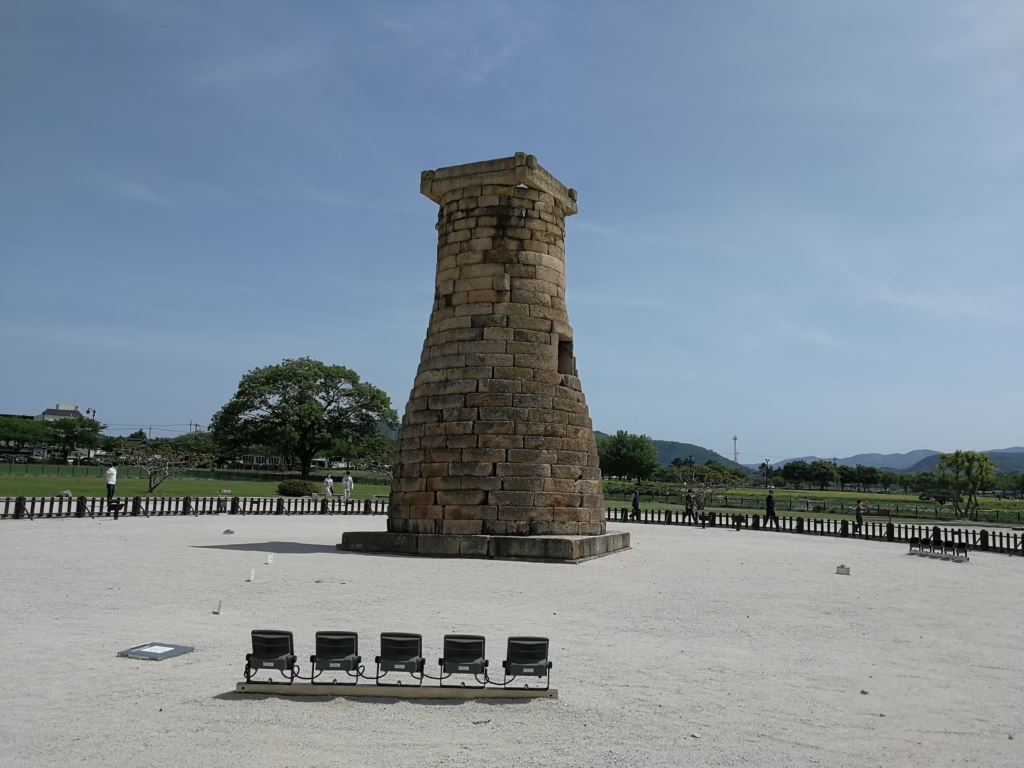
Cheomseongdae is one of Gyeongju’s most iconic landmarks and serves as a remarkable testament to the scientific achievements of the Silla Kingdom. Widely recognized as the oldest surviving astronomical observatory in East Asia, the stone structure demonstrates the advanced understanding of astronomy, mathematics, and engineering possessed by Silla scholars more than 1,300 years ago. Standing gracefully amid open fields and seasonal flower gardens, Cheomseongdae remains a powerful symbol of Korea’s long tradition of scientific inquiry and innovation.
Scientific Significance
Constructed during the reign of Queen Seondeok (632-647 CE), one of Korea’s most celebrated monarchs, Cheomseongdae was built to observe the movement of celestial bodies and predict important astronomical events such as solar and lunar cycles. These observations played a vital role in an agricultural society, helping determine planting and harvesting periods while also supporting the kingdom’s calendar system. Beyond its practical function, the observatory showcases the impressive scientific knowledge of the Silla era. Historians and researchers often describe the structure as a masterpiece of ancient engineering, with its proportions, stone arrangement, and architectural symbolism reflecting a sophisticated understanding of mathematics, astronomy, and the natural world.
- The Stone Count: It consists of roughly 365 stones, matching the number of days in a year.
- Layers of Meaning: There are 27 circular layers of stone, which historians believe honors Queen Seondeok as the 27th ruler of Silla.
- The Windows: The central window is placed such that it divides the tower into 12 layers above and 12 below, representing the 12 months and 24 solar terms.
Resilience and Engineering
Despite standing for more than 1,300 years, Cheomseongdae has survived centuries of weathering and numerous earthquakes that have affected the Korean Peninsula. Its remarkable durability is a testament to the engineering expertise of the Silla Kingdom. According to the Korea Tourism Organization, the observatory’s distinctive bottle-shaped design and broad foundation help distribute weight evenly and keep the center of gravity low. This ingenious construction method allows the stone blocks to absorb and adapt to minor ground movements, helping the structure withstand seismic activity while remaining largely intact for over a millennium. Today, Cheomseongdae continues to inspire visitors as both a scientific monument and an enduring symbol of Korea’s architectural ingenuity.
- Location: Inwang-dong (Central Gyeongju Historic Area).
- Getting There: Walkable from the Daereungwon Tomb Complex and the popular Hwangnidan-gil street.
Bulguksa Temple: The Land of Buddha

Bulguksa Temple is widely regarded as the masterpiece of Silla Buddhist architecture and represents one of South Korea’s most treasured cultural landmarks. Nestled on the slopes of Mount Toham, the temple showcases the artistic, spiritual, and engineering achievements of the Silla Kingdom at its height. Its elegant stone terraces, intricate wooden halls, and iconic pagodas have made it a symbol of Korean Buddhism for centuries. In recognition of its outstanding cultural and historical significance, Bulguksa was inscribed on the UNESCO World Heritage List in 1995 alongside the nearby Seokguram Grotto, cementing its status as one of the most important heritage sites in East Asia.
History and Construction
Although the origins of Bulguksa Temple date back to 528 CE, the magnificent complex visitors admire today began taking shape in 751 CE during the reign of King Gyeongdeok, when the temple underwent a major expansion and reconstruction. The project was overseen by Kim Dae-seong, a prominent statesman of the Silla Kingdom who envisioned the temple as a physical representation of the Buddhist “Land of Bliss,” a heavenly paradise where enlightenment and peace await the faithful. Every element of the complex, from its elevated stone terraces and graceful staircases to its carefully arranged halls and pagodas, was designed to symbolize the journey from the earthly world to a spiritual realm of harmony and enlightenment.
Key Treasures
- Dabotap and Seokgatap Pagodas: Located in the main courtyard, these two pagodas represent two different Buddhas. Dabotap is highly ornate and feminine, while Seokgatap is minimalist and masculine. They are so culturally significant that Dabotap is featured on the 10 won coin.
- The Sacred Bridges: Visitors enter the temple by crossing the Cheongun-gyo (Blue Cloud) and Baekun-gyo (White Cloud) bridges. These symbolize the 33 steps required to leave the earthly realm and enter the pure land of Buddha.
- Mineral Spring (Siksudae): Near the entrance, the dragon-headed fountain provides fresh mountain water. It is a traditional practice to drink from this spring to purify the spirit before entering the prayer halls.
- Location: 15-1 Jinhyeon-dong, on the slopes of Mt. Tohamsan.
- Transport: Take Bus #10 or #11 from the city center; the ride takes roughly 45 to 60 minutes.
More Highlights Worth Adding
Daereungwon Tomb Complex: a park of grass-covered royal burial mounds in the city center, including Cheonmachong, the only tomb you can enter. It is right next to Cheomseongdae and Hwangnidan-gil.
Seokguram Grotto: a granite Buddha in an artificial cave on Mount Toham above Bulguksa, also a UNESCO World Heritage site. Combine it with Bulguksa by bus or taxi.
Essential Travel Logistics
Reaching Gyeongju
Gyeongju is easy to reach thanks to South Korea’s high-speed rail and bus network, so you can visit either as a day trip or as a multi-day stop.
From Seoul, the KTX high-speed train reaches Gyeongju Station (formerly Singyeongju) in about two hours. From Busan, it takes less than an hour by train or intercity bus, which makes Gyeongju one of the most popular day trips from Busan.
- From Seoul: The KORAIL KTX high-speed train from Seoul Station to Gyeongju Station takes approximately 2 hours.
- From Busan:
- High-Speed Rail: Only 30 minutes from Busan Station via KTX or SRT.
- Intercity Bus: Takes about 50 minutes from the Busan Central Bus Terminal (Nopo).
Local Navigation
Most visitors arriving by KTX use Gyeongju Station (formerly called Singyeongju Station), the city’s high-speed rail hub about 15 to 20 minutes from central Gyeongju. From the station, frequent local buses such as #50, #51 and #70, as well as taxis, connect you with the historic center.
Once you arrive in downtown Gyeongju, exploring the city becomes remarkably simple. Many of the most famous attractions, including Cheomseongdae Observatory, Donggung Palace and Wolji Pond, Daereungwon Tomb Complex, and Hwangridan-gil, are located within a compact area and can be visited on foot. This walkable layout allows travelers to enjoy Gyeongju’s unique atmosphere at a relaxed pace while discovering centuries of history around almost every corner.
Recommended Seasons
- Spring (April): Thousands of cherry blossoms bloom around the Gyeongju Historic Area and Bomun Lake.
- Autumn (October-November): The foliage on Mount Toham (Bulguksa) turns brilliant shades of red and gold.
Gyeongju FAQ
What is Gyeongju known for?
Gyeongju was the capital of the Silla Kingdom for nearly a thousand years (57 BCE to 935 CE) and is often called a museum without walls for its extraordinary concentration of historic sites, including Bulguksa Temple, the Cheomseongdae observatory, and Donggung Palace.
What are the must-see sights in Gyeongju?
The essentials are Bulguksa Temple, the ancient Cheomseongdae observatory, and Donggung Palace with Wolji Pond, which is especially beautiful lit up at night. With more time, add the Seokguram Grotto and Bomun Lake.
Can you visit Gyeongju as a day trip from Busan?
Yes. The KTX takes about 30 minutes and the intercity bus about 50 minutes, so a day trip covering Bulguksa, Cheomseongdae, and Donggung Palace at night is very doable.
How many days do you need in Gyeongju?
One full day covers the central historic area and Bulguksa. Two days let you add the Seokguram Grotto, Bomun Lake, and a slower evening on Hwangnidan-gil.
Which train station do you use for Gyeongju?
KTX trains stop at Gyeongju Station, the former Singyeongju Station, outside the city center. Local buses and taxis reach downtown in about 15 to 20 minutes.
Continue Your South Korea Journey
Gyeongju’s ancient history is just one part of the story. Whether you’re heading to the mountains or looking for the best beaches, there is so much more to explore:
- The Big Picture: Start with my South Korea Insider Guide for an overview of every province.
- Northern Mountain Gateway: Discover Sokcho, the perfect base for exploring Seoraksan National Park.
- Southern Coastal Gems: Experience the quiet beauty and unique German Village in Namhae.
- West Coast Surf: Head to Mallipo for some of the best surfing and sunset views on the Taean Peninsula.
- Maritime Soul: Explore the vibrant fish markets and beaches of Busan.
- Jeongdongjin’s Edge of the World: Walk the dramatic Badabuchae-gil coastal trail and witness the world’s closest sunrise at the station where the rails meet the sea.
Not sure where to head next? View my full South Korea Destination Map to plan your perfect route across the peninsula.
Author

Get My Personal Travel Maps




Leave a Reply