Swiss Christmas markets are smaller than the famous giants in Germany, but they make up for it with old towns, lakes and mountains as a backdrop. From late November, almost every Swiss town lights up its squares, opens wooden huts and fills the air with the smell of Glühwein, raclette and roasted chestnuts. If you spend December in Asia instead, here is how Christmas in Japan compares.
I grew up in Solothurn and live in Switzerland again, so these markets are part of my winter. In Zurich I have been to the Wienachtsdorf at Bellevue and the market inside the main station. I have also been to the lakeside market in Montreux, the Sternenmarkt in Bern and, of course, the markets in my hometown. This guide lists all the big Swiss Christmas markets with their usual dates, explains what makes each one special and shows how to visit several of them by train.

Swiss Christmas Markets at a Glance
The table shows when each market usually runs, with this season’s dates (2026) in brackets. I update them every autumn when the organisers publish their programme, but always check the official website before you travel.
| Market | Where | Usually open (2026) | Best for |
|---|---|---|---|
| Zurich, Wienachtsdorf | Sechseläutenplatz at Bellevue | 3rd week of Nov to 23 Dec (19 Nov to 23 Dec) | Huts, ice rink, lake and opera house |
| Zurich, Christkindlimarkt | Main station hall | 3rd week of Nov to 24 Dec (19 Nov to 24 Dec) | Indoor market, rainy days |
| Zurich, Singing Christmas Tree | Werdmühleplatz | 3rd week of Nov to 23 Dec (19 Nov to 23 Dec) | Choirs in the evening |
| Zurich, Münsterhof | In front of the Fraumünster | 3rd week of Nov to 24 Dec (19 Nov to 24 Dec) | Old town atmosphere |
| Zurich, Dörfli market | Niederdorf | 3rd week of Nov to 23 Dec (19 Nov to 23 Dec) | Small stalls in old lanes |
| Basel | Barfüsserplatz and Münsterplatz | Late Nov to 23 Dec (26 Nov to 23 Dec) | Size and the cathedral square |
| Bern, Sternenmarkt | Next to the Federal Palace | Mid Nov to after Christmas (19 Nov to 27 Dec) | Fondue and a modern market |
| Bern, Waisenhausplatz | Old town | Late Nov to 24 Dec (27 Nov to 24 Dec) | Classic huts in the UNESCO old town |
| Montreux Noël | Lake promenade | 3rd week of Nov to 24 Dec (20 Nov to 24 Dec) | Lake Geneva and the mountains |
| Lausanne, Bô Noël | Several squares | Second half of Nov to 31 Dec (about 20 Nov to 31 Dec) | City centre squares, open until New Year |
| Geneva, Noël au Quai | Quai du Mont-Blanc | 3rd week of Nov to 24 Dec (19 Nov to 24 Dec) | Lakefront chalets |
| St. Gallen, Sternenstadt | Old town | Late Nov to 24 Dec (26 Nov to 24 Dec) | 700 stars above the streets |
| Lucerne | Old town | December to just before Christmas (3 to 21 Dec) | Combining with sightseeing |
| Einsiedeln | In front of the monastery | About 10 days from late Nov (27 Nov to 6 Dec) | A short, special market |
| Solothurn, Winter Wunderland | Dornacherplatz | Late Nov to 31 Dec (2026 to be confirmed) | Local winter village |
| Solothurn, Wiehnachtsmäret | Kreuzackerplatz by the Aare | 5 days before Christmas (16 to 20 Dec) | Crafts and a small-town feel |
When Do Swiss Christmas Markets Open?
Most Swiss Christmas markets open in the second half of November and close on 23 or 24 December. Zurich, Geneva and Montreux usually start first, around the third week of November. Basel and St. Gallen follow in the last week of November, and Lucerne and some smaller towns only start in December. A few markets stay open after Christmas, like the Sternenmarkt in Bern, Lausanne’s Bô Noël and the Winter Wunderland in Solothurn.
Opening hours are usually from late morning to the evening, with longer hours on Fridays and Saturdays. On 24 December most markets close in the afternoon, and almost everything is closed on 25 and 26 December.
Zurich: Six Markets in One City
Zurich has the most choice in Switzerland, with six markets running at the same time from 19 November. That makes it the easiest city for a Christmas market weekend.
Wienachtsdorf at Bellevue
The Wienachtsdorf on Sechseläutenplatz, right at Bellevue between the lake and the opera house, is the one I have been to. It is a whole Christmas village with around 100 wooden huts, an outdoor ice rink and plenty of food stalls, and the lights of the opera house and the lake make the setting special. It usually runs from the third week of November to 23 December, Monday to Saturday from 11 am to 10 pm and on Sunday until 8 pm. Bellevue is a big tram stop, so it is easy to reach from anywhere in the city.
Christkindlimarkt in the Main Station
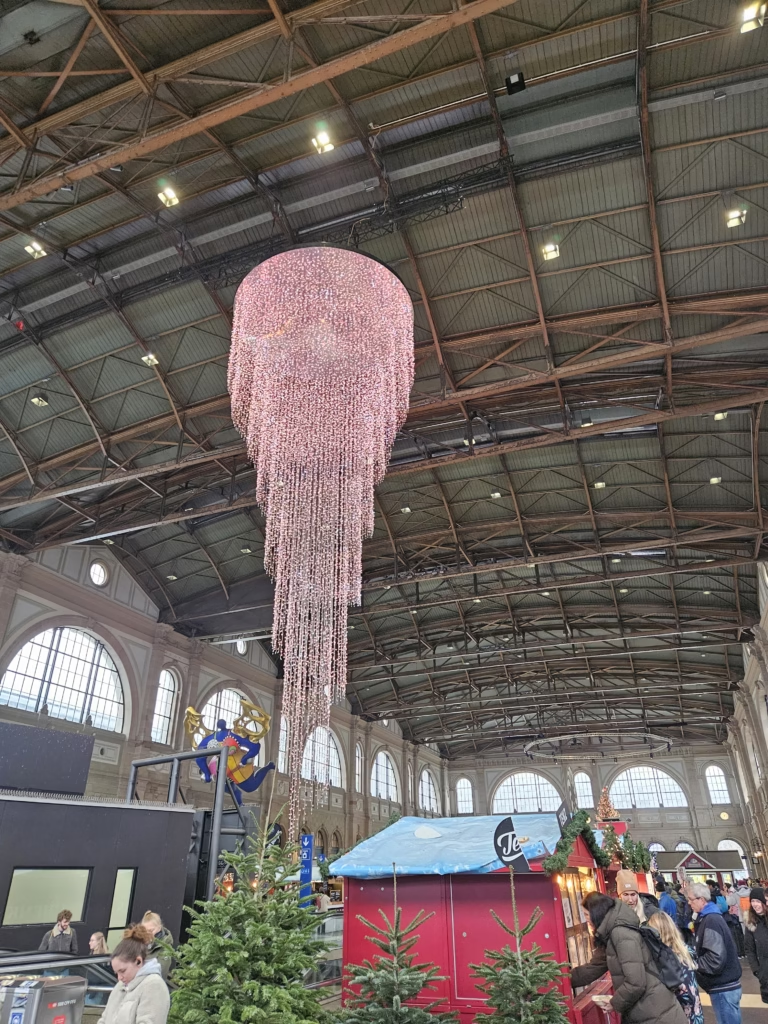
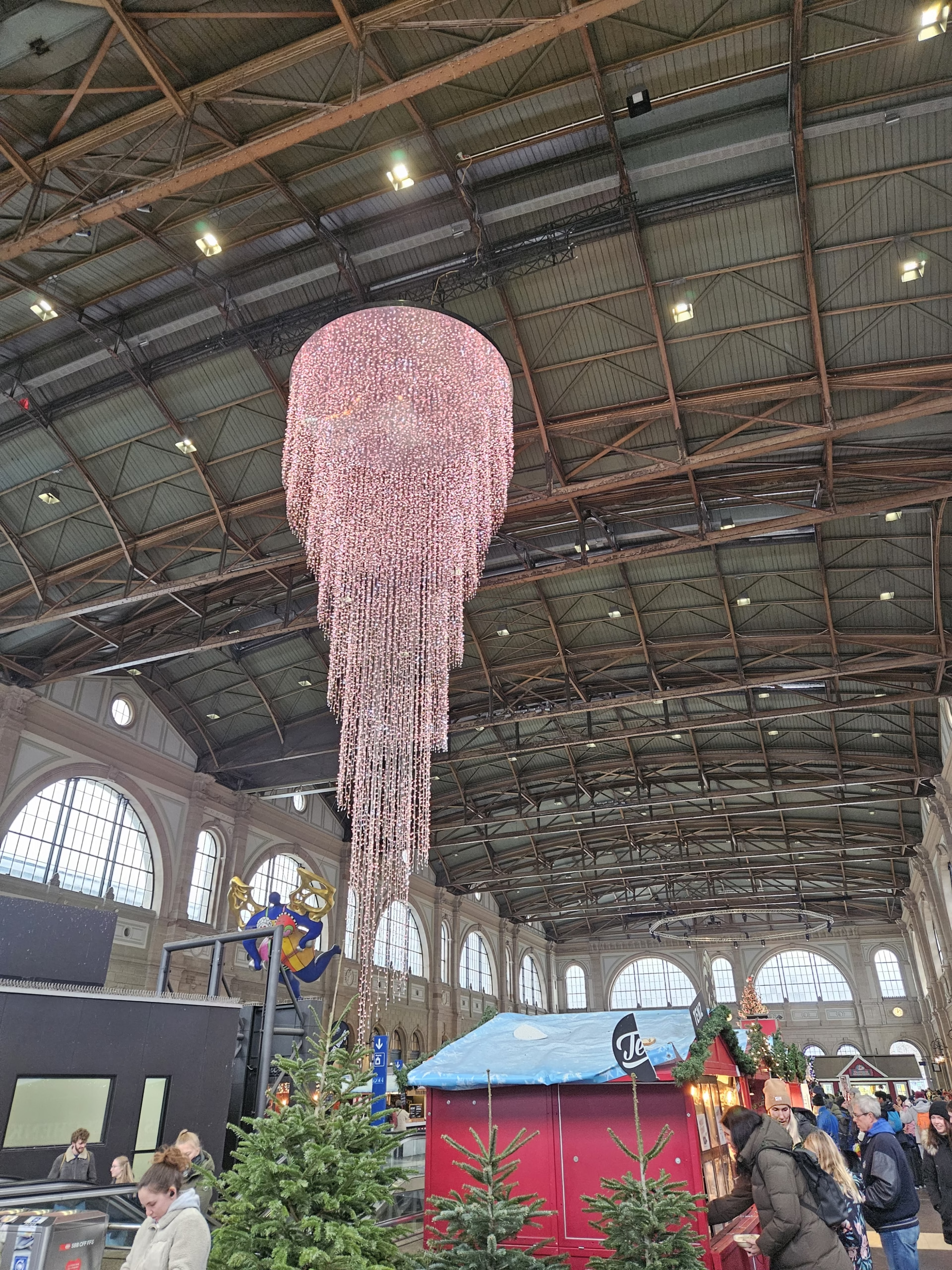
The other Zurich market I have been to is the Christkindlimarkt inside the main station hall. It is one of the largest indoor Christmas markets in Europe: red wooden huts and small fir trees stand right under the huge steel roof of the old station hall, with a giant sparkling light decoration hanging above them. Because it is indoors, it is the best choice on a rainy or snowy day, and it is easy to stop by between two trains. It usually runs until 24 December.
The other Zurich markets
- Singing Christmas Tree on Werdmühleplatz: choirs sing on a tree-shaped stage, usually around 5:30 pm and 6:30 pm, just off Bahnhofstrasse.
- Münsterhof: a classic market in front of the Fraumünster church, until 24 December.
- Dörfli market in the Niederdorf: stalls along the old town lanes towards Rosenhof.
- Europaallee: a more modern market concept behind the main station.
You can walk from the main station through the Niederdorf to Bellevue in about 15 to 20 minutes and see most markets on the way. Read my Zurich guide for more things to do in the city.
Basel: The Big Classic
Basel’s Christmas market is often called the most beautiful in Switzerland. It usually runs from late November to 23 December on two squares in the old town: Barfüsserplatz and Münsterplatz, in front of the red sandstone cathedral. Both are typically open daily from 11 am to 8:30 pm. Expect crafts, candles and ornaments, and try Basler Läckerli, the spiced honey biscuit of the city. On the last day they close earlier.
Bern: Sternenmarkt and the Old Town Markets
Bern has several markets, and the one I have been to is the Sternenmarkt next to the Federal Palace. It is a more modern market with wooden chalets and a fondue chalet, and it usually stays open until a few days after Christmas, so you can still go when most markets have closed. A few minutes away, the market on Waisenhausplatz (late November to 24 December) is the classic one, and there is also a small market on Münsterplatz in front of the cathedral. Bern’s arcades keep you dry on the way between them. See my Bern guide for the rest of the city.
Montreux Noël: Christmas on Lake Geneva
Montreux has the most scenic setting of all Swiss Christmas markets: wooden chalets along the lake promenade, with Lake Geneva and the mountains of the French Alps across the water. I have been there too. Montreux Noël usually runs from the third week of November to 24 December. It gets busy on weekends, so a weekday evening is calmer, and it is easy to combine with Chillon Castle, a short ride along the lake.
Lausanne and Geneva
Lausanne’s Bô Noël spreads over several squares in the city centre. It usually runs from late November until the end of December.
Geneva’s Noël au Quai sets up its chalets on the Quai du Mont-Blanc, right by the lake, usually from the third week of November to 24 December.
St. Gallen, Lucerne and Einsiedeln
- St. Gallen, Sternenstadt: from late November to 24 December, around 700 stars hang above the old town lanes, which gives the city its Christmas name. Combine it with the Abbey Library.
- Lucerne: the Lozärner Wiehnachtsmärt in the old town usually runs in December, until just before Christmas. Lucerne is compact, so you can combine the market with the Chapel Bridge and the old town. The Bourbaki Panorama is a good indoor stop on a cold day.
- Einsiedeln: one of the shortest markets, only about ten days from late November, with stalls in front of the huge baroque monastery.
Smaller towns hold their own markets too. Bremgarten in Aargau is known for one of the largest one-off markets for a few days in early December, and Stein am Rhein turns its painted old town into a Christmas town. Check their websites for the current dates.
Solothurn: Christmas in My Hometown
Solothurn is not a big Christmas market city like Basel or Zurich, but it is my hometown and the markets here feel local rather than touristy. In December the narrow old town lanes are lit up.
- Winter Wunderland on Dornacherplatz: a winter village just across the Aare from the old town, with huts for food and drinks. It usually runs from mid or late November until New Year’s Eve.
- Soledurner Wiehnachtsmäret: the Christmas market on Kreuzackerplatz by the Aare, for five days in the week before Christmas, from Wednesday to Sunday, open in the afternoon and evening.
- Chlausemäret: a small market on Friedhofplatz in the old town in early December, around Saint Nicholas Day.
- Weissenstein: Solothurn’s local mountain has its own winter programme when there is snow.
Solothurn is about half an hour from Bern and about an hour from Zurich and Basel by train, so it fits well into a Christmas market trip. My Solothurn guide has the sights, and for dinner see my list of the best restaurants in Solothurn.

What to Eat and Drink
- Glühwein: mulled wine, served hot in a mug with a deposit.
- Raclette: melted cheese scraped onto bread or potatoes.
- Fondue: many markets have a fondue chalet, like the Sternenmarkt in Bern.
- Bratwurst: grilled sausage with bread, a market classic.
- Marroni: roasted chestnuts in a paper bag.
- Läckerli and Lebkuchen: spiced biscuits and gingerbread.
- Hot chocolate and punch: non-alcoholic options for everyone.
Want more Swiss classics? See my Swiss food guide.
How Much Do Swiss Christmas Markets Cost?
Entry to the markets is free. Food and drinks are priced like everything else in Switzerland. Rough ranges:
- Glühwein: about CHF 5 to 8, plus a mug deposit
- Bratwurst with bread: about CHF 7 to 10
- Raclette portion: about CHF 8 to 12
- Bag of roasted chestnuts: about CHF 5 to 8
You get the deposit back when you return the mug, or you keep it as a souvenir. Most stalls accept cards and mobile payment. For overall budgets, read my Switzerland trip cost guide.
Tips for Visiting
- Go on a weekday evening: the lights look best after dark and there are fewer people than on Saturdays.
- Dress warmly and wear good shoes. Standing outside gets cold quickly.
- Bring a bag for the mug if you want to keep it.
- Book hotels early for December weekends, especially in Montreux, Basel and Zurich.
- Plan around 24 to 26 December: markets close and most shops stay shut on the 25th and 26th.
A Christmas Market Route by Train
Switzerland is small and the trains are frequent, so you can see several markets in a long weekend:
- Day 1: Zurich. Start at the station market, walk through the Niederdorf to the Wienachtsdorf at Bellevue and end at the Singing Christmas Tree in the evening.
- Day 2: Basel or Lucerne. Basel is about an hour from Zurich, Lucerne under an hour.
- Day 3: Bern and Solothurn. The Sternenmarkt and the old town markets in Bern, then about half an hour by train to Solothurn for the Winter Wunderland.
- Day 4: Montreux. About an hour and a half to two hours from Bern, for the lakeside market and Chillon Castle.
With a Swiss Travel Pass all these trains are covered. Travel times are approximate, so check the SBB timetable for your dates.
Frequently Asked Questions
What is the biggest Christmas market in Switzerland?
Basel is usually described as the most beautiful classic market, and the Christkindlimarkt in Zurich’s main station is one of the largest indoor markets in Europe. Zurich as a city has the most markets, with six at the same time.
When do Christmas markets in Switzerland start?
Zurich, Geneva and Montreux usually open around the third week of November, Basel and St. Gallen in the last week and Lucerne in December. Most close on 23 or 24 December.
Are Swiss Christmas markets open after Christmas?
A few are. The Sternenmarkt in Bern usually runs until a few days after Christmas and Lausanne’s Bô Noël until 31 December. Solothurn’s Winter Wunderland usually stays open until New Year’s Eve.
Which Swiss Christmas market is best?
Basel for the classic old town market, Zurich for choice, Montreux for the lake and mountain setting and Bern for a mix of old town charm and a modern market. If you want something local and less touristy, add a smaller town like Solothurn.
Can I visit several markets in one day?
Yes. Zurich has six markets within walking distance, and Bern and Solothurn are only about half an hour apart by train.
Are Swiss Christmas markets expensive?
Entry is free, but food and drinks cost more than in neighbouring countries. Plan about CHF 20 to 40 per person for a few snacks and drinks.
Final Thoughts
Swiss Christmas markets are a cosy way to see the country in winter. Pick one big city market, like Zurich or Basel, and add a smaller town for contrast. For more seasonal ideas, read about Christmas in Switzerland.
Author

Get My Personal Travel Maps



Leave a Reply