
The first time I bought a cake from a vending machine, near the Nitori store in Shinjuku, I understood that vending machines in Japan are not just for drinks. Later, in Naha, I stood in front of a machine selling sriracha sauce. Japan has millions of these machines, and some of them sell things you would never expect: hot soup, frozen dumplings, beer, art and even dessert. In this guide I share the unusual vending machines I have found myself, explain how to use and pay at them, and show which weird ones are worth looking for on your trip.
Below are the unusual vending machines I have used or seen myself during my years in Japan, a few famous ones you can look for, and the practical stuff: how many machines there are, why they are everywhere, how to pay, what the red and blue labels mean, and why some of them give away drinks for free after an earthquake.
Why does Japan have so many vending machines?
Japan has a lot of vending machines, but the number is shrinking. According to the Beverage Research Institute (Inryo Soken), Japan had about 1.95 million soft drink vending machines at the end of 2025, the first time the number fell below 2 million since its records began in 1995. The peak was in the mid 2010s, at around 2.4 million. Count all types together (food, tickets, cigarettes, coin lockers and other automated machines) and market research estimates put the total at close to 3.9 million.
Why so many? A few reasons work together:
- Safety. In most countries a box full of cash on the street gets broken into. In Japan, vandalism and theft are rare enough that machines can stand on quiet country roads, in front of houses and next to rice fields.
- Land and labour. Space in cities is expensive and staff are hard to find. A machine needs one square metre and no employee.
- Extra income for landowners. Many machines stand in front of private houses. The owner gets a share of the sales for providing the spot and electricity.
- Convenience culture. Japan loves things that are available anytime, anywhere. If you want to understand that mindset, my Japan convenience store guide is the other half of the story.
- Technology and design. Japanese makers developed machines that can sell hot and cold drinks from the same unit, which made them useful all year round.
The drop in numbers comes from rising prices, cheaper drinks in supermarkets and convenience stores on every corner. Operators are removing machines that do not earn enough and replacing others with smarter, cashless models.
The unusual vending machines I have seen in Japan
These are all machines I have seen or used myself. None of them is a “museum piece” you need to hunt for; they are part of normal life, which is what makes them so fun.

Ice cream vending machines
Ice cream machines are common at stations, shopping centres and highway rest areas. The most famous ones sell Glico’s Seventeen Ice, in flavours that change with the seasons. On a hot summer day in Tokyo this is one of the small joys of walking around the city.
You will find these ice cream machines near station exits, inside shopping malls and at rest areas on the expressways. The flavours rotate with the seasons, so it is worth checking what is new each time you pass one.
Sriracha sauce in Okinawa
In Okinawa I came across a vending machine selling sriracha sauce. Okinawa has a strong American influence because of the US bases, and the local food culture mixes Japanese, Ryukyu and American ideas, so a hot sauce machine somehow fits. My Ishigaki and Miyakojima trip shows more of the islands.
The one I found was in Naha. If Okinawa is not on your route, there is also a sriracha vending machine in Ikebukuro in Tokyo.
Muji products inside Muji stores
Muji has vending machines inside some of its own stores, which sounds strange at first. Why would a shop sell things from a machine when the shelves are right there? The idea is speed: drinks, snacks and small daily items you can grab without queuing at the till. It is a very Japanese way of saving 30 seconds.
Cake from a vending machine
Yes, cake. Cake vending machines, often selling cake in a jar or a can, have become popular in Japan in the last few years, especially at stations. The cake is layered with cream and fruit inside a sealed container so it survives the drop. It is surprisingly good and makes a fun present.
I bought mine from a cake vending machine near the Nitori store in Shinjuku.
Beer in hotels and near liquor stores
Beer vending machines still exist, but you mostly find them inside hotels, often on the same floor as the ice machine, and next to small liquor stores. Outdoor alcohol machines have become rare because of concerns about minors buying alcohol. Many of the remaining ones are switched off late at night and in the early morning. In business hotels, a cold can of beer from the machine down the corridor is part of the experience. If you are into beer, my guide to craft beer in Japan takes you further than the vending machine.

Cigarette vending machines and the taspo card
Cigarette machines are one of the most interesting examples of Japanese problem solving. To stop minors from buying cigarettes, Japan introduced the taspo card in 2008. It was an IC card, similar to Suica, with one purpose: proving that the holder is at least 20 years old, Japan’s legal age for smoking. Without the card, the machine would not sell you cigarettes. For tourists this meant cigarette machines were basically useless.
Taspo no longer exists. The service ended on 1 April 2026, because the mobile network that the card readers used was shut down. Since then, many cigarette machines have disappeared, and the remaining ones need other ways to check age. As a tourist, do not count on buying cigarettes from a machine; convenience stores are the easy option, where you may need to confirm your age on the screen at the till.
More weird vending machines in Japan (worth looking for)
I have not used all of these myself, but they are well known and many travellers look for them:
- Canned oden: the classic weird Japan example, warm canned oden (fish cakes, egg, konjac in broth), famously found in Akihabara.
- Frozen food machines: frozen gyoza, ramen and even restaurant dishes. These spread quickly in recent years because restaurants used them to sell outside opening hours.
- Dashi soup: bottles of dashi stock from machines, popular in western Japan.
- Umbrellas and phone chargers: practical machines at stations for sudden rain or a dead battery.
- Mystery machines: you pay a fixed price and get a random item, a lottery in a box.
- Art: on Naoshima, the art island in the Seto Inland Sea, I found a vending machine that is part of the art experience. My Naoshima art island guide has the full trip.
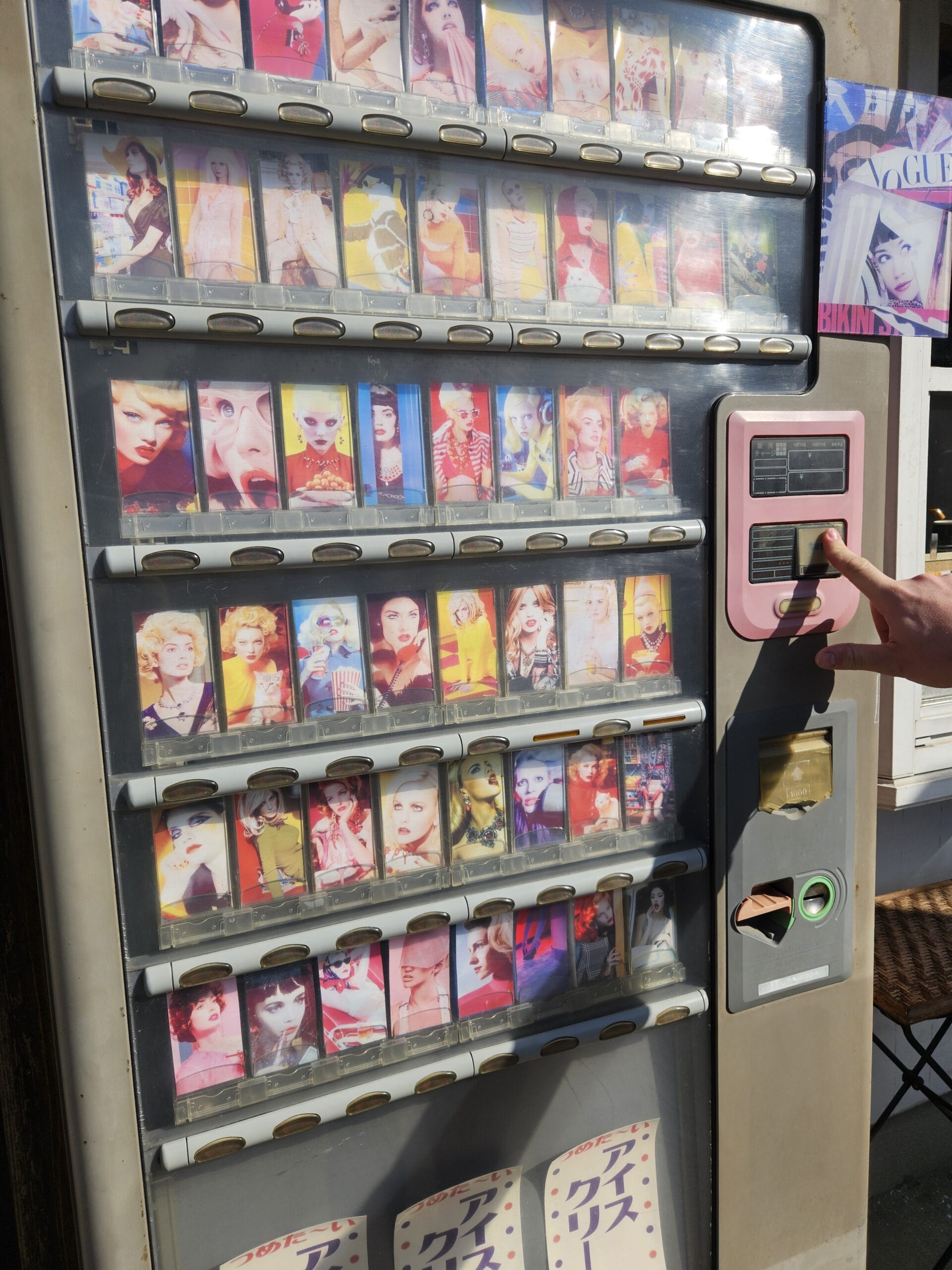
And then there are the capsule toy machines, gashapon, which are a world of their own and deserve a separate trip to the many gacha shops in Akihabara and Ikebukuro.
Hot or cold? How to read a Japanese vending machine
Japanese drink machines are easy once you know the colour code:
- Red label under the drink, often with the word atatakai (あたたかい): hot. Yes, hot coffee, tea and even corn soup come out of the same machine.
- Blue label, tsumetai (つめたい): cold.
- A red urikire (売切) light means sold out.
Hot drinks appear in autumn and disappear in spring, so the selection changes with the season. A hot can of milk tea or corn soup on a winter evening is something you will remember. Be careful: hot cans really are hot, so hold them by the top.
Prices for drinks are typically about 130 to 200 yen, a bit more at tourist spots, mountain tops and theme parks, where the operator has to bring stock up by truck or cable car.

How to pay: coins, IC cards and smartphones
Nearly every machine accepts 10, 50, 100 and 500 yen coins and 1,000 yen notes. Many newer ones also accept IC cards like Suica and PASMO: you just tap the card on the reader. This is the easiest way for tourists, because you never need coins. My Suica guide explains how to get one, including on your iPhone.
Some machines accept QR code payments or credit cards, but not many. Older machines in the countryside are often coin only, so keep some change.
Bonus tip: there are rarely rubbish bins on Japanese streets, but next to vending machines there is usually a recycling box for cans and bottles. Use it only for drinks bottles and cans, not general rubbish.
Disaster support vending machines: free drinks after an earthquake
This is my favourite fact about Japanese vending machines. Some machines are registered as disaster support vending machines. In normal times they are ordinary drink machines. After a major earthquake or other disaster, they can be switched to free mode, so people can take drinks without paying. Some also have an electronic message board that shows emergency information.
One recent example is in Ako City, Hyogo Prefecture, where the city and a company called Earth Corporation set up machines near evacuation shelters that sell drinks and emergency food normally and open for free after a strong earthquake or an evacuation order. Because the stock is constantly sold and refilled, nothing expires. It is a clever idea: the emergency supply pays for itself.
These machines are part of why Japan feels so prepared for disasters, along with apps, drills and emergency kits. My article on whether Japan is living in the future looks at that mix of high tech and very traditional ideas.
Are vending machines in Japan safe and clean?
Yes. The drinks are sealed cans and bottles, the machines are serviced regularly, and food machines are checked by the operators. Machines are so common and so well maintained that most people never think about it.
You will sometimes see machines with very cheap drinks, around 50 to 100 yen. These usually sell small brands or stock close to its best before date. That is perfectly fine; just check the date on the can if it matters to you.
Frequently Asked Questions
How many vending machines are there in Japan?
About 1.95 million soft drink machines at the end of 2025, according to the Beverage Research Institute. Including all types, the estimate is close to 3.9 million.
Why are there so many vending machines in Japan?
Low crime, expensive land, few workers, extra income for landowners and a strong culture of convenience. Machines that sell both hot and cold drinks also work all year round.
Can tourists buy cigarettes from vending machines in Japan?
Not easily. Until 2026, machines required a taspo age card that tourists did not have. Taspo ended on 1 April 2026 and many machines were removed. Buy cigarettes at a convenience store instead.
Can you pay with Suica at vending machines?
Yes, at most newer machines in cities. Look for the IC card reader near the coin slot. Countryside machines are often coin only.
What are the weirdest vending machines in Japan?
Cake in a jar or a can, canned oden, frozen gyoza, dashi soup, sriracha sauce and art machines like the one on Naoshima are some of the most unusual.
Do Japanese vending machines give free drinks during disasters?
Some do. Disaster support vending machines can be switched to free mode after a major earthquake, so people can get drinks without paying.
Do Japanese vending machines sell beer?
Yes, but mostly inside hotels and next to liquor stores. Many outdoor alcohol machines have been removed, and remaining ones often switch off at night.
Vending machines are one of those small things that make daily life in Japan feel different. For more of these, have a look at the weird things I noticed while living in Tokyo.
Get My Personal Travel Maps


Leave a Reply