This post contains affiliate links. If you book through them, I may earn a small commission at no extra cost to you. More about this.
Prague has a split personality, and it’s a good one. By day it’s one of the most beautiful cities in Europe: Gothic spires, golden domes, and Baroque churches packed into a walkable old town. By night it turns into one of the most efficient party cities on the continent, with an entire nightlife district you can bar-hop without ever needing a taxi. Add in a food scene built around serious Czech butchery, a candlelit medieval feast eaten entirely with your hands, and a day trip that ends with you driving an actual tank, and you get a city that works equally well for a quiet long weekend or a full group celebration.
This guide covers all of it: the landmarks worth building your day around, where to eat, where to go once the sun goes down, and two experiences worth planning your whole trip around if you want something out of the ordinary. If Prague is one stop on a longer European trip, it pairs well with a weekend in Budapest a few hours down the Danube, or you can bookend it with something calmer like a layover afternoon in Florence or a day walking Rome. For the wider region, check out our Europe hub.
Quick answer: Prague is worth 3 to 4 days minimum. Base yourself near Wenceslas Square or the Old Town for walking access to the National Museum, St. Vitus Cathedral, and the Dlouhá street nightlife strip. Budget roughly 300 CZK for the National Museum, 100 CZK for St. Nicholas Church, and 450 CZK for the Prague Castle circuit that includes St. Vitus Cathedral. For food, go to Čestr for a sit-down steak dinner and Kantýna for a cheaper, faster butcher-counter meal. For something out of the ordinary, book the medieval feast at V Krále Brabantského and spend a day driving tanks and shooting at a former military base just outside the city.
Prague at a Glance
- Time needed: Three to four days for the city, five if you add the medieval feast and a day trip
- Best base: Wenceslas Square or the edge of the Old Town, walkable to sights, food and nightlife
- Currency: Czech koruna (CZK), not the euro, though cards are widely accepted
- Cheaper than: Paris, London or Vienna for food, beer and mid-range activities
- Don’t miss: Prague Castle and St. Vitus Cathedral, a butcher-shop steak dinner, and Dlouhá street at night
- Book ahead: Castle tickets in high season (May to September) and any tank-driving day trip
Prague by Day: Three Landmarks to Build Your Route Around
Prague’s old town is compact enough to cover on foot, and three buildings in particular are worth planning your route around. Below each one you’ll find what it actually costs to get inside, when to go, and how to reach it, not just what it looks like from the outside.
The National Museum

Walking up from Wenceslas Square, the National Museum (Národní muzeum) sits at the top like it’s guarding the city. The Neo-Renaissance building was designed by architect Josef Schulz and finished in 1891, though the museum itself as an institution dates back to 1818, making it one of the oldest in Central Europe. It’s taken damage twice in its history, once during the fighting in 1945 and again during the 1968 invasion (bullet scars from that second event are still visible on the columns facing Wenceslas Square if you know where to look), and it went through a decade-long reconstruction that wrapped up in 2018, timed to the museum’s 200th anniversary.
Inside, the collection runs from natural history to Czech cultural history, spread across a historical building and a connected new building, with an underground passage between the two that has its own exhibition. The standout for most visitors is the cupola at the top of the historical building, reachable by a short climb, with one of the better panoramic views over Wenceslas Square and the old town roofline.
Practical details worth knowing before you go:
- Opening hours: Daily, 10:00 to 18:00, with extended hours to 20:00 on Wednesdays. Always check the museum’s own site for holiday closures before you plan around it.
- Ticket price: Around 300 CZK for a standard adult ticket, with reduced pricing for students and seniors and free entry for children up to 15. The ticket typically also covers entry to several smaller National Museum branches around the city, including the Czech Museum of Music, within a several-day window, so it’s worth checking what else is included before you throw the ticket away.
- Getting there: The Muzeum metro station (lines A and C) sits directly beneath the building, and the same-named tram stop is a few steps away, so this is one of the easiest major sights in Prague to reach.
- Best time to visit: Late afternoon, when the golden dome catches the low light and the building glows against the sky, especially from across the square looking up the length of Wenceslas Square.
Čestr, one of the two restaurants covered below, sits just around the corner on Legerova street, close enough that this square does double duty as both a sightseeing stop and a dinner reservation.
Tours and tickets in Prague
Prague rewards wandering on foot, but the headline sights and the day trips out of the city go more smoothly with a ticket booked ahead. You can book a Prague Castle ticket or a day trip and browse other Prague tours and tickets on Klook below.
St. Nicholas Church, Malá Strana
Across the river in Malá Strana, Malostranské náměstí is anchored by the Baroque façade of St. Nicholas Church (Kostel sv. Mikuláše), with its golden “IHS” monogram glowing above the entrance. Don’t confuse it with the other St. Nicholas Church on Old Town Square across the river; this is the bigger and more architecturally important of the two. Construction ran from 1673 to 1755, spanning three generations of the Dientzenhofer family of architects, and the result is regarded as one of the finest Baroque buildings north of the Alps. The dome alone is 20 metres across, and the interior climbs to nearly 50 metres, making it the tallest indoor space in Prague.
Mozart is said to have played the church’s organ during his 1787 stay in Prague, and a requiem mass in his honor was reportedly held here in December 1791, shortly after his death, a detail that draws a steady stream of classical music fans on top of the usual sightseeing crowd. The church still hosts organ and orchestral concerts year-round on that same historic instrument.
Practical details worth knowing before you go:
- Opening hours: Generally 9:00 to 17:00 or later depending on the season, with last entry roughly 15 minutes before closing; check locally as hours shift around religious services and concerts.
- Ticket price: Around 100 CZK for the church interior, with a separate, roughly 200 CZK ticket for the bell tower, a 215-step climb that was once used as a Prague watchtower and, later, as a Communist-era surveillance post looking out toward the nearby Western embassies.
- Getting there: Trams 12, 20, and 22 all stop at Malostranské náměstí, and it’s about a 5-minute walk from Charles Bridge, making it an easy add-on if you’re already crossing the river on foot.
- Best time to visit: Late afternoon or just before sunset if you’re climbing the bell tower, for the best light over the Lesser Town rooftops.
It’s a short walk from U Mecenáše, a wine bar tucked into the cellar passage right next to the church, a good option if you want a quieter drink before heading into the old town for the evening.
St. Vitus Cathedral, Prague Castle

Nothing quite prepares you for walking around a corner inside Prague Castle and having St. Vitus Cathedral suddenly fill the entire sky. The Gothic spires, flying buttresses, and forest of pinnacles make it feel less like a building and more like something that grew out of the ground. Construction began in 1344 under Charles IV, led first by architect Matthias of Arras and then by Peter Parler, and it took nearly 600 years to actually finish, with the final sections completed only in 1929. The nave runs 124 metres long, it’s the burial site of Bohemian kings including Charles IV himself, and the Czech crown jewels are kept inside behind a door with seven separate locks, each held by a different official; opening it requires all seven to agree.
Look for the stained glass window by Art Nouveau painter Alfons Mucha in the third chapel on the north side, one of the most photographed details inside the cathedral and a sharp contrast to the surrounding Gothic stonework.
Practical details worth knowing before you go:
- Opening hours: The cathedral generally follows Prague Castle’s historical buildings schedule, roughly 9:00 to 17:00 from April to October and 9:00 to 16:00 from November to March, with last entry around 20 minutes before closing. Sunday mornings are usually closed to visitors for services.
- Ticket price: The nave itself is free to enter, but the historical core (the choir, royal tombs, and the climb up the Great South Tower) requires the Prague Castle Main Circuit ticket, around 450 CZK for adults, which also covers the Old Royal Palace, St. George’s Basilica, and Golden Lane, and stays valid for two consecutive days.
- Getting there: The Malostranská metro station (line A) or tram lines up to Pražský hrad or Pohořelec are the easiest approaches; from either stop it’s a walk uphill through the castle courtyards to reach the cathedral itself.
- Best time to visit: Go on a clear day if you can, and go early. Even with a crowded courtyard, the scale of the place quiets everyone down for a minute, but arriving right at opening gives you a real shot at photographing the west façade without a wall of tour groups in front of it.
Where to Eat: Čestr and Kantýna
Prague’s food scene runs on two things: butchers and beer, and both of the restaurants below are run by the same group, Ambiente, which has more or less mastered the “serious Czech meat, casual setting” formula.
Čestr
Čestr is a steakhouse on Legerova street, close to the National Museum at the top of Wenceslas Square. It’s named after the Czech spotted cattle breed (Český strakatý skot) it specializes in, and the menu runs through dozens of cuts of aged Czech beef alongside proper Czech classics like beef tartare, duck confit, and a very serious mashed potato. It’s a good pick for a first dinner in the city: unpretentious, loud, full of locals, and consistently excellent meat.
Kantýna

Kantýna is a former Art Nouveau bank building turned into a self-service butcher-shop-meets-canteen just off Wenceslas Square, and it works equally well for lunch or dinner. You grab a paper tally card at the door, order meat by weight straight from the butcher counter, pick your sides, and everything gets marked on your card until you pay on the way out. It’s noisy, it’s cheap by Prague-center standards, and you’ll hear more Czech than English around you, which after a day of sightseeing crowds is exactly what you want.
Between Čestr and Kantýna you get the two ends of Prague’s meat culture in one trip: a sit-down steakhouse experience and a stand-in-line, point-at-the-cut butcher hall. Both sit within easy walking distance of Wenceslas Square, so it’s simple to alternate between them depending on the day.
Prague Nightlife: The Dlouhá Street Strip
Once the sun goes down, central Prague nightlife funnels toward one street: Dlouhá, in the Old Town, a two-minute walk from the Old Town Square. It’s dense enough that you can bar-hop the entire street without a single long walk between venues.
- James Dean is a 1950s American-diner-themed bar sitting right in the middle of the Dlouhá cluster, all neon, leather booths, and rockabilly energy. Small, loud, and a good place to start the night before the crowds build up.
- Moon Club is the newest and most polished stop on the strip: a restored former bank turned into a 400-person club with a dance floor, a bar under a glass “night sky” roof, and lounge seating if you need a breather between rounds. Good cocktails, good sushi if you’re hungry, proper club energy once it fills up.
- Fear Bar is a horror-movie-themed cocktail bar a short walk over toward New Town rather than directly on Dlouhá, split into a main bar area plus a “Vampire Room” and “RIP Lounge.” Low lighting, staff in horror makeup, and a genuinely different vibe from anywhere else on this list. A good stop if your group wants something weirder than another generic club.
- Karlovy Lázně, near Charles Bridge, is the multi-floor superclub that regulars sometimes describe as having “seven levels” of party, though it’s officially built across five distinct themed floors inside a former 15th-century spa house, everything from an oxygen bar to an ice bar to a robot cocktail maker. It’s touristy and it’s huge, and it’s still worth one visit just for the scale of the place.
Treat Dlouhá less like a single destination and more like a bar crawl route. Pick a rough starting point (James Dean is a good one), work through the cluster, and finish the night at Karlovy Lázně if you still have the energy for five floors of dancing.
For comparison, this kind of dense, walkable nightlife district has a similar “everything within one block” energy to Taipei’s nightlife scene or the bar-hopping culture of Tokyo’s nightlife districts, just swapping izakaya lanes for Baroque side streets and craft cocktails for unfiltered Czech beer and absinthe.
A Medieval Feast Worth Building a Night Around
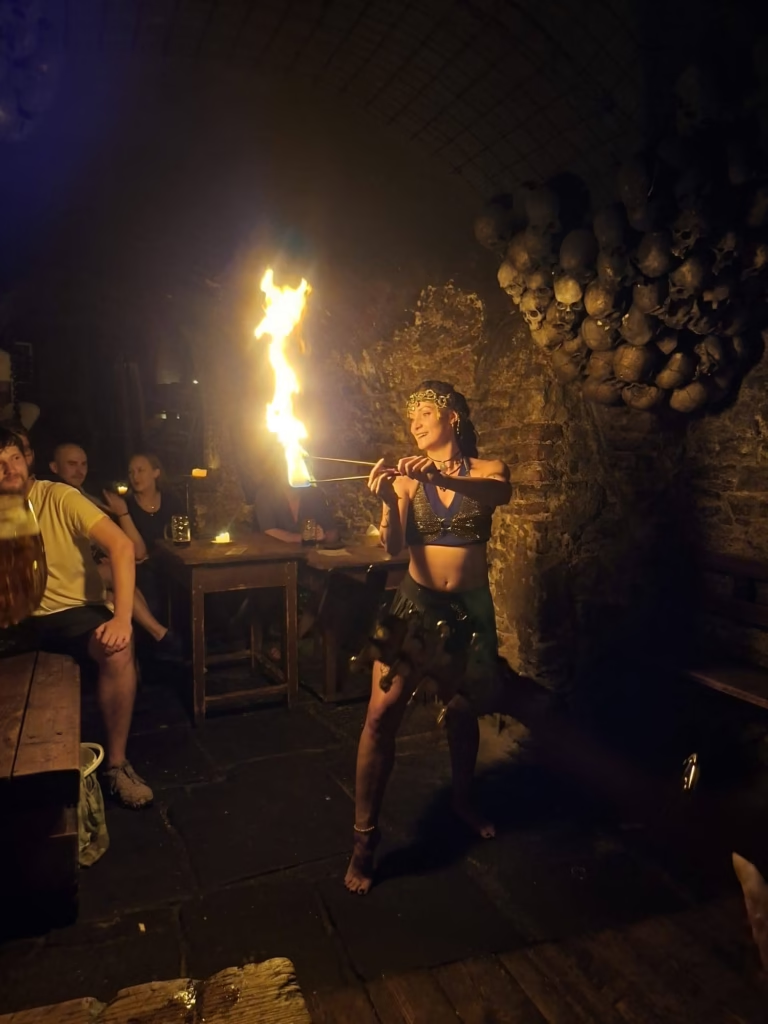
If you want one dinner in Prague that turns into an actual event rather than just a meal, book the Royal All Inclusive Package at Středověká krčma V Krále Brabantského (“The Medieval Tavern at the King of Brabant”), tucked away on Thunovská street just below Malá Strana. It’s a strong pick for any group celebration, a bachelor or bachelorette party included, but it works just as well for a family trip or a group of friends who just want a different kind of night out.
The Setting
The tavern is dark, lit mostly by candles and torches, with long communal wooden benches instead of individual tables. It’s the kind of “mysterious place to sit,” as the menu itself puts it, where a medieval show unfolds right in front of you and you end up talking to whichever strangers happen to be sitting across the table. Expect the whole bench, often a mix of nationalities who’ve never met before, to turn into one loud, mead-fuelled conversation by the second hour. That’s exactly the vibe the format is built for.
What’s Included

The 19:00 to 22:00 medieval show runs through belly dancers, sword-fighting demonstrations, a juggler, a fire show, and live historical music, all happening between courses. You’re welcomed with a shot of honey mead the moment you sit down, and from there the food doesn’t stop:
- Welcome drink: almond honey mead
- Amuse bouche: homemade liver paté with cranberries and almonds
- Starter: a selection of Czech and Slovakian cheese and meat, salad, and traditional Prague cooked ham with honey, mustard, and horseradish
- “Venison from Czech forests and groves”: deer ragout cooked in red wine, served with Carlsbad dumplings
- Main course: smoked pork ribs, honey pork ribs, chicken wings, chicken thighs, and shredded duck, with potatoes, corn, and a homemade plum-and-garlic sauce
- Something sweet: homemade pie, homemade chocolate ice cream, and fruit
- Digestive: a selection of Czech schnapps
All of it, down to the ribs, is eaten with bare hands. No cutlery in sight. Combined with the candlelight and the noise of the crowd, it stops feeling like a themed restaurant experience after about twenty minutes and starts feeling like an actual medieval feast.
Drinks are unlimited for the length of the package: the tavern’s own dark and light unfiltered beer, Pilsner Urquell, mead, non-alcoholic drinks, coffee, and tea. One thing worth knowing going in: they will not automatically bring you water. Ask twice if you have to, and ask early if you want a jug on the table. On the other end of that same coin, a second or third ask for something can sometimes turn into a round of absinthe shots on the house, and don’t be alarmed if a shot listed under a name like “meth” shows up on the menu. It’s a herbal Czech liqueur, not the substance, worth clarifying for anyone startled by the name.
At 2,390 CZK per person, roughly what you’d pay for a mid-range dinner-and-show combo in most Western European capitals, it’s not the cheapest meal in Prague, but given that it replaces dinner, drinks, and entertainment for an entire evening, it’s genuinely good value.
A Day Trip Outside the City: Tanks, Guns, and an Old Army Vehicle Collection
For something completely different from the old town, spend a day at a former Soviet-era military base outside Prague, driving tanks and shooting a lineup of rifles and pistols.
This is a well-established activity on the Prague circuit, run by several operators from a decommissioned Czechoslovak army site, usually 35 to 50 minutes outside the city depending on where you’re staying. From a hotel just off Wenceslas Square, like the Grandium Hotel Prague, the drive out takes a little over an hour.
The base itself is genuinely impressive if you have any interest in military history: a hangar packed with an enormous collection of Cold War-era vehicles, Soviet tanks, armored personnel carriers, trucks, and equipment, all kept in running condition. After a safety briefing, one person from the group gets behind the controls of an actual tank and drives it across rough, muddy terrain while everyone else rides along or watches. The attached shooting range lets you fire under the supervision of certified instructors, several of whom are former Czech army or police.
A few practical notes:
- You cannot be drunk when you arrive. Instructors will turn away visibly hungover-drunk guests, which is worth planning around if this is part of a bigger group trip.
- Alcohol is very much part of the package on the other end. Once the driving and shooting are done, beers are handed out, and after a morning of adrenaline that beer hits differently than it normally would.
- Book this earlier in your trip rather than later, ideally during the day, so you’re fresh enough to actually remember driving a tank, and so it doesn’t clash with a big night out at the medieval feast or on Dlouhá street.
Practical Tips for Planning Your Trip
- Base yourself centrally. Staying near Wenceslas Square puts you within walking distance of Čestr, Kantýna, and the Dlouhá nightlife strip, and keeps pickup for the tank-driving day simple.
- Spread out the big nights. If you’re doing both the medieval feast and a full Dlouhá street crawl, put a day between them so you actually enjoy both.
- Do the tank driving and shooting in daylight, not after a night out. You need to be sober to participate, and it’s a far better experience with a clear head.
- Pace the Dlouhá street crawl. It’s genuinely possible to hit five or more venues in one night just by walking from door to door, so treat it as a marathon, not a sprint.
- Ask for water early at the medieval dinner if you want it on the table. Ask twice and the staff will very likely bring you a round of absinthe shots instead, that’s not a joke, it’s just how the place runs.
Frequently Asked Questions About Visiting Prague
How many days do you need in Prague?
Three to four days is enough to cover the main sightseeing (the National Museum, Prague Castle, St. Vitus Cathedral, St. Nicholas Church, and the Old Town), fit in a proper dinner or two, and still have a night free for the Dlouhá street nightlife strip. Add a fifth day if you also want to do the medieval feast and the tank-driving day trip without rushing either one.
What is the best area to stay in Prague?
Around Wenceslas Square or the edge of the Old Town is the most practical base. It puts the National Museum, Čestr, Kantýna, and the Dlouhá street bars all within walking distance, and it keeps pickup times short for day trips outside the city, like the tank-driving and shooting experience.
Is Prague expensive?
Prague is noticeably cheaper than Western European capitals for food, beer, and mid-range activities, though sightseeing tickets and central hotels have risen closer to Western European prices in recent years. A sit-down steak dinner, a full day of tank driving and shooting, or an all-inclusive medieval feast still tend to cost less in Prague than the equivalent experience in Paris, London, or Vienna.
What is the medieval dinner in Prague called?
The best-known version is the Royal All Inclusive Package at Středověká krčma V Krále Brabantského, a themed tavern near Malá Strana that runs a multi-course feast, unlimited drinks, and a live medieval show with belly dancers, sword fighting, and fire performance, all eaten without cutlery.
Where is the best nightlife in Prague?
Dlouhá street in the Old Town is the center of central Prague’s nightlife, with bars and clubs like James Dean, Moon Club, and Fear Bar packed within a two-minute walk of each other. Karlovy Lázně near Charles Bridge is the largest multi-floor superclub in the city if you want one big venue instead of a bar crawl.
Do you need to book Prague Castle and St. Vitus Cathedral tickets in advance?
It’s not strictly required, but booking the Main Circuit ticket online in advance saves time in high season (May to September), when ticket office queues can run long. The cathedral’s free-entry nave doesn’t need a ticket, but the historical core, including the royal tombs and the South Tower, does.
Is the tank driving and shooting experience safe for beginners?
Yes. These day trips run with certified instructors, many of them former Czech army or police, and include a mandatory safety briefing before anyone touches a vehicle or a firearm. The one firm rule across every operator is that you cannot be visibly drunk when you arrive, so it’s best scheduled earlier in a trip rather than after a big night out.
Prague manages something that a lot of European capitals can’t: it’s a genuinely beautiful, history-heavy city during the day, and one of the most efficient party cities in Europe once the sun sets. Whether you’re planning a quiet cultural weekend, a food trip built around butcher counters, or a full group celebration, Prague can flex to match. If it has you thinking about where else in Europe delivers on both culture and chaos, our guides to Budapest and Switzerland are good next stops to plan around.
Author

Get My Personal Travel Maps


Leave a Reply