
If you’ve got a few hours in Florence between trains, you can see far more of the city than you’d think, and without dragging your luggage across cobblestones the whole time. We had roughly six to seven hours here while waiting for our connecting train to Rome, and rather than sit it out at the station, we turned the layover into one of the best afternoons of our trip. This is the exact walking loop we did, whether it’s your first time in Florence or your tenth: art, river views, a proper Tuscan lunch, and the leather shopping the city is famous for, all on foot and all within easy reach of the station. There are some personal stops along the way too, including where we ate and where my girlfriend found the leather bag she’d been hunting for.
The first thing to sort out is your bags. We used the station’s official left-luggage office at Santa Maria Novella, which is on the ground floor near platform 16 and open daily from 6am to 11pm. It cost us about €6 to store a bag for the first five hours, which covered our whole window comfortably, and the handover took only a few minutes. There are cheaper booking services dotted around the station too, like Bounce and Radical Storage, if you’d rather reserve ahead, but the official office was right there and simple enough that we didn’t bother. Walking out hands-free made the difference between a stressful rush and an actual visit, so whatever you do, drop the bags first.
🕒 Start: 10:00 AM – Santa Maria Novella
With our bags gone, the day started right where we were standing, at Santa Maria Novella itself. It’s easy to walk straight out of the station and miss it, but the church is worth the twenty minutes before you go anywhere else, and it sets the tone for everything the walk is about. This is one of the most important Gothic churches in Tuscany, built by Dominican friars whose construction began around 1278, and it’s been collecting masterpieces ever since.
Start in the piazza and look up at the facade, because it’s older at the bottom than the top. The lower Romanesque half, with its marble tombs and arches, dates to the fourteenth century, while Leon Battista Alberti completed the upper section, finishing it in 1470. Look for the S-shaped marble scrolls he added to bridge the tall nave with the lower aisles, a solution so elegant it got copied on churches for centuries afterward. The whole front is one of the earliest times Renaissance proportions were worked into a Florentine church facade, so it’s worth a slow look before you go in.
Inside, head for Masaccio’s Holy Trinity, painted on the wall of the left aisle. Masaccio produced it between 1425 and 1427, and it’s routinely called one of the first paintings to use true mathematical perspective, built so the painted chapel seems to recede right into the solid wall. He leaned on the perspective experiments of his friend Brunelleschi to pull it off. Two things to notice that most people miss: the Virgin Mary is painted as an older woman rather than the usual young girl, and at the base there’s a skeleton on a tomb with an inscription that translates to roughly “I once was what you are, and what I am you will be.” It’s a quiet memento mori hiding under one of the most famous paintings in the city. There’s a good story here too. Vasari covered the fresco over in the sixteenth century, which accidentally preserved it, and it was rediscovered by chance during renovations at the end of the nineteenth century.
Look up in the centre of the nave for the huge painted crucifix by Giotto. It’s an early work from around 1280, which makes it the oldest major artwork in the church, and it’s a big one at over five and a half metres tall. Giotto meant it to hang in open air so you’d picture the real crucifixion, and even now it stops people in their tracks.
The piece I’d send you to find, though, is the wooden crucifix by Brunelleschi in the Gondi Chapel, just left of the main altar. He carved it around 1410 to 1415, and it comes with one of the best stories in Florence. Brunelleschi had seen the crucifix his friend Donatello made for Santa Croce and told him it looked like a farmer on a cross, so Donatello challenged him to do better, and this is Brunelleschi’s answer. One legend even has Donatello so stunned when he first saw it that he dropped a basket of eggs he was carrying for their dinner. It’s a small, restrained piece by the same man who later raised the dome over the Duomo, and seeing his work at this scale is its own reward.
Before you leave, walk through the cloisters next door. The oldest is the Chiostro Verde, the Green Cloister, built in the mid-fourteenth century and named for the green-toned frescoes Paolo Uccello painted on its walls. They’re calm and largely empty, a complete change of pace from the station you just walked out of, and a good place to slow down for a minute.
One last stop, and it’s just around the corner. The Officina Profumo-Farmaceutica di Santa Maria Novella is one of the oldest pharmacies in the world, traced back to 1221 when the Dominican friars began making balms and remedies from the herbs in their garden. Even if you buy nothing, step inside. The vaulted, frescoed rooms, antique bottles, and old marble counters feel far more like a museum than a shop, and the soaps, rosewaters, and tonics are still made to recipes the friars wrote down centuries ago. It’s a good place to pick up something small and genuinely Florentine before the walk carries you down toward the river.
👜 12:00 PM – Leather Shopping in Oltrarno
After the church, we crossed the river into the Oltrarno, the district on the south bank that still feels like the working, artisan side of Florence. The streets here are quieter and more local, with workshop doors left open and the smell of leather drifting out of them. This was the part of the day my girlfriend had been waiting for, because if there’s one thing actually worth buying in Florence, it’s a good leather bag. The city’s leather tradition is centuries old and still very much alive, but it’s also surrounded by cheap imitations, so it pays to know what you’re looking at before you spend.
A quick word on that, because it saves you money and disappointment. The phrase you want is “full-grain, vegetable-tanned” leather, which is the traditional Tuscan method: it ages into a soft patina and lasts for decades. Be wary of anything stamped only “genuine leather” or “vera pelle,” which sounds reassuring but is actually one of the lowest grades and often used on mass-produced goods sold near the tourist squares. Real Florentine leather has a warm smell, a slightly irregular surface, and a price to match. If it’s suspiciously cheap and perfectly uniform, it probably isn’t the real thing.
We started at The Bridge, which is one of the names worth knowing. It began in 1969 as a leather workshop just outside Florence and grew into a respected Tuscan brand, but it still makes its bags from full-grain, vegetable-tanned Italian leather in that classic, slightly retro style. The staff let us browse slowly and walked us through the differences in leather and stitching with no pressure. My girlfriend kept circling back to one tan shoulder bag, sturdy and simple and the kind of thing that only looks better as it wears in. That’s the one she took home, and it still gets compliments.
A few steps away we found I Medici, a smaller family-run shop with a completely different feel, tucked between a wine bar and a paper goods store. Where The Bridge is polished and consistent, this place was rustic and full of character, the shelves stacked with soft, earthy tones and a lot of one-off pieces made on site. The prices were fair for genuinely handmade work, and honestly, visiting both back to back is half the fun: one shows you the refined end of the tradition, the other the rougher, more personal side of it. Seeing them side by side is the best way to understand what you’re actually paying for.
Both shops offered to personalise pieces, and several bags came with a certificate of authenticity, which is worth asking for since it confirms the leather and the maker. By the time we left, it was clear we weren’t buying a souvenir but a piece of a living craft that has been part of this city for centuries. In Florence, good leather isn’t a trend, it’s a legacy, and the Oltrarno is the right place to find it.
🌉 12:30 PM – Ponte Vecchio

Walking back toward the river brings you to the Ponte Vecchio, and crossing it is one of those small moments that makes even a layover feel like a real trip. There has been a crossing at this narrow point of the Arno since Roman times, and the bridge you walk today was built in 1345 after a flood swept the previous one away. It is famous for being one of the few bridges in the world still lined end to end with shops, their backs hanging out over the water on wooden brackets exactly as they have for centuries.
The shops were not always the glittering jewellers you see now. For generations the bridge was home to butchers, fishmongers, and tanners, who used the river below as a convenient rubbish chute, and the smell was notorious. The turning point came after the Medici built the Vasari Corridor, the private elevated passageway that still runs above the shops, letting the family walk unseen between the Palazzo Vecchio and the Palazzo Pitti. Grand Duke Ferdinando I, walking overhead, found the stench from the butchers intolerable, and in 1593 he decreed that only goldsmiths and jewellers could trade on the bridge. That ban is still in force today, which is why every window now glitters with gold rather than meat. Look up as you cross and you can still see the corridor running along the top.
Here is the fact that sticks with most people though. During the German retreat in August 1944, every other bridge in Florence was blown up, and the Ponte Vecchio was the only one left standing. Nobody is entirely sure why. The romantic version credits a direct order to spare it out of admiration for its beauty, while other accounts point to local efforts, but whatever the truth, you are walking across the one bridge that survived. Keep an eye out near the centre for the bronze bust of Benvenuto Cellini, the great Renaissance goldsmith, set on the open viewing platform where the shops part and the Arno opens up on both sides.
Now a practical tip, because it is the single most useful thing I can tell you here: the bridge is the worst place to photograph the bridge. From on it, all you see is shop windows and crowds. For the shot everyone actually wants, walk one bridge west to the Ponte Santa Trinita and look back. From there you get the three arches, the overhanging shops, and the hills behind, all reflected in the river, and at golden hour the whole thing lights up gold. It is a two minute detour and completely worth it.
One honest word of caution, because this is the busiest stretch of the whole route. Pickpockets work the crowds here, and it is easy to get distracted by the windows and the view. Keep your bag zipped and in front of you, wear a backpack on your chest, and keep your phone and wallet out of back pockets. Florence is a safe city overall, but this is the one spot where it genuinely pays to pay attention.
Once you are across, wander down Borgo San Jacopo, one of the most atmospheric streets in the Oltrarno, lined with artisan workshops, antique shops, wine bars, and tiny doorways that open onto hidden courtyards. The facades still hold their medieval character, all irregular arches and weathered stone. Tucked into a quiet side alley off here we found Humilis, a small boutique making handcrafted jewellery inspired by Florentine and spiritual motifs. It was where I found a birthday gift for my girlfriend, a delicate necklace in sterling silver and olive wood. The staff explained the meaning behind each piece with real passion and offered to wrap it with a handwritten note, and that small unplanned stop turned into one of the moments we both remember most from the whole day.
🍝 1:00 PM – Best lunch spots Oltrarno Florence: Osteria Tripperia Il Magazzino

By now you have earned lunch, and a few streets back into the Oltrarno is Osteria Tripperia Il Magazzino, sitting on a quiet little square called Piazza della Passera. This is proper old Florentine food, built around the offal and tripe dishes the city actually grew up eating. If that sounds intimidating, stay with me, because understanding what is on the plate is half the pleasure here.
The star is lampredotto, and it has a better story than most tourist menus let on. It is made from the abomasum, the fourth and final stomach of the cow, slow-cooked for hours in a broth of tomato, onion, celery and parsley until it turns as tender as roast beef. This is cucina povera, peasant cooking, born centuries ago from working-class families who refused to waste any part of the animal, and trippai (tripe vendors) have been pushing their carts through Florence’s squares since at least the fifteenth century. There is even a nice link to the bridge you just crossed: in the medieval days when butchers worked the Ponte Vecchio, they tossed the offal into the Arno, and locals gathered to collect these cheap cuts. The name itself comes from the lamprey, an eel once prized by Florentine nobles, because the pleated texture of the tripe reminded people of the fish, so the poor gave their humble dish a regal nickname.
Alongside lampredotto you will find trippa alla fiorentina, tripe simmered in tomato with a dusting of parmesan, and nervetti, and if you would rather ease in, there are usually a few non-offal options like pappardelle with wild boar or gnocchi with butter and sage. The wine list leans local, mostly Chianti Classico, and a glass of red is the traditional partner for any of this.
We stopped here and the flavours were the real thing. The room is rustic, the service is warm, and the crowd was mostly locals and regulars, which is always the sign you have found the right place. The staff were happy to explain each dish, and there is a sampler plate if you want to try a few traditional things in smaller portions before committing to a whole one.
Honest heads-up, because this matters: a good part of the menu is offal, so if stomach and intestines are not your thing, glance at the options before you sit down. There is still plenty here for you, but if you would rather play it safe, Osteria del Cinghiale Bianco is only a few streets away and does more familiar Tuscan classics like wild boar pasta and bistecca. Either way, the move is to order something traditional, ask the staff to walk you through it, and pair it with a glass of Chianti.
When you are done, take a slow turn around Piazza della Passera itself. It is tiny but full of life, dotted with flower pots and ringed by small galleries and artisan studios, and it is a lovely place to sit on a bench with a post-lunch espresso before the climb that finishes the day.
🌇 3:00 PM – Piazzale Michelangelo: The Grand Finale

Two factual upgrades worth making (the bronze David and the Poggi/Italy-capital backstory), one correction on La Loggia, and then the internal linking. Here’s the finale.
First, on the internal links, here’s my honest take before the text: you currently have one outbound internal link, and it points to a winery page using the anchor “7 Day in Tuscany Itinerary,” which is a mismatch (the anchor promises an itinerary, the URL is about wineries). Mismatched anchor and destination is mildly bad for both readers and SEO. A good ending should send the reader to two or three genuinely relevant next steps with anchor text that matches where it goes. I’ve built that in below.
One thing I can’t do: I don’t know your exact /europe URL. I’ve written the link in and marked the spot so you can drop in the real slug. Use descriptive anchor text, not “click here.”
End the day with the climb up to Piazzale Michelangelo, the terrace that gives you the view every postcard of Florence is taken from. From the Oltrarno it is roughly a twenty minute walk uphill, and the route up through San Niccolò is half the reward, a neighbourhood of small cafes and boutiques tucked under the old Renaissance walls. On the way you will pass the Porta San Niccolò, a tall medieval gate-tower from 1324 that survived when most of the city walls were torn down. About halfway up, duck into the Giardino delle Rose, a free garden on the slope with more than a thousand kinds of roses, a small Japanese garden, and a scattering of bronze sculptures by the Belgian artist Jean-Michel Folon, plus a view that is already opening up beneath you.
Here is something most people do not realise about the terrace itself: it is not ancient. It was designed in 1869 by the architect Giuseppe Poggi, during the brief years Florence served as the capital of a newly unified Italy and the whole city was being remade. The bronze David standing in the middle is a copy, hauled up the hill in 1873, the same year the original was moved indoors to the Accademia to protect it. At its base sit bronze copies of Michelangelo’s four allegories from the Medici Chapel. So the whole square is essentially a nineteenth-century tribute to Michelangelo, which is a nice thing to know while you are standing in it.
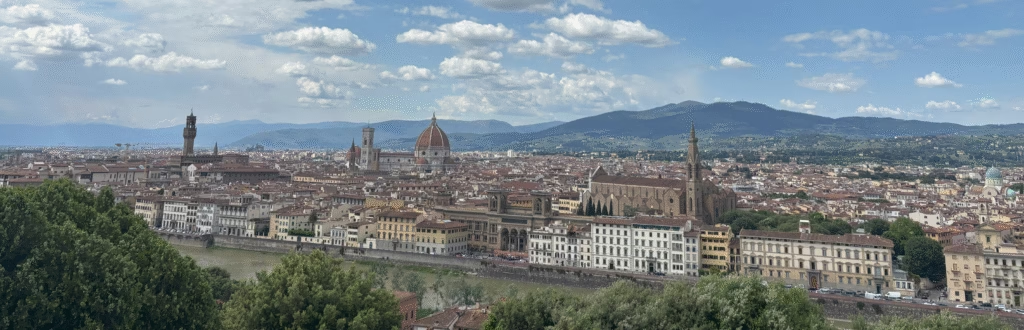
Then there is the view, and it still lands in person no matter how many photos you have seen. The whole city is laid out below you: Brunelleschi’s dome, the tower of Palazzo Vecchio, Santa Croce, and the Arno cutting straight through the middle, with the Tuscan hills behind. If you have timed it for late afternoon, the light turns everything gold and the city seems to glow.
When we were there, a street musician was playing guitar in a way I had never seen, laid flat across his knees and tapped like a piano, and the sound was strange and dreamlike with a small crowd gathered round. It is the kind of moment you cannot plan, and it stuck with us more than half the things we had ticked off all day. Find a spot on the wall or the stone steps, grab a gelato from one of the vendors, and just sit with it for a while. If you want a proper drink to mark the end, the Neoclassical loggia behind the terrace houses a restaurant called La Loggia, where you can have an Aperol Spritz with the same view.
That is the loop. Six hours, on foot, from the station to the best view in the city and back, with art, leather, lampredotto, and one very good afternoon in between. When you are ready, head back down toward the station, keeping that train buffer in mind, with Florence behind you and a layover that turned into something you will actually remember.
If you have longer in the region, this walk pairs naturally with a few of our other guides. For slowing down in the countryside, see our 7-day Tuscany itinerary and its loop through the wine towns near San Gimignano and Volterra. If Florence is one stop on a bigger trip, our Rome walking itinerary is the obvious next leg, and you can browse the rest of our Europe travel guides for more city routes and trip ideas.
Author

Get My Personal Travel Maps
Keep Reading: More Articles You’ll Love
 Tuscany Itinerary – Wine, Culture & Culinary Adventures from San Gimignano to Volterra
  Is Japanese Food Actually Chinese? The Surprising Origins of Japanese Cuisine
  One Day in Rome on Foot: My Self-Guided Walking Route from Colosseum to Vatican
  Top 4 Favorite Locations in Kyoto: A Personal Journey Through Japan’s Historic Heart
  Matsumoto Itinerary: The Perfect 3-Day Guide Including Kamikochi
  Hiroshima Travel Guide: 3-Day Itinerary, Okonomiyaki, Hotels & Itsukushima Shrine Tips
  Osaka Travel Guide 2025: Takoyaki, Nara Deer Park & Expo Highlights


Leave a Reply