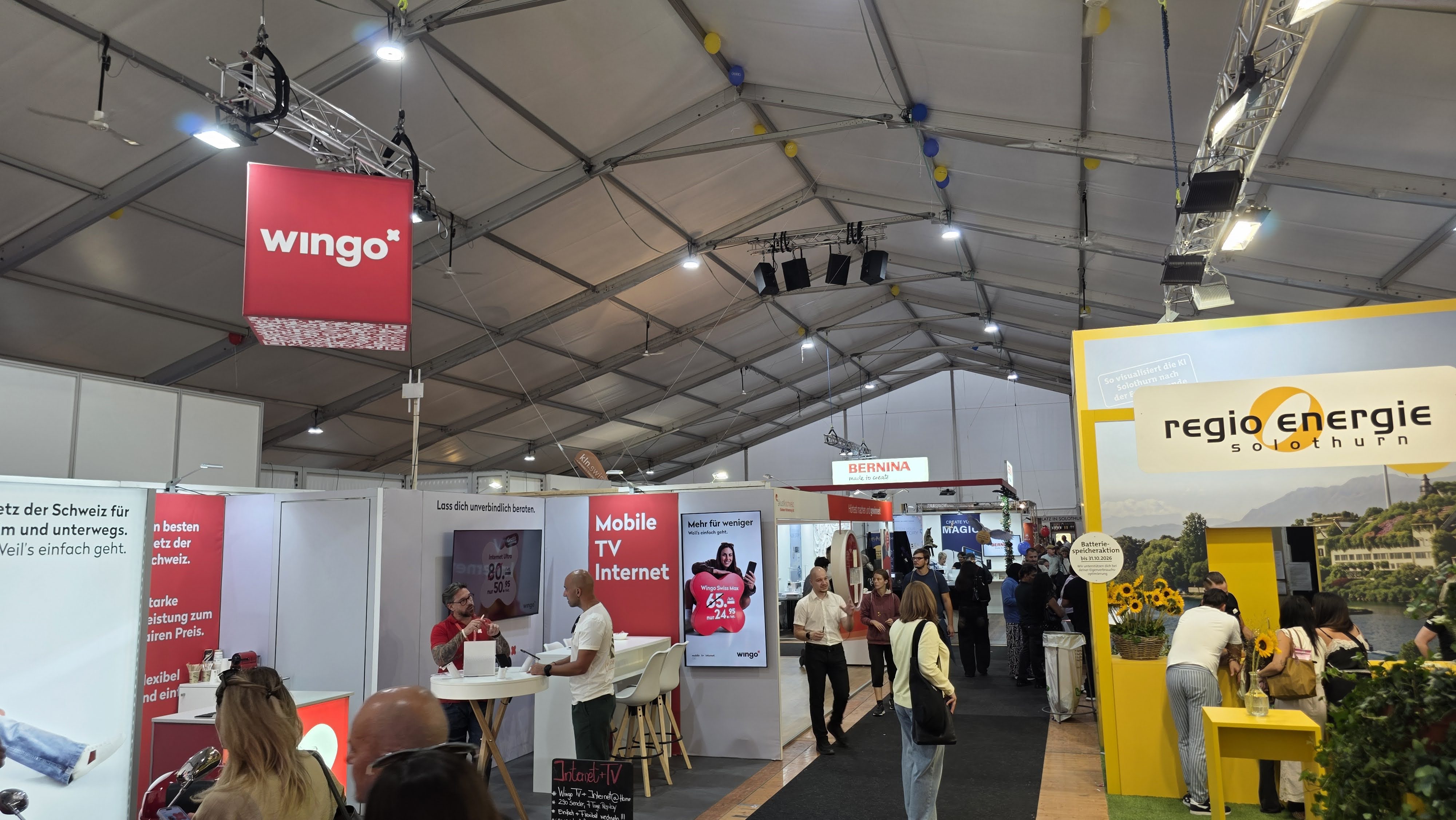
Every September, Solothurn quietly turns into the busiest city in the canton for ten days straight. Around 100,000 people pass through the Schanzengrabengelände at the edge of the old town for HESO, the Herbstmesse Solothurn, and if you have never been, the name alone does not tell you much. It sounds like a trade show, and technically it is one, but calling HESO a trade show is a bit like calling Solothurn’s old town “some buildings.” What is actually going on inside those halls is a mix of a commercial fair, an agricultural show, a fairground, and a genuine community reunion, all packed under one roof at the edge of the Aare.
I want to walk through what HESO actually is, where it came from, and the specific things worth seeing while you are there, because the program changes every year but a handful of fixtures never do: the piglet races, the animal stands, and the tents that fill up once the exhibition halls start winding down for the night.
What HESO Actually Is
HESO stands for Herbstmesse Solothurn, literally the Solothurn autumn fair, and it has been running since 1977. It is organized by Rythalle Soledurn AG and counts as the largest public fair in the Espace Mittelland, the region stretching roughly from Bern to Basel. Around 230 exhibitors set up across the fairgrounds each year, covering nearly every part of daily life you can think of: trade and industry, cars, home and garden, food and drink, technology, health, and local crafts. Entry is free, which is part of why the fair pulls in six figures of visitors from across the region rather than just from Solothurn itself.
What makes HESO different from a typical trade fair is that it was never built purely for business. From the beginning it was designed as a meeting point for the whole region, somewhere a farmer from the Bucheggberg, a family from town, and a company from Bern could all end up standing at the same stand. That community angle is still the reason it keeps growing decades later, long after plenty of regional fairs elsewhere in Switzerland have shrunk or disappeared.
Two Weekends, Almost Everything Indoors
HESO always spans two full weekends, running for ten days from a Friday to the following Sunday, which gives visitors two separate Saturdays and Sundays to work with rather than squeezing everything into one. That structure matters more than it sounds, because the exhibition itself is almost entirely indoors. The halls on the Schanzengrabengelände are what people mean when they talk about “going to HESO,” so a rainy September does very little to the fair beyond keeping the outdoor food stands a bit quieter. You can spend an entire afternoon wandering from hall to hall without ever stepping back outside, which is exactly the point for a fair built to run rain or shine, ten days deep into a Swiss autumn.
Opening hours shift depending on the day. Weekday afternoons run shorter, generally from early afternoon until around nine in the evening, while the two Saturdays stretch from late morning all the way into the night, and the two Sundays wrap up earlier for a calmer, more family-oriented close to each week of the fair.
Robots, Cars, and Free Tastings Inside the Halls
Wandering the halls is where HESO earns its reputation as more than a shopping trip. In any given year you might find a stand demonstrating the latest industrial robots doing something oddly hypnotic with a robotic arm, right next to a hall full of the newest cars from regional dealerships that you can sit in, walk around, and ask endless questions about. A few steps further and you will run into the Stadtpolizei Solothurn, who keep a stand at the fair every year specifically so people can walk up, ask questions, and get a look at the job from the other side of the badge, rather than only seeing the police at a distance.
Then there is the part of HESO that keeps people coming back with an empty stomach and leaving considerably less sober. Wine producers from the region set up tasting stands where you can work your way through a full flight for free, and it is not unusual to find a stand pouring gin or vodka tastings a few metres further down the same hall. None of this feels like a beer tent free-for-all. It is closer to a relaxed, walk-and-taste afternoon, the kind where you end up chatting with the person who actually distilled what is in your glass.
Every edition also carries a dedicated Sonderschau, a themed special exhibition that changes from year to year and gets its own section of the fairgrounds, covering everything from regional agriculture one year to public safety and everyday risk the next. It is worth checking what that year’s theme is before you go, since it usually comes with its own stage program of talks and demonstrations layered on top of the regular exhibition halls.
The Piglet Race Everyone Talks About
If there is one thing that gets mentioned before anything else when locals describe HESO, it is the Säulirennen, the piglet race. Young pigs are lined up at a small track inside the fairgrounds, and once the starting signal goes, they wobble, wander, get distracted, and eventually sprint toward the one thing that reliably motivates a piglet: a feeding trough waiting at the finish line. It sounds simple, and it is, which is exactly why families crowd around the track the moment the gates open every single day.
Local companies sponsor individual piglets for the race, and sponsoring one comes with a tradition that has turned into its own small spectacle: dressing your piglet in a tiny branded coat and giving it a name that is usually a pun on the sponsor’s own name. That is where one of my favorite running jokes at HESO comes in. A regional bank once sponsored a piglet and named it Spaekli, a name that hides the bank’s own initials, AEK, right in the middle of the Swiss German word for a little piece of bacon, Speck. Everyone at the trackside gets the joke instantly and groans at it anyway, because a bank naming its racing pig after the thing it is eventually going to become is exactly the kind of dry, self-aware humor that keeps this event fun rather than just cute. If you want the full Solothurn street party experience to go with it, our guide to Stadtfest Solothurn covers the city’s other big annual gathering, which happens outdoors rather than under the HESO roof.
The Wisent Stand and the Story Behind It
Tucked among the commercial stands is something you would not expect at a trade fair: an information booth about the wisent, the European bison, and the small wild herd now living in the Jura hills above Welschenrohr, not far outside Solothurn. The banner strung across the booth says it best: “Nach 1000 Jahren zurück in Solothurn,” back in Solothurn after 1000 years. It is easy to walk past without realizing what you are actually looking at, which is one of Europe’s genuine conservation success stories, playing out a short drive from where you are standing.

The wisent used to roam across most of Central and Western Europe. Hunting and the steady loss of forest to farmland pushed the species back further every century, until only two wild populations were left anywhere by the late 1800s, one in Poland’s Białowieża Forest and one in the Caucasus. Poaching finished off the Polish population in 1921, and the last wild Caucasian wisent was shot in 1927. At that point, the species existed nowhere in the wild at all. What kept it from disappearing entirely was a group of roughly a dozen founder animals scattered across zoos and private parks in Germany and beyond, the entire genetic future of a species reduced to a number you could fit around one dinner table.
The person most responsible for what happened next was Kurt Priemel, the director of Frankfurt Zoo. In 1923, while the last wild herds were still being hunted down, Priemel brought together a small international group of zoologists and conservationists and founded a society dedicated to saving the species before it was too late. What made his approach different was a studbook, a meticulously kept record tracking every surviving wisent’s bloodline so breeders across different countries could pair animals without accidentally inbreeding a species already down to its last few dozen individuals. It is considered the first studbook ever created for a wild animal, and it is the reason there was a genetically viable population left to reintroduce decades later. Priemel did not live to see the biggest payoff of that work, but the framework he built in 1923 is directly why wisent exist in the wild again today.
Reintroduction began in Białowieża in 1952, and it worked. That population alone now numbers in the hundreds, and wild wisent herds today live across eight European countries, including Poland, Belarus, Germany, and Romania, all descended from that same small founder group Priemel worked to protect a century ago. The Welschenrohr project, run by the canton of Solothurn, is testing whether the species can once again live wild in the Swiss Jura, the same hills where wisent roamed roughly a thousand years ago before disappearing from the region entirely, which is exactly what that banner on the HESO booth is getting at. The release herd is capped at a maximum of twenty-five animals, with the current family sitting somewhere in the five to twenty-five range as the project’s ten-year monitoring period plays out, tracking how the animals behave, how they interact with hikers and livestock, and whether this patch of Jura forest can genuinely support a free-living herd long term. Standing at the HESO information stand looking at photos of that small Solothurn herd, knowing it traces back to just twelve animals and one zoo director’s studbook a hundred years ago, is a better story than almost anything else on the fairgrounds.
When the Halls Wind Down, the Tents Take Over
HESO does not stop when the exhibition halls close for the night. As the evening sets in, the fairgrounds shift into their second identity, with several party tents opening up around the site for anyone who wants to stick around past dinner. The Schwingerzelt is the one locals gravitate toward first. Once the Schwingerbar opens for the evening, the tent fills in properly by around nine, and from there it runs as a proper Swiss festival tent: long benches, cold beer, and enough noise that you will not hear yourself think, in the best possible way. Some evenings lean into themed nights, including one that turns the whole tent into a full-on carnival party with brass bands marching through. A handful of other venues around the site run their own evening programs in parallel, from DJ sets to live bands, so if the Schwingerzelt gets too packed there is almost always somewhere else on the grounds still going.
It is a strange but genuinely good contrast, spending your afternoon looking at industrial robots and free wine tastings and then ending your night at a long wooden bench in a beer tent listening to a brass band. That contrast is basically what HESO is, in one sentence.
Planning Your Visit
If you are building a Solothurn trip around HESO, it is worth checking our Solothurn events calendar to see what else lines up with the fair dates that year, and our Solothurn travel guide covers the rest of the city for the days you are not spending inside a fairground hall. Since you will be hungry after a few hours of walking the exhibition floor, our guide to the best restaurants in Solothurn is worth a look for something better than fair food once you head back into the old town.
Author

Get My Personal Travel Maps
Keep Reading: More Articles You’ll Love
 Events in Solothurn: The Complete Yearly Calendar Best Restaurants in Solothurn: Why This Small Swiss Town Eats So Well
  Stadtfest Solothurn: Inside the Baroque Old Town’s Biggest Party
  Swimming in the Aare River: The Complete Guide to Switzerland’s Favorite Wild Swim
  Ryuichi Sakamoto exhibition: Seeing Sound, Hearing Time – An insane Journey Into the Mind of a Musical Genius
  A Magical Christmas in Switzerland: A First-time Experience with My Chinese Girlfriend
  My Experience at the Pokémon x Kogei Exhibition at Ropping Hills Gallery


Leave a Reply