
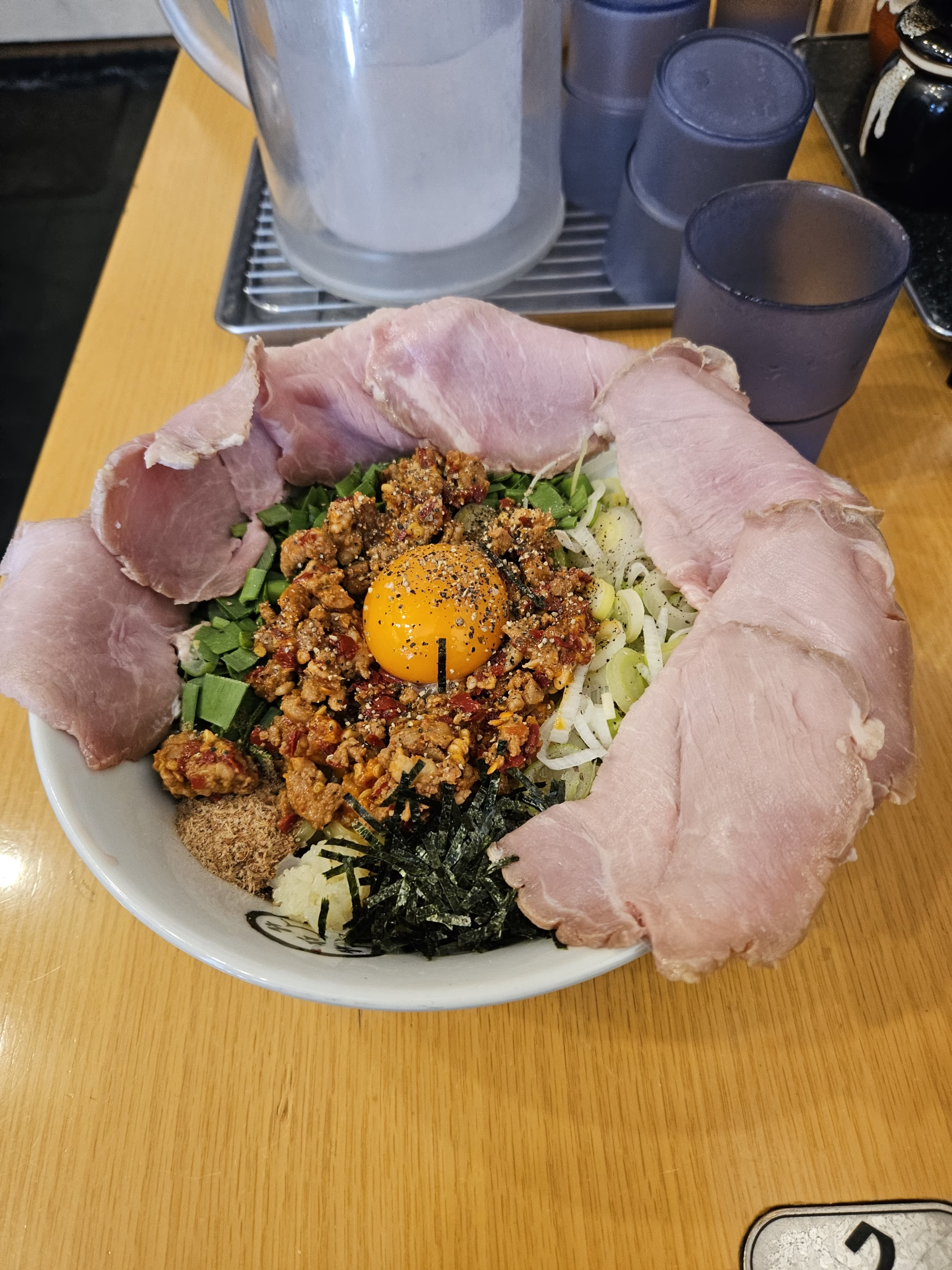
The bowl arrives and there is no soup. Just thick, glossy noodles hidden under a small mountain of spicy minced pork, chopped chives, green onion, garlic, seaweed, fish powder and, right in the middle, a bright orange raw egg yolk. The staff tell you to mix. Not stir a bit, but really mix, twenty or thirty times, until everything is coated in a sticky, spicy, garlicky sauce. That is maze soba, and once you have tried it, a normal ramen can suddenly feel a bit watery.
Maze soba is one of the most exciting noodle styles in Japan right now, and Tokyo is full of shops serving it. But it is also confusing: what is the difference between maze soba, abura soba and tsukemen? Why is it called “soba” if there is no buckwheat? And why do people throw rice into the empty bowl at the end? Here is everything you need to know, plus where to eat it in Tokyo.
What is maze soba, exactly?
Maze soba (まぜそば) means “mixed noodles”. Mazeru is the Japanese verb for “to mix”, and soba here does not mean the buckwheat noodles you know from soba restaurants. In Japan, ramen-type wheat noodles were historically called “chuka soba” (Chinese soba), and the word soba stayed in many ramen names. So maze soba is a ramen dish without soup, where the noodles are mixed with a concentrated sauce and toppings right before eating.
The noodles are usually thick, chewy and slightly wavy, so they hold onto the sauce. At the bottom of the bowl, there is a small amount of tare: a strong seasoning base of soy sauce, oil, sometimes garlic and fish or pork flavours. Everything you need for flavour is in that small layer, so mixing is not optional.
The classic toppings
- Spicy minced pork (the “Taiwan minchi”), the heart of the most famous version
- Nira (garlic chives) and green onion
- Raw egg yolk in the middle
- Chopped nori seaweed
- Fish powder (gyofun) made from dried fish
- Fresh minced garlic, often a lot
- Sometimes chashu pork, menma (bamboo shoots) or cheese
Born in Nagoya, named after Taiwan (and invented in neither)
The most famous kind of maze soba is “Taiwan maze soba”, and it has a funny history. It was not invented in Taiwan at all. It was created in Nagoya, in 2008, at a ramen shop called Menya Hanabi, by chef Naoto Niiyama.
The name comes from an older Nagoya speciality: “Taiwan ramen”. This is a spicy ramen with chilli-garlic minced pork, which was created in Nagoya in the 1970s at a Chinese restaurant called Misen, run by a Taiwanese-born chef. It became so popular locally that “Taiwan” in Nagoya simply started to mean that spicy minced meat topping.
The story at Hanabi, as it is usually told, is that the chef was experimenting with a version of Taiwan ramen and the soup did not work. Someone suggested putting the minced meat directly on the noodles, without soup. The details depend on who tells the story, so take it with a little salt. What is sure is the result: soupless noodles with spicy pork, raw yolk and fish powder became a hit, and from Nagoya it spread across Japan and abroad. Menya Hanabi now has shops in many cities, and lots of other shops make their own version.
It is a good example of how Japanese food constantly borrows from China and Taiwan and turns it into something new. I wrote more about this in my article on Chinese influences on Japanese food.
Maze soba vs abura soba vs tsukemen
These three are all ramen without a full bowl of soup, and even in Japan people mix them up. Here is the simple version:
| Maze soba | Abura soba | Tsukemen | |
|---|---|---|---|
| Soup | No soup, sauce at the bottom | No soup, oily sauce at the bottom | Separate bowl of thick dipping soup |
| Toppings | Many: minced pork, chives, yolk, garlic, fish powder | Few: chashu, menma, green onion | Usually chashu, egg, menma |
| Typical flavour | Spicy, garlicky, rich | Simple, soy and oil, you season it yourself | Intense, often fish and pork |
| How to eat | Mix everything well | Add vinegar and chilli oil, then mix | Dip cold or warm noodles into the soup |
| Origin | Nagoya, 2008 (Taiwan maze soba) | Western Tokyo, 1950s | Tokyo, 1950s |
The honest truth: the line between maze soba and abura soba is blurry. Many shops use both names for similar dishes. A rough rule is that abura soba is the older, simpler Tokyo version, and maze soba is the newer, topping-heavy style.
Abura soba: Tokyo’s own soupless ramen
Abura soba (“oil noodles”) comes from the Musashino and Tama area of western Tokyo in the 1950s. Two shops are usually named as its inventors: Chinchintei in Musashino and Sankou in Kunitachi. Who was first is still debated. The dish was popular with students, especially near Asia University, and became famous across Japan from the late 1990s. At the table, you usually add rice vinegar and rayu (chilli oil) to taste, which gives it a sharp, fresh edge.
How to eat maze soba like a local
Maze soba is not complicated, but there are a few steps that make a big difference:
- Buy a ticket at the machine. Most shops use a ticket machine (shokkenki) at the entrance. Choose your bowl, size and extra toppings, pay, and hand the ticket to the staff. My guide on how to travel in Japan without speaking Japanese has tips for machines with only Japanese buttons.
- Choose your size carefully. Portions are often big, and many shops offer the same price for regular and large. Regular is enough for most people, because you will probably want the rice at the end.
- Mix. Then mix more. Break the yolk and turn the noodles from the bottom up, again and again, until no sauce is left at the bottom and everything is shiny. Some shops have signs telling you to mix at least 20 times. Do it.
- Adjust at the table. Look for vinegar (often kombu vinegar), chilli oil, extra garlic or pepper. A splash of vinegar halfway through cuts the richness.
- Finish with oimeshi. This is the best part. When the noodles are gone, there is still sauce, meat and bits of topping in the bowl. Many shops give you a small scoop of rice, often for free, which you mix with what is left. It is called oimeshi (“chasing rice”). Do not skip it.
Wear something dark. Thick noodles, oil and enthusiastic mixing are not friends with white shirts. Many shops have paper aprons, just ask for “kami epuron”.
Where to eat maze soba in Tokyo
Tokyo has hundreds of shops serving maze soba or abura soba, from big chains to tiny counters with a line outside. Branches open and close often, so check the current location and opening hours on Tabelog or Google Maps before you go. Here are good names to start with:
My favourite: Mazesoba Minami in Koenji
My own favourite is Mazesoba Minami in Koenji, the neighbourhood I lived in. If you ask me where to try maze soba in Tokyo, this is the bowl I send you to first. Koenji is only a few minutes from Shinjuku on the JR Chuo Line, and my Koenji guide has more places to eat around it. Koenji is also home to my favourite Mexican restaurant in Tokyo.
Menya Hanabi
The original creator of Taiwan maze soba from Nagoya, with branches in the Tokyo area. If you want to taste the “reference” version, this is the place: spicy minced pork, yolk, chives, fish powder and oimeshi at the end.
Kajiken
Another maze soba specialist that started in the Nagoya region and has grown into a chain with shops in Tokyo and other cities. A good, easy option if you see one near your hotel.
Tokyo Aburagumi Sohonten
A popular abura soba chain with many shops around Tokyo. The bowls are simpler than maze soba, and the fun is in seasoning them yourself with vinegar and chilli oil. A great introduction to the Tokyo-style dish.
Chinchintei (Musashino)
For noodle history fans: one of the two shops said to have created abura soba, in western Tokyo. It is a trip out of the centre, but you can combine it with a day in nearby Kichijoji, which I wrote about in my Kichijoji guide.
If you would rather try lots of ramen styles in one place, the shops at Tokyo Ramen Street in Tokyo Station are an easy way to compare, and some of them serve soupless bowls too.
What maze soba costs in Tokyo
Maze soba is still a cheap meal by Tokyo standards. Expect roughly:
- Basic bowl: about 950 to 1,300 yen
- Extra toppings (extra meat, cheese, egg, chashu): about 100 to 300 yen each
- Large size: often free or about 100 to 200 yen more
- Oimeshi rice: often free, sometimes about 50 to 100 yen
Like most ramen shops, maze soba places are fast. You eat, you leave, and someone else takes your seat. Lunchtime between 12 and 1 pm and the evening after work are the busiest, so go a bit earlier or later to avoid queues.
Is maze soba for everyone? Spice, garlic and dietary needs
Taiwan maze soba is spicy, but not extreme. Many shops let you choose a less spicy level, or add more chilli if you like it hot. The bigger issue is garlic: it can be a lot. If you have a meeting or a date afterwards, ask for less garlic (“ninniku sukuname”) or no garlic (“ninniku nashi”).
For vegetarians, maze soba is difficult. The sauce usually contains pork or fish, the minced meat is the main topping, and the fish powder is everywhere. Some modern shops offer vegan versions, but they are the exception. If you eat raw egg carefully, ask for the yolk to be left out. Raw eggs in Japan are produced for raw eating and are commonly served this way.
If you love noodles in general, also look at my piece on why udon might beat ramen, which is a fun counterpoint to all this garlic.
Frequently Asked Questions
What is maze soba?
A Japanese ramen dish without soup. Thick noodles are mixed with a concentrated sauce and toppings like spicy minced pork, chives, garlic, fish powder and raw egg yolk.
Is maze soba made with buckwheat?
No. Maze soba uses wheat ramen noodles. “Soba” comes from the old name chuka soba for ramen noodles.
What is the difference between maze soba and abura soba?
Both are soupless. Abura soba is the older and simpler Tokyo style that you season yourself with vinegar and chilli oil. Maze soba usually has more toppings and a stronger, spicier flavour.
Where did Taiwan maze soba come from?
From Nagoya. It was created at Menya Hanabi in 2008 and is based on Nagoya’s “Taiwan ramen”. It has nothing to do with Taiwan directly.
What is oimeshi?
A small portion of rice that you mix with the leftover sauce and toppings at the end of your maze soba. Many shops serve it for free.
Is maze soba spicy?
Taiwan maze soba is medium spicy. Many shops let you adjust the spice level, and other versions are not spicy at all.
How much is maze soba in Tokyo?
About 950 to 1,300 yen for a basic bowl, plus extra for toppings.
Maze soba is proof that Japanese noodle culture never stands still: a Nagoya chef takes a Taiwanese-inspired topping, drops the soup, and starts a nationwide trend. Find a shop, buy your ticket, mix like you mean it and save room for the rice. For more noodle and food ideas, browse my Japanese food guide.
Author

Get My Personal Travel Maps



Leave a Reply