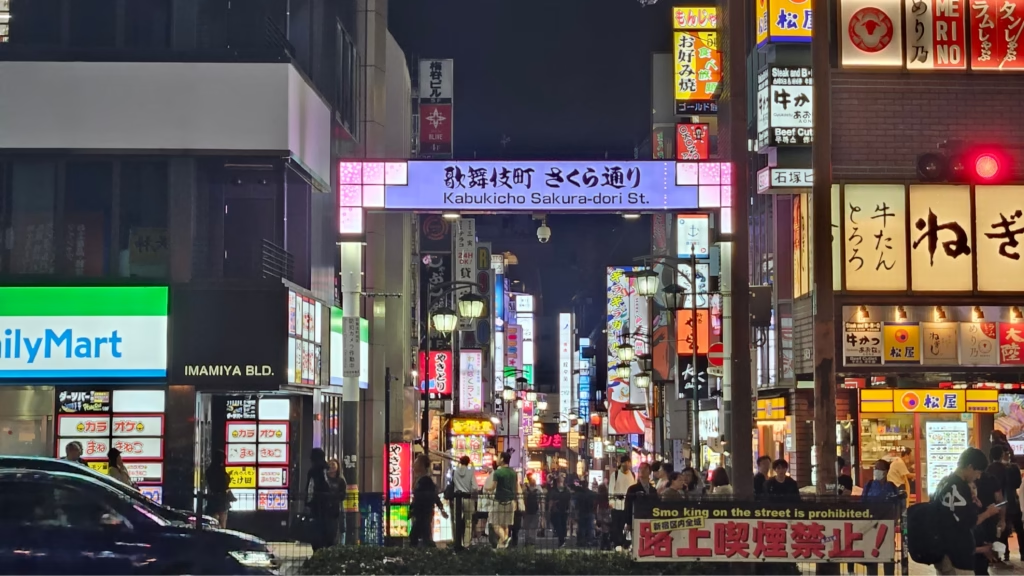
If you’re planning a trip to Japan, one question almost always comes up before booking flights or hotels: Is Tokyo safe?
At first glance, Tokyo feels remarkably different from many other global cities. People leave laptops unattended in cafés, children ride public transport alone, and lost wallets often find their way back to their owners. International rankings consistently place Tokyo among the safest major cities in the world, particularly when it comes to violent crime.
However, “safe” does not mean risk-free.
Every year, thousands of visitors encounter problems ranging from nightlife scams and overcharging schemes to theft, fraud, and alcohol-related incidents in entertainment districts such as Kabukicho and Roppongi. Solo travelers often wonder whether it is safe to walk around Tokyo at night, while families and first-time visitors want to know which neighborhoods to avoid and what precautions are worth taking.
As someone who has lived in Tokyo, explored the city late at night, and spent years interacting with both locals and foreign residents, I’ve seen both sides of the story. Tokyo is exceptionally safe by international standards, but many travel guides oversimplify the reality.
In this guide, you’ll find crime statistics, common tourist scams, neighborhood-specific safety advice, and real-world examples of incidents involving foreign visitors. By the end, you’ll understand not only why Tokyo has earned its reputation as one of the world’s safest cities, but also where that reputation can create a false sense of security.
For a broader overview of neighborhoods, transport, and practical planning beyond safety, I’ve organized everything in my Tokyo Travel Guide.
Tokyo travel safety tips: What the Numbers Say
So, is Tokyo safe for tourists based on hard data? In short, yes. By almost every international measure, Tokyo ranks among the safest major cities in the world. According to the Numbeo Crime Index, Tokyo typically scores around 24 out of 100 for crime, significantly lower than many popular tourist destinations in Europe and North America. Cities such as Paris, London, and Los Angeles generally report substantially higher crime levels and lower safety scores.
However, statistics only tell part of the story. What surprises many visitors is how these numbers translate into everyday life. In Tokyo, it is common to see people reserve café seats with a smartphone, wallet, or laptop while ordering food. Lost property is frequently handed to station staff or the police. Children as young as elementary school age often travel independently on public transportation, something that would be unusual in many Western cities.
The majority of crimes reported in Tokyo involve non-violent offenses such as bicycle theft, umbrella theft, minor property damage, and occasional scams targeting tourists. Violent crimes such as armed robbery, assault by strangers, or street muggings are comparatively rare. For most visitors, the biggest risk is not physical danger but becoming overly relaxed because the city feels so secure.
One reason for Tokyo’s reputation is its unique approach to community policing. Throughout the city, small police stations known as kōban are located near train stations, shopping streets, and residential neighborhoods. Officers are visible, approachable, and often assist with everything from directions to lost property reports. Combined with extensive CCTV coverage, well-lit streets, and a strong culture of social responsibility, these factors create an environment where opportunistic crime is less common than in many other global capitals.
That said, safety is not distributed equally across every part of Tokyo. Entertainment districts that attract large numbers of tourists, such as Kabukicho and parts of Roppongi, experience a disproportionate share of scams, overcharging schemes, and alcohol-related incidents involving foreign visitors. These areas are generally not dangerous by international standards, but they are where most tourists are likely to encounter problems.
The key takeaway is that Tokyo is not safe because crime is nonexistent. It is safe because the likelihood of becoming a victim of serious crime is exceptionally low compared with most cities of similar size. Visitors should remain aware of their surroundings, particularly in nightlife districts, but they can generally explore the city with a level of confidence that is difficult to find elsewhere in the world.
The Hidden Dangers in Kabukicho and Roppongi
While Tokyo generally feels incredibly safe, not every district follows that same pattern. Two nightlife hubs, Kabukicho in Shinjuku and Roppongi, stand out as exceptions. These are the places where a disproportionate number of incidents involving foreign tourists occur.
In Kabukicho, street touts, often referred to as “scouts,” regularly approach visitors and invite them into bars, clubs, or hostess establishments. Many speak fluent English and present themselves as friendly guides offering special deals or hidden local spots. Unfortunately, some of these invitations lead to establishments that engage in overcharging, drink tampering, or intimidation tactics designed to extract large sums of money from customers.
The situation in Roppongi is similar. Although the district is home to many legitimate bars, restaurants, and nightclubs, it has also developed a long-standing reputation for scams targeting foreign visitors. Credit card fraud, inflated bills, and incidents involving suspected drink spiking have been reported for years. The district became notorious enough that foreign embassies have periodically issued warnings advising travelers to exercise caution when accepting invitations from strangers.
What makes these scams particularly effective is that they prey on a false sense of security. Many visitors arrive in Tokyo having heard that Japan is one of the safest countries in the world. While that is generally true, some assume that means they can let their guard down completely.
I’ve personally seen this happen multiple times. Over the years, three friends ignored my advice about following touts into bars in Kabukicho and Roppongi. One incident happened more than a decade ago, while two others occurred within the last three years. In every case, the pattern was remarkably similar: a friendly stranger approached them, promised a great deal or an authentic local experience, and convinced them to enter a venue they had never planned to visit. The evening ended with unexpectedly large bills and a very expensive lesson. Fortunately, none of them were physically harmed, but all three wished they had simply walked away.
The rule is simple: if someone approaches you on the street and tries to convince you to enter a bar, club, or restaurant, politely decline and keep walking. Legitimate businesses in Tokyo rarely need aggressive street recruitment. Following this one piece of advice eliminates the vast majority of nightlife-related problems that tourists encounter in the city.
If nightlife is part of your Tokyo plans, knowing where to go and what to avoid matters. I’ve broken this down clearly in my Tokyo Nightlife Guide, including safer areas and common red flags.
Real Stories That Reveal the Risks
To really understand whether Tokyo is safe for tourists, you have to go beyond the statistics and look at actual experiences. While the numbers show low violent crime, Shinjuku Kabukicho and Roppongi have a long-standing reputation for nightlife-related scams and safety issues. In fact, in parts of Shinjuku, there are automated loudspeakers that play regular safety announcements in Japanese and English. These warnings explicitly caution visitors not to follow touts or scouts into clubs, a sign of how persistent and serious the problem is. Despite Tokyo’s overall safety, there have been cases of women being raped in these areas, especially after being drugged in clubs or misled by hosts and street scouts. Though these incidents are not widely reported in mainstream Japanese media, they have been acknowledged in warnings from embassies and local authorities. These are not typical tourist experiences, but they are real—and they highlight why caution is critical when exploring Tokyo’s nightlife zones.
Story 1: Passed Out, No Memory, and a Massive Bill
One incident that always comes to mind happened about ten years ago when a friend visited Tokyo for the first time. While exploring Kabukicho, he was approached by a scout who invited him into a nightclub. At first, everything seemed normal. He ordered a few drinks, chatted with staff, and enjoyed the atmosphere.
The next thing he remembers is waking up in an office inside the building with several employees demanding payment. According to the bill presented to him, he had allegedly ordered numerous expensive drinks and bottle-service packages throughout the night. The charges amounted to a staggering sum, yet he had little to no memory of the events leading up to it.
To this day, he remains convinced that something was put into his drink. While it is impossible to prove exactly what happened, the sudden memory loss, confusion, and inability to account for hours of the evening were highly unusual. Fortunately, he was not physically injured, but he lost a significant amount of money and learned a harsh lesson about accepting invitations from strangers in nightlife districts.
Stories like this are one reason Kabukicho and Roppongi continue to attract warnings from experienced residents, embassies, and long-term foreign visitors. The vast majority of Tokyo is exceptionally safe, but these entertainment districts operate by different rules. When alcohol, aggressive touts, and tourists unfamiliar with the area come together, the risk of scams increases dramatically.
The most effective defense is also the simplest: never follow a street scout into a bar or club that you were not already planning to visit. If you want to experience Tokyo’s nightlife, research venues beforehand, read recent reviews, and enter establishments on your own terms rather than through unsolicited invitations.
Story 2: Celebrating, Then Waking Up on the Street
A more recent incident involved another friend during a night out in Shinjuku. He was celebrating with a group at a well-known bar and had consumed alcohol, but not to the extent that anyone considered it unusual. At some point during the evening, he stepped outside alone for a cigarette.
The next thing he remembers is waking up on the pavement several hours later. He was disoriented, had no clear memory of what had happened, and quickly discovered that the cash he had been carrying, more than €2,500 (approximately $2,900 USD at the time), was missing.
To this day, he cannot explain exactly what occurred during those missing hours. Whether he was simply targeted while intoxicated, had his drink tampered with elsewhere during the night, or fell victim to an opportunistic theft remains unknown. What is clear is that he went from enjoying a normal evening with friends to waking up alone without his money and with no recollection of how he got there.
Incidents like this illustrate an important point about Tokyo’s nightlife districts. While violent crime remains rare, alcohol can significantly increase vulnerability. Areas such as Kabukicho and Roppongi attract millions of visitors every year, and most nights pass without incident. However, tourists who become separated from their group, carry large amounts of cash, or place too much trust in strangers can quickly find themselves in difficult situations.
One lesson stands out from this story: avoid carrying large sums of cash during a night out, stay with trusted friends, and be particularly cautious if you suddenly feel far more intoxicated than expected. Even in one of the safest cities in the world, common-sense precautions remain essential.
Story 3: Wallet Gone, Cards Maxed, Phone Ditched
The third incident involved a Swiss friend who was visiting Tokyo on business. After returning to his hotel in Shin-Okubo, a generally quiet and safe neighborhood, he decided to head back out for a few more drinks in Kabukicho.
At some point during the night, he lost both his wallet and his phone. By the time he realized what had happened, several unauthorized transactions had already been made using his credit cards. He never revealed the exact amount of money involved, but given his profession in Swiss banking, it was likely a significant loss.
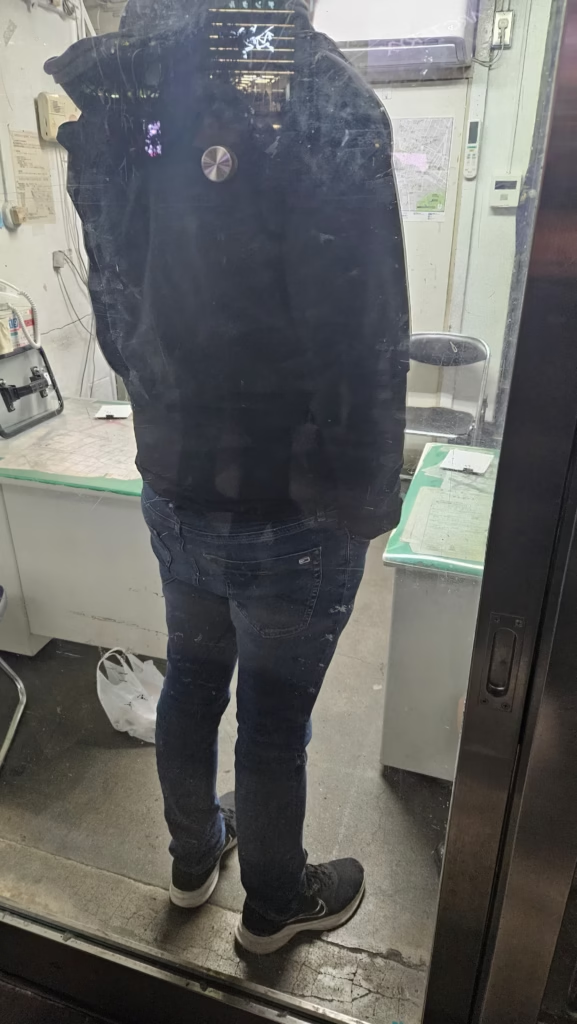
What makes the story particularly strange is that his phone was eventually recovered by the police, not near the nightlife district where it disappeared, but abandoned outside a kōban several kilometers away. To this day, he has no clear explanation for how it ended up there.
While it is impossible to know exactly what happened that night, the outcome highlights a recurring pattern seen in many nightlife-related incidents worldwide. Once tourists become separated from friends, lose situational awareness, or become heavily intoxicated, they become much easier targets for theft and financial fraud. Tokyo’s low violent crime rate does not eliminate these risks.
Stories like these are rare compared with the millions of safe nights enjoyed in Tokyo every year, but they demonstrate why visitors should not confuse “safe” with “risk-free.” Most problems reported by foreign tourists in Kabukicho and Roppongi are not violent crimes. Instead, they involve theft, fraud, drink tampering, or situations where impaired judgment makes someone vulnerable to exploitation.
Is Tokyo Safe for Solo Female Travelers?
Tokyo is widely regarded as one of the safest major cities in the world for women traveling alone. Violent crime against tourists is rare, public transportation is generally clean and reliable, and many women report feeling comfortable exploring the city well into the evening. Compared with many large cities in Europe or North America, solo female travelers often describe Tokyo as remarkably secure.
That said, safety concerns do exist, and they tend to differ from those found in other countries.
One of the most commonly discussed issues is chikan (痴漢), a term used for groping and sexual harassment on crowded trains. While railway operators have invested heavily in awareness campaigns, security cameras, and reporting systems, incidents still occur, particularly during rush hour when trains are extremely crowded. To help address the problem, many rail companies operate women-only cars during peak commuting times.
Another issue that occasionally appears in Japanese media is upskirting, where hidden cameras are used to photograph or record underneath clothing without consent. Japan has strengthened laws against this behavior in recent years, but it remains a concern in densely populated public spaces.
Some travelers may also encounter reports about ぶつかり男 (butsukari-otoko), literally “the bumping man.” This refers to individuals who intentionally collide with strangers, often women, in busy train stations or crowded pedestrian areas. While relatively uncommon, the phenomenon has received media attention because it exploits the anonymity and density of large urban environments.
For most female visitors, these risks are far more relevant than concerns about robbery or violent assault. In practical terms, Tokyo is generally safest during the day, on busy streets, and in well-trafficked areas. As with any major city, additional caution is sensible late at night, in nightlife districts, or when traveling alone after consuming alcohol.
Women who frequently wear skirts may choose to wear shorts underneath while navigating crowded public transportation, particularly during peak commuting hours. Staying aware of your surroundings, avoiding distractions when moving through busy stations, and seeking assistance from station staff or police officers when something feels wrong are simple precautions that can reduce risk.
It is also worth understanding that reporting harassment can feel challenging for both locals and visitors. Language barriers, uncertainty about procedures, and a cultural preference for avoiding confrontation sometimes discourage victims from coming forward. However, awareness of these issues has increased significantly in recent years, and railway operators, police, and local authorities now provide more resources and reporting mechanisms than in the past.
The overall conclusion remains reassuring: Tokyo is one of the safest destinations in the world for solo female travelers. Understanding the specific risks that do exist allows visitors to enjoy the city with confidence while avoiding the situations where problems are most likely to occur.
While Tokyo is much safer than many cities for solo female travelers, some risks remain. One of the more common offenses is chikan, or groping, particularly on packed trains. Upskirting—using hidden cameras to film under women’s skirts—is also an ongoing problem. Japan has implemented some countermeasures, like women-only cars during rush hours, but incidents still happen.
The Tokyo Safety Paradox
One of the most fascinating aspects of Tokyo is what I call the “Tokyo Safety Paradox.” On one hand, the city often feels almost impossibly safe. It is not unusual to see people leave laptops, smartphones, or bags unattended in cafés while they order food. Lost property is frequently returned to its owner, and police stations receive millions of lost-item reports every year.
Yet this reputation can sometimes create a false sense of security.
My girlfriend experienced this firsthand when she lost her wallet twice within a six-month period. In both cases, parts of the wallet’s contents eventually found their way back. The credit cards were recovered, and official documents were not permanently lost. However, the cash and the wallet itself were never returned.
These incidents highlight an important reality: Tokyo is exceptionally safe, but it is not crime-free. The city’s strong reputation for honesty does not eliminate opportunistic theft entirely. Valuable items can still disappear, particularly when there is little chance of identifying the person responsible.
The difference is often one of scale rather than existence. In many cities, travelers worry about pickpockets, bag snatching, or street robberies. In Tokyo, such incidents are considerably less common, which leads many visitors to lower their guard completely. That can be a mistake. The safest approach is to appreciate Tokyo’s low crime rate while still following the same basic precautions you would take anywhere else: keep track of valuables, avoid carrying large amounts of cash, and do not assume that every lost item will automatically find its way back to you.
The lesson is not that Tokyo is unsafe. Rather, it is that Tokyo’s extraordinary safety can sometimes make people forget that crime still exists. Understanding this distinction helps explain why the city feels so secure while occasional thefts and scams continue to occur.
Everyday Safety in Tokyo
If you avoid the nightlife districts where most tourist-related incidents occur, your experience of Tokyo will likely be remarkably uneventful from a safety perspective. For most visitors, daily life in Tokyo consists of trains, cafés, shopping streets, restaurants, parks, and sightseeing areas where crime is rarely a concern.
One of the most common questions travelers ask is whether it is safe to walk around Tokyo at night. Compared with most major cities around the world, the answer is generally yes. It is not unusual to see commuters, students, office workers, and tourists using public transportation late into the evening. Many neighborhoods remain active long after midnight, and even solo travelers often report feeling comfortable walking between train stations and hotels after dark.
Public transportation is one of Tokyo’s greatest strengths. The rail network is clean, heavily used, and generally regarded as one of the safest urban transit systems in the world. Missing the last train is often considered a bigger inconvenience than personal safety concerns. Even late at night, most passengers are simply tired commuters heading home rather than people looking for trouble.
The same atmosphere extends to many of Tokyo’s cafés and coworking-friendly spaces. Chains such as Starbucks and Tully’s, as well as countless independent cafés, often operate on a level of trust that surprises foreign visitors. It is common to see customers reserve seats with a bag, notebook, or other personal belongings while ordering drinks. In many cases, those items remain untouched for extended periods.
However, visitors should be careful not to misunderstand this culture. The fact that many people leave valuables unattended does not mean it is a good idea. Tokyo’s low crime rate should be viewed as a bonus, not as a replacement for common sense. Opportunistic theft still exists, and replacing a lost passport, phone, or wallet can quickly ruin an otherwise perfect trip.
The best approach is simple: enjoy the freedom that comes with visiting one of the world’s safest cities while maintaining the same basic awareness you would practice anywhere else. Keep valuables secure, avoid unnecessary risks, and trust your instincts. Most travelers who follow these simple rules will experience Tokyo exactly as it is known around the world: clean, orderly, welcoming, and exceptionally safe.
Final Verdict: Is Tokyo Safe for Tourists?
Yes. Tokyo is one of the safest major cities in the world and, for most visitors, it will likely feel safer than any large city they have visited before.
The statistics support this reputation, but so does everyday life. Millions of people use Tokyo’s trains every day, children commute independently, lost property is frequently returned, and many visitors complete their entire trip without experiencing a single safety issue. In most neighborhoods, violent crime is exceptionally rare, and the greatest challenge is often navigating the rail network rather than worrying about personal security.
At the same time, Tokyo’s reputation for safety can create a dangerous illusion that nothing can go wrong. Throughout this article, I shared several real incidents involving friends who lost significant amounts of money after nights out in Kabukicho and Roppongi. None of them expected to become victims. In fact, their trust in Tokyo’s safety may have contributed to their vulnerability.
The reality is that Tokyo is both extraordinarily safe and imperfect at the same time. The vast majority of risks faced by tourists are concentrated in a small number of nightlife districts and usually involve scams, theft, drink tampering, or poor decisions made under the influence of alcohol rather than violent crime.
If you’re traveling solo, especially as a woman, take sensible precautions in crowded trains and nightlife areas. If you’re planning to party, stay with friends, avoid street recruiters, never leave drinks unattended, and carry only the cash and cards you actually need. These simple habits eliminate most of the risks discussed in this guide.
For everyone else, Tokyo offers a level of safety that is increasingly rare among global cities. Walk through residential neighborhoods at night, ride the train across the city, explore hidden side streets, and enjoy the freedom that comes with visiting one of the world’s most orderly urban environments.
My honest assessment after living in Tokyo is simple: you should absolutely visit, but you should not mistake “very safe” for “risk-free.” Stay informed, use common sense, and you’ll likely leave with the same impression as millions of travelers before you: Tokyo is an extraordinary city that has earned its reputation as one of the safest destinations on Earth.
Disclaimer: The personal stories included in this article are based on my own experiences and conversations with close friends. They are shared to illustrate potential risks rather than to suggest that such incidents are common. Most visitors will never encounter these situations and will enjoy a safe, memorable, and overwhelmingly positive experience in Tokyo.
Author
Get My Personal Travel Maps
Keep Reading: More Articles You'll Love
 Kabukicho Tokyo: The Ultimate Insider Guide to Shinjuku’s Wildest District
  Crime in Japan: Foreigners vs. Japanese – Statistics & Trends (2021-2024) – Foreign crime rates in Japan
  What Is a Koban? Japan’s Police Box System Explained
  Living in Tokyo vs Zurich – The Ultimate Expat Guide
  Japan Travel Myths vs Reality: What Tourists Still Get Wrong About Japan
  Standing Bars in Shinjuku: The Ultimate Guide to Tokyo’s Cheapest and Most Authentic Night Out
  Halloween in Tokyo: From Shibuya to Shinjuku and Beyond