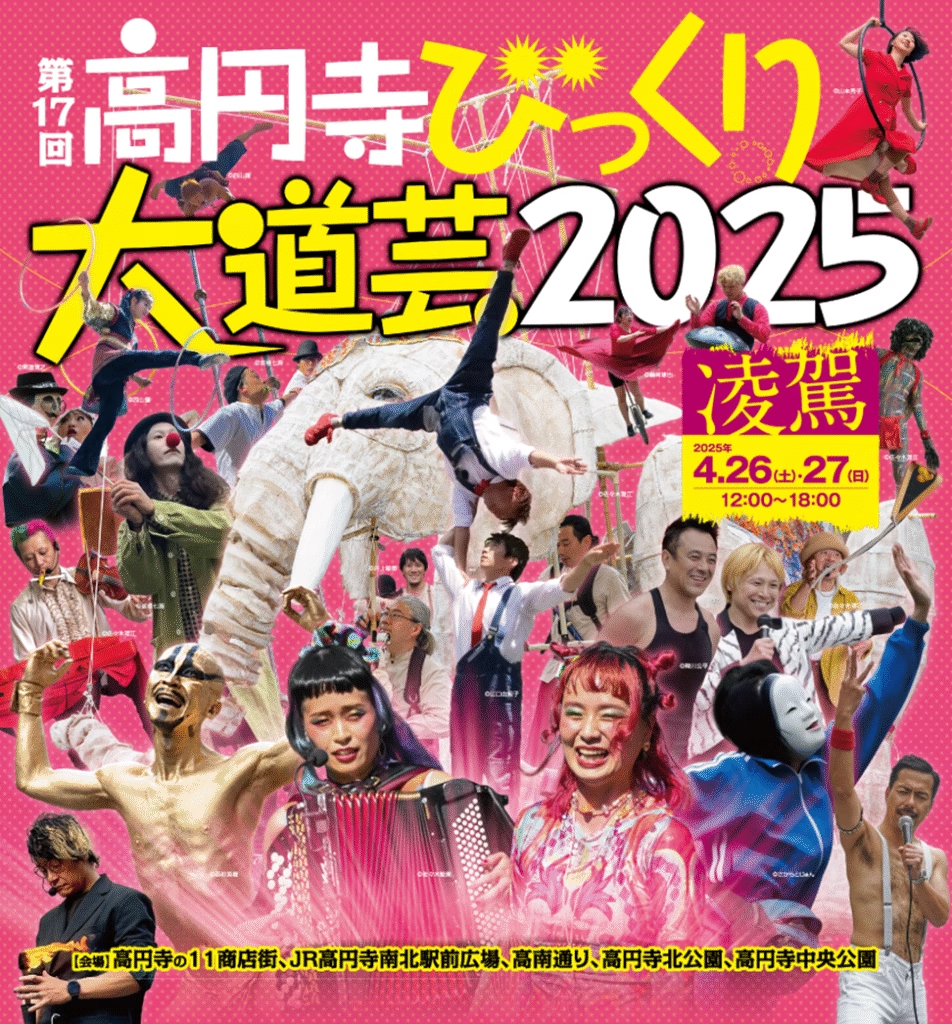
The Koenji Street Performer Festival (高円寺びっくり大道芸) is one of Tokyo’s most unique annual events, transforming the streets around Koenji Station into a giant open-air stage filled with acrobats, musicians, comedians, jugglers, and international performers. Held each spring in the vibrant Koenji neighborhood of western Tokyo, the festival attracts thousands of visitors who come to experience a side of the city that feels completely different from the skyscrapers of Shinjuku or the crowds of Shibuya.
Unlike many traditional Japanese festivals that focus on shrines, food stalls, or religious ceremonies, the Koenji Street Performer Festival celebrates live entertainment and creativity. Professional artists from Japan and abroad perform directly on the streets, often just a few meters away from the audience. One moment you might be watching a Chinese acrobatic troupe balancing impossibly high above the crowd, and the next you could discover a hidden café, a cosplay gathering, or a spontaneous comedy show tucked away in one of Koenji’s famous side streets.
When my fiancée and I woke up on a sunny Saturday morning, we had no plans to attend a festival. What started as a simple trip through Tokyo unexpectedly turned into one of the most memorable days we had experienced in the city. By pure chance, we arrived in Koenji just as the festival was taking over the neighborhood, and within minutes we found ourselves surrounded by performers, music, and an atmosphere unlike anything we had encountered elsewhere in Japan.
In this guide, I’ll share what we experienced at the Koenji Street Performer Festival, the best performances we saw, hidden spots worth visiting in the area, practical travel tips, and why this event deserves a place on any Tokyo itinerary.
A Rushed Morning in Shinjuku
The morning started with more stress than excitement.
My fiancée had a company-sponsored health check scheduled in Shinjuku, one of Tokyo’s busiest commercial districts and a major hub for medical services. Many Japanese companies require employees to undergo annual health examinations, known as kenkō shindan (健康診断), as part of the country’s preventive healthcare system. These checkups are taken seriously, and missing required identification or paperwork can sometimes mean waiting weeks or even months for a new appointment.
Of course, during the morning rush, she had forgotten some of the most important documents at home, including the identification needed for the appointment.
After a frantic trip across Tokyo to retrieve everything, we finally arrived in Shinjuku with enough time to spare. What had started as a stressful morning quickly turned into an opportunity to explore one of the city’s most diverse neighborhoods.
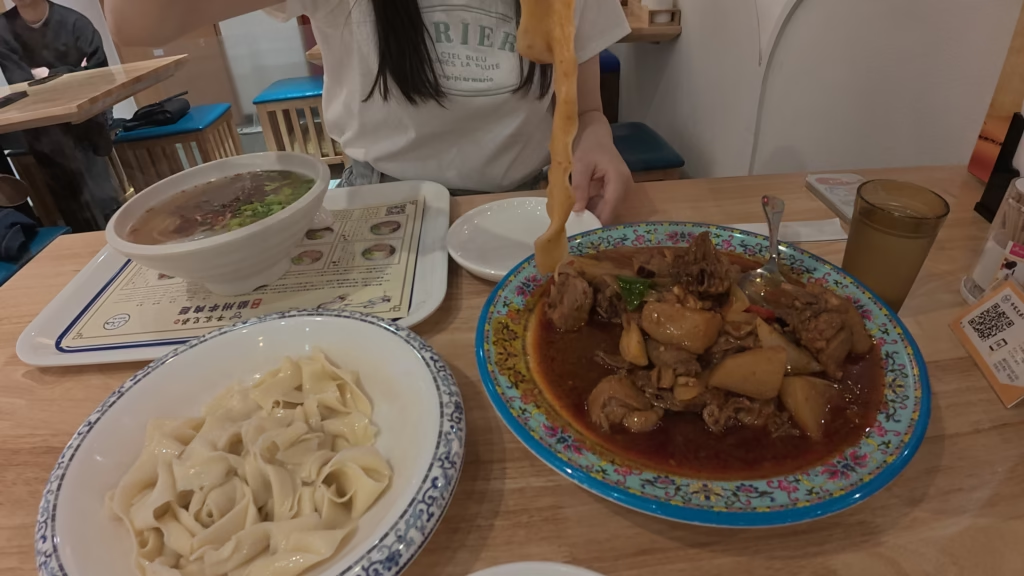
While waiting, we decided to grab lunch at Bull Brothers Halal Restaurant Lanzhou Beef Noodles Shinjuku, a small but highly regarded restaurant known among both local residents and international visitors. As the name suggests, the specialty here is Lanzhou-style hand-pulled beef noodles, a dish originating from northwestern China that has gained a loyal following in Tokyo’s multicultural food scene.
The meal was exactly what we needed after the morning’s chaos. The rich, aromatic broth was packed with flavor, the freshly hand-pulled noodles had the perfect chewy texture, and the tender slices of beef practically melted in our mouths. For travelers searching for a good halal restaurant in Shinjuku, it is an excellent option and a refreshing alternative to the Japanese cuisine that dominates much of the area.
With lunch finished and the health check successfully completed, we assumed the rest of the day would be uneventful. We had no idea that just a few train stops away, one of Tokyo’s most unusual festivals was about to completely change our plans.
The best: All the clinics are closed on weekends! So we heading just shortly into H&M and Uniqlo and bought some presents for her nieces birthday. After it we went home direction Koenji.
Cosplay on the Streets of Koenji

As we stepped out near Koenji Station, something immediately felt different.
The streets were far more crowded than usual, and the atmosphere buzzed with excitement. What first caught our attention were two women dressed in dazzling cosplay costumes, striking dramatic poses in the middle of a road that had been completely closed to traffic. Their elaborate makeup, colorful wigs, and carefully crafted outfits sparkled under the afternoon sun as curious visitors stopped to take photographs and admire their creativity.
At first, we assumed it was simply a small cosplay gathering. Tokyo is famous for anime culture, and spontaneous meetups featuring cosplayers are not uncommon in neighborhoods known for their alternative and creative communities.
However, the deeper we ventured into Koenji, the clearer it became that something much bigger was taking place.
Every corner seemed to reveal a new performance. Musicians filled the streets with lively melodies, magicians gathered fascinated audiences around impossible tricks, and comedians had entire crowds laughing out loud. Jugglers, dancers, acrobats, and entertainers of every kind transformed ordinary sidewalks into stages. Instead of cars and buses, the streets belonged entirely to performers and spectators.
What makes Koenji such a perfect setting for this event is the neighborhood itself. Located just west of Shinjuku, Koenji is known for its independent spirit, vintage clothing stores, underground music scene, and thriving artistic community. Unlike the polished luxury of Ginza or the neon spectacle of Shibuya, Koenji has long been a cultural hub for artists, musicians, and creative personalities. The district’s relaxed atmosphere provides the ideal backdrop for a festival dedicated to street performance and public entertainment.
Only then did we realize what we had stumbled upon: the Koenji Street Performer Festival 2025 (高円寺びっくり大道芸), one of Tokyo’s most beloved annual festivals. Each year, the event transforms the neighborhood into a giant open-air theater where professional performers from Japan and around the world entertain thousands of visitors. What began as a simple afternoon walk had unexpectedly become one of the most memorable festival experiences we had ever encountered in Tokyo.
What Is the Koenji Street Performer Festival?
The Koenji Street Performer Festival, known in Japanese as Koenji Bikkuri Daidougei (高円寺びっくり大道芸), is one of Tokyo’s largest and most distinctive street performance festivals. Held annually in the Koenji neighborhood of Suginami City, the event transforms ordinary shopping streets into a giant open-air theater where performers and spectators interact at close range. Unlike traditional Japanese festivals that revolve around shrines, religious processions, or food stalls, this event focuses entirely on live entertainment, creativity, and audience participation.
First launched in 2000, the festival has become a major fixture on Tokyo’s spring events calendar. Every year, professional performers from across Japan and abroad gather in Koenji to showcase a wide variety of talents, including acrobatics, juggling, clown acts, mime performances, comedy, street music, magic shows, puppetry, dance, and interactive theater. The festival attracts both Tokyo residents and visitors looking to experience a more local and artistic side of the city beyond the famous tourist districts.
The 2025 edition took place on April 26 and 27, turning the area around Koenji Station into a pedestrian-friendly festival zone. Popular shopping streets such as Azuma Dori, Junjo Shotengai, PAL Shopping Street, and Look Street were temporarily closed to vehicle traffic, allowing thousands of visitors to freely explore the performances. The unique layout encouraged attendees to wander through the neighborhood rather than remain in a single location, creating a sense of discovery around every corner.
More than 30 performance areas were scattered throughout the district. One of the festival’s defining characteristics is that there is no single main stage. Instead, visitors create their own experience by moving between different venues, following applause, music, laughter, or simply their curiosity. At one intersection, a juggler might be balancing flaming torches, while just a few minutes away an acrobatic troupe performs gravity-defying stunts above a captivated crowd.
One reason the festival remains so popular is its accessibility. Admission is completely free, making it one of the best free events in Tokyo for families, couples, photographers, and travelers. Visitors can spend an entire day exploring the performances or simply stop by for a short visit while exploring the surrounding neighborhood. This open and inclusive format helps create an atmosphere that feels welcoming rather than commercial.
The festival’s location plays a major role in its success. Koenji is widely regarded as one of Tokyo’s most creative neighborhoods, famous for its vintage clothing stores, independent music venues, second-hand shops, and alternative culture. The district has long attracted artists, musicians, and free spirits, giving it a character that feels very different from the corporate skyscrapers of Shinjuku or the luxury boutiques of Ginza. The area’s narrow streets, retro storefronts, and locally owned cafés provide the perfect backdrop for a festival dedicated to imagination and performance.
For travelers looking to experience a lesser-known side of Tokyo, the Koenji Street Performer Festival offers a unique opportunity to explore one of the city’s most vibrant neighborhoods while enjoying world-class entertainment in an informal and highly interactive setting.
Our Festival Favorites: Chinese Acrobats and Comedy Legends
Over the two days, we watched dozens of acts — each unique, each charming in its own special way.
Some made us laugh until our cheeks hurt, others made us hold our breath in awe.
But a few performances etched themselves so deeply into our memories that even now, just thinking about them brings a smile to our faces.
Among all the incredible talents, the Chinese acrobats group, officially known as 中国雑技芸術団 (Chūgoku Zatsugi Geijutsudan), left the most powerful impression.
From the very first moment they stepped into the small street stage, there was an electric tension in the air.
Their costumes shimmered under the sunlight, and even before the show truly began, the crowd instinctively drew closer, sensing something extraordinary was about to happen.

Their precision, strength, and balance felt almost superhuman. Watching them from only a few meters away was completely different from seeing an acrobatic performance on television. There were no special effects, no camera tricks, and no safety nets visible to the audience. Every movement relied entirely on years of training, trust, and absolute control over their bodies.
The performance began with a seemingly simple stack of chairs. One chair was carefully placed on top of another, each positioned at a slightly different angle. As the structure grew taller, the audience became noticeably quieter. What initially looked unstable soon transformed into a towering platform balanced on only a few narrow points of contact.
Then came the moment that left everyone speechless.
One performer slowly climbed the structure while the other stabilized it from below. Reaching the top, they performed a series of poses and balancing acts that appeared to defy gravity itself. Standing on a single hand, stretching into impossible positions, and maintaining perfect composure high above the crowd, they demonstrated a level of skill that was difficult to comprehend.
Every small adjustment sent a ripple of tension through the audience. Each time a chair shifted slightly, hundreds of people instinctively held their breath. Small children gasped in surprise, elderly couples exchanged astonished smiles, and even people who had been merely passing through stopped in their tracks to watch.
What impressed me most was not just the danger of the performance but the confidence with which it was executed. The artists never appeared nervous. Their movements were deliberate, elegant, and almost effortless, making one of the most physically demanding acts of the festival look deceptively easy.
When they finally completed the routine, the silence instantly exploded into thunderous applause. For several minutes afterward, people continued talking about the performance, many agreeing that it had been one of the highlights of the entire Koenji Street Performer Festival.
The second part of their act brought even more wonder.
They moved seamlessly into breathtaking aerial hoop performances, spinning and flipping high above the street, with only a simple metal ring keeping them suspended in the sky.
The combination of grace, danger, and perfect synchronization created a kind of magic that words can barely describe.
These artists weren’t just performers; they were the result of a lifetime of training, discipline, and an unbreakable passion for their craft — many of them beginning their training as young as four or five years old.
Every smile they flashed at the audience wasn’t just for show.
It felt genuine, warm, and a reminder of the years of hard work it took to transform skill into something that looked so effortless.
Adding an even deeper layer of magic to their act, the Chinese acrobats paid tribute to the legendary art of Bian Lian (变脸), the ancient Chinese face-changing technique often referred to as “the hundred faces art.” Though traditionally associated with Sichuan opera, this breathtaking mastery of transformation — switching faces with lightning speed — could be felt in the way the acrobats shifted their balance, poses, and energy throughout their performance. Each seamless transition was like a new “face” of their art, keeping the audience mesmerized, breathless, and fully captivated, as if witnessing a living tapestry of a hundred different expressions in motion.
Equally unforgettable, but in a completely different style, was Freddino (フレディーノ), the brilliant and hilarious parody artist inspired by Freddy Mercury.
Where the acrobats amazed, Freddino entertained and charmed.
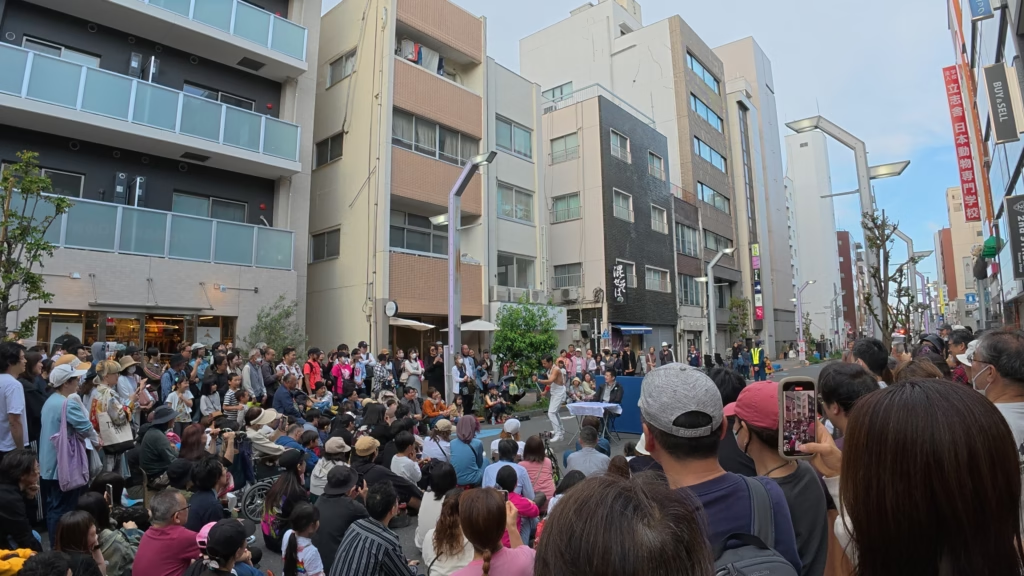
Dressed in Queen’s iconic stage outfits — from the tight white pants to the yellow military jacket — and sporting an exaggerated fake mustache, he took the street stage with larger-than-life energy.
But Freddino wasn’t just doing a simple imitation.
Through a mixture of live singing, exaggerated dance moves, and slapstick comedy, he created an act that was both a loving tribute and a uniquely Japanese twist on British rock legend fandom.
At one point, he led the entire street in a sing-along of “We Are the Champions,” complete with dramatic hand gestures and playful mock-serious expressions.
Strangers smiled at each other, couples swayed arm in arm, and children jumped around in pure excitement.
Countless other smaller acts filled the festival with endless delight.
Magicians wandered through the crowd, making coins disappear behind ears and pulling endless colorful scarves out of seemingly empty hats.
Clowns performed silent skits, drawing laughter without saying a single word, and turning the sidewalks into stages where anything was possible.
At one corner, a tiny group of children spontaneously joined a street musician, clapping and singing off-key but with such enthusiasm that even the musician had to pause and laugh.
Another performer, dressed as a jester, offered balloon animals to wide-eyed toddlers while playfully teasing their parents.
The whole atmosphere felt electric — not in the noisy, overwhelming way of a concert, but in a pure, contagious way that made you feel more alive with every passing moment.
It wasn’t just entertainment; it was connection. It was community.
Everyone, young and old, Japanese and foreigner alike, was part of something bigger for a few precious hours.
The magic of the Koenji Street Performer Festival wasn’t just on the stages — it was in the air itself.
The Koenji Vibe: A Living, Breathing Community
More than just a festival, the Koenji Street Performer Festival felt like a glimpse into a side of Tokyo that many visitors never get to see.
Popular images of Tokyo often focus on futuristic skyscrapers, crowded train stations, and endless neon lights. While those elements certainly exist, events like this reveal something equally important: the city’s strong sense of community. Neighbors, families, students, artists, and travelers all shared the same streets, united by curiosity, creativity, and a willingness to simply enjoy the moment together.
Everywhere we looked, there was something happening. Children clapped enthusiastically after every performance, often becoming the loudest supporters in the audience. Parents smiled as performers incorporated young volunteers into their acts. Elderly residents chatted with visitors while watching the shows from folding chairs placed outside local businesses.
The surrounding shopping streets were equally lively. Food vendors filled the air with tempting aromas, offering festival favorites such as takoyaki, yakisoba, grilled meats, and sweet treats. Local bars and cafés welcomed visitors throughout the day, while craft beer stands gave adults a chance to relax and enjoy the atmosphere between performances.
The festival also highlighted Koenji’s reputation as one of Tokyo’s most creative neighborhoods. Independent artists displayed handmade jewelry, illustrations, paintings, vintage goods, and quirky souvenirs that reflected the district’s alternative character. Unlike heavily commercialized events, much of what was being sold felt personal and locally connected.
One of the most remarkable aspects of the festival was the lack of separation between performers and spectators. There were few physical barriers and almost no sense of distance. Audience members could interact directly with artists, participate in performances, volunteer for magic tricks, dance to live music, or simply strike up conversations. The experience felt intimate and spontaneous rather than carefully choreographed.
This accessibility created an atmosphere that was both welcoming and authentic. The performers were not hidden behind large stages or security fences. Instead, they shared the same space as everyone else, turning ordinary streets into places of collective creativity and human connection.
Even after many of the official performances had concluded, the energy of the neighborhood remained. Small groups gathered outside bars, musicians continued playing guitars on side streets, and aspiring performers practiced tricks while friends cheered them on. Under the warm glow of streetlights, Koenji retained the feeling of an open-air gathering rather than a festival that had simply ended.
As we made our way back toward the station, I couldn’t help but feel that we had experienced something special. The Koenji Street Performer Festival was not merely a collection of performances. It was a celebration of community, creativity, and the uniquely human ability to bring people together through art. In a city famous for its scale and technology, it offered a refreshing reminder that some of Tokyo’s most memorable experiences are still found in its neighborhoods and among the people who call them home.
Discovering a Hidden Café in Koenji
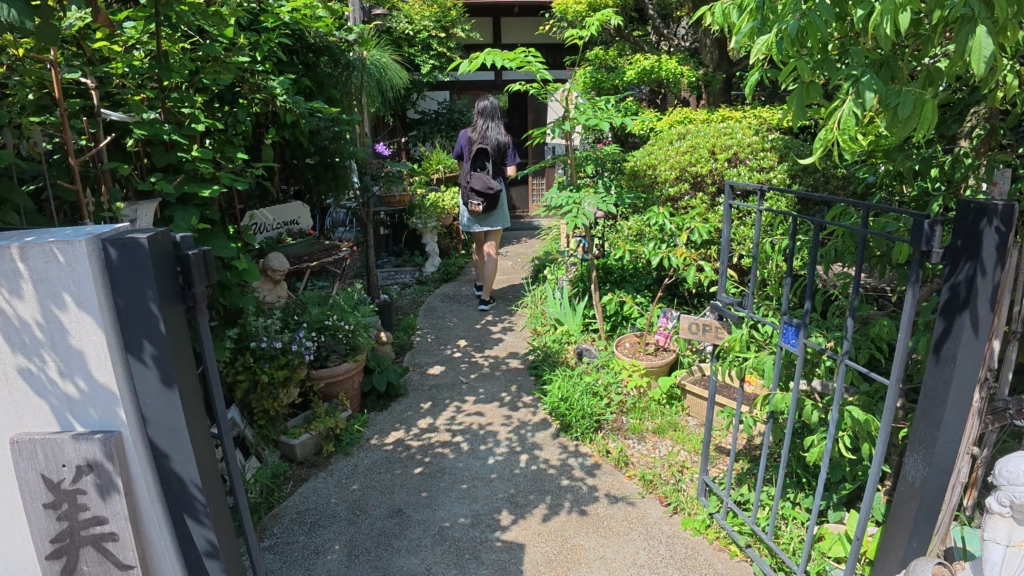
On Sunday afternoon, tired but glowing with happiness, we decided to slow down.
Following a quiet side street, we stumbled upon a true hidden café in Koenji — a little paradise away from the crowds.
Before even entering, we were enchanted by its garden.
In Tokyo, where space is as precious as gold, seeing real trees, flowers, and a little stone path felt surreal.
The garden wasn’t huge, but it created a serene, welcoming atmosphere.
They offered set lunches starting at 1400 yen.
We both chose different meals: I went for the juicy hamburger steak drenched in demi-glace sauce, and my girlfriend picked the oven-baked pasta with bubbling cheese.
Each lunch came with a starter — we received a delicate wasabi miso soup and tiny seasonal appetizers like pickled vegetables and a fresh tofu salad.
For an extra 200 yen, we enjoyed a rich cup of hand-dripped coffee at the end, sipping slowly, savoring every moment.
I immediately saved this hidden café into my personal Google Maps lists — a secret spot that felt like a reward at the end of an adventure.
Our Final Thoughts: A Weekend of Pure Joy and Discovery
Sometimes, the best travel experiences are the ones you never planned.
What began as a stressful morning involving forgotten documents and a rushed trip across Tokyo unexpectedly became one of our favorite weekends in Japan. By pure chance, we discovered the Koenji Street Performer Festival, and what we found was far more than a collection of performances. It was a celebration of creativity, community, and the unique character that makes Koenji one of Tokyo’s most fascinating neighborhoods.
From the breathtaking Chinese acrobats balancing high above the crowd to the colorful cosplay, talented musicians, street magicians, and hidden cafés tucked away between vintage shops, every corner of the district offered something new to discover. Unlike many large-scale events, the festival never felt commercial or overcrowded. Instead, it felt local, authentic, and deeply connected to the community that hosts it every year.
For visitors searching for unique things to do in Tokyo, the Koenji Street Performer Festival deserves a place alongside the city’s more famous attractions. While millions of tourists visit places like Shibuya Crossing, the Tokyo Skytree, and Sensō-ji Temple, festivals like this provide a rare opportunity to experience everyday Tokyo culture in a way that feels personal and genuine.
If you are planning a trip to Tokyo in late April, I highly recommend checking whether the Koenji Street Performer Festival is taking place during your visit. Admission is free, the atmosphere is welcoming, and the performances range from world-class acrobatics to intimate street entertainment. Whether you are traveling as a couple, with friends, or as a family, it offers a side of Tokyo that many international visitors never get to experience.
And even if the festival is not running, Koenji itself is worth exploring. Its vintage stores, independent cafés, live music venues, and artistic spirit make it one of the most interesting neighborhoods in the city.
As we boarded the train home that evening, tired but smiling, I realized something important: the places you remember most are often the ones you never intended to visit. The Koenji Street Performer Festival reminded us that some of Tokyo’s greatest treasures are not found in guidebooks, but in unexpected moments, hidden streets, and the joy of simply following your curiosity.
Author

Get My Personal Travel Maps
Keep Reading: More Articles You’ll Love
 Living in Tokyo vs Zurich – The Ultimate Expat Guide
  Koenji Tokyo Guide: The Ultimate Hub for Vintage, Vinyl, and Local Eats
  Christmas in Roppongi: Winter Illuminations, Market & Tokyo Tower Views
  Halloween in Tokyo: From Shibuya to Shinjuku and Beyond
  A Night at Tantra Tokyo: Burlesque, Glamour & Unexpected Surprises
  Is Tokyo Really Safe? What I Learned Living Here for 3 Years
  The Ultimate Guide to the Best Furniture Stores in Tokyo: MUJI vs. Nitori vs. IKEA


Leave a Reply