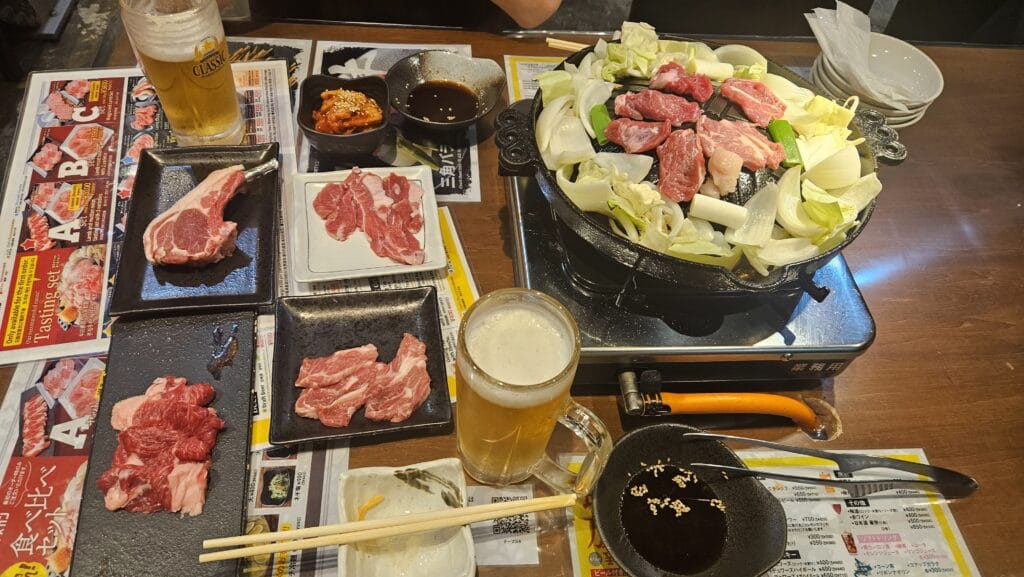
If there’s one dish you have to eat in Sapporo, it’s Jingiskan (ジンギスカン, also written Jingisukan): grilled lamb and vegetables cooked at your table on a dome-shaped iron grill. It’s Hokkaido’s signature barbecue, cheap, smoky and incredibly satisfying on a cold winter evening. We had it on a February evening in Sapporo, right before heading out to the Sapporo Snow Festival, and it was one of the best meals of our trip.
In this guide, I’ll explain what Jingiskan is, where the name comes from, how to eat it like a local, our experience at Hiratsuka Genghis Khan and a few other famous places to try it in Sapporo.
Jingiskan Quick Facts
- What: Lamb or mutton grilled with vegetables on a dome-shaped grill at your table
- Where: All over Hokkaido, especially Sapporo
- Price: Usually around ¥3,000 to ¥4,000 per person with drinks
- Best area in Sapporo: Susukino, the nightlife district
- Good to know: Your clothes will smell of barbecue, so don’t wear your nicest jacket
What Is Jingiskan?
Jingiskan is the Japanese pronunciation of Genghis Khan. Despite the name, it isn’t a Mongolian dish. It’s a Japanese invention, inspired by grilled mutton dishes from northeastern China, and it has become one of Hokkaido’s most iconic foods.
The dish is cooked on a convex iron grill that is said to resemble a warrior’s helmet. Thin slices of lamb or mutton are placed on the hot top of the dome, while vegetables like onions, bean sprouts, cabbage, peppers and pumpkin cook around the edge. As the meat grills, its juices run down the sides and flavor the vegetables, which is the whole idea behind the special grill shape.
There are two main styles. In the marinated style, the meat is soaked in a sweet soy-based sauce before grilling, which is typical of Takikawa in central Hokkaido. In the dipping style, more common in Sapporo, the meat is grilled plain and then dipped in a sauce, often made with soy, fruit and garlic. Many restaurants also let you choose between lamb, which is tender and mild, and mutton, from older sheep, which has a richer, stronger flavor.
A Short History of Jingiskan
The story starts with wool, not food. In 1918, the Japanese government set up sheep farms to produce wool for uniforms, and the farms in Hokkaido, including Tsukisamu in Sapporo and Takikawa, were the only ones that really succeeded. With all those sheep around, people looked for ways to eat the meat, and grilled mutton became popular. The name Jingiskan first appeared in writing in the early 1930s.
After World War II, Jingiskan became a cheap, filling meal for workers and families across Hokkaido, and over the decades it turned into the region’s signature dish. Today, most of the lamb and mutton used for Jingiskan is imported, mainly from Australia and New Zealand. Lamb actually raised in Hokkaido is rare and served as a premium option at a few restaurants.
Our Experience at Hiratsuka Genghis Khan
Among the many Jingiskan restaurants in Sapporo, we chose Hiratsuka Genghis Khan, and it was a great introduction for first-timers. Each table has its own grill, and you cook the meat and vegetables yourself at your own pace. The staff were friendly and quick to show us how to grill properly, which is very welcome if you’ve never done it before.
The lamb was tender and full of flavor, and the vegetables slowly soaked up the juices as they cooked around the dome. The restaurant’s sauce is slightly sweet, tangy and savory, and it complements the lamb without overpowering it. The interior is simple and relaxed, with the sizzling of the grills and the smell of barbecue filling the room. Even when it was busy, it felt comfortable rather than rushed.
Its central location makes it easy to combine with an evening in Susukino or a visit to the Snow Festival. After a few hours out in the cold, sitting in front of a hot grill is exactly what you want.
Opening hours and menus can change, so check the restaurant’s website before you go.
How to Eat Jingiskan
- Wait until the grill is properly hot. Staff usually rub a piece of lamb fat over the dome to grease it.
- Put the vegetables around the lower edge of the grill first, since they take longer to cook.
- Place the meat on the top of the dome, where it’s hottest. Thin slices only need a short time on each side.
- Dip the meat in the sauce if you’re eating the dipping style, and eat the vegetables once they’ve soaked up the juices.
- Order rice and a cold beer. Jingiskan and Sapporo beer are a classic combination.
Other Famous Places to Eat Jingiskan in Sapporo
Daruma in Susukino is probably the most famous Jingiskan restaurant in Sapporo. The small counter restaurant has been serving lamb since the 1950s, and there’s often a line outside, especially in the evening.
Sapporo Beer Garden serves Jingiskan in the historic brick buildings of the Sapporo Beer complex, often as an all-you-can-eat and all-you-can-drink course. It’s a fun choice for groups and can be combined with a visit to the Sapporo Beer Museum next door.
Tips for Eating Jingiskan
- Your clothes and hair will smell of barbecue. Many restaurants give you an apron and a plastic bag for your jacket, so use them.
- Popular restaurants get busy, especially during the Snow Festival. Reserve if you can, or go early in the evening.
- Try both lamb and mutton if the restaurant offers them. The difference is surprisingly big.
- You can also buy Jingiskan meat and sauce in supermarkets in Hokkaido, and some places even sell the dome grill as a souvenir.
Curious about real Mongolian food after trying the Japanese version? Lao Sui Yuan in Ikebukuro serves authentic Mongolian dishes right in Tokyo.
Jingiskan is the perfect dinner after a ski day. If you plan to hit the slopes while you are in Sapporo, my guide to the best ski resorts in Hokkaido covers Sapporo Teine, Kokusai, Niseko, Rusutsu and every other ski area on the island.
For more food, sights and day trips, read my Sapporo travel guide.
Frequently Asked Questions
What is Jingiskan?
Jingiskan (also written Jingisukan) is Hokkaido’s lamb barbecue. Thin slices of lamb or mutton are grilled with vegetables on a dome-shaped iron grill at your table.
Why is it called Jingiskan?
Jingiskan is the Japanese pronunciation of Genghis Khan. The name was chosen because the dish was inspired by grilled mutton from northeastern China, and the dome-shaped grill is said to look like a warrior’s helmet. It is not actually a Mongolian dish.
Where can I eat Jingiskan in Sapporo?
Susukino has the most choice. Popular options include Hiratsuka Genghis Khan, the famous counter restaurant Daruma and the all-you-can-eat courses at Sapporo Beer Garden.
How much does Jingiskan cost in Sapporo?
Expect to pay around ¥3,000 to ¥4,000 per person including a drink at most restaurants. All-you-can-eat courses cost a bit more but include unlimited meat and drinks.
What is the difference between lamb and mutton?
Lamb comes from young sheep and is tender with a mild flavor. Mutton comes from older sheep and has a richer, stronger taste. Many Jingiskan restaurants offer both.
Is the lamb for Jingiskan from Hokkaido?
Mostly not. The majority of lamb and mutton used for Jingiskan today is imported, mainly from Australia and New Zealand. Hokkaido-raised lamb is rare and usually sold as a premium option.
Final Thoughts
Jingiskan is one of those meals that tells you a lot about the place you’re in: simple, warming and made for sharing on a cold Hokkaido night. Whether you go to Hiratsuka Genghis Khan, line up at Daruma or eat at the Sapporo Beer Garden, don’t leave Sapporo without trying it.
Planning your trip? Read my Sapporo Snow Festival guide, and for a sweet ending after your barbecue, visit the Shiroi Koibito Park chocolate factory with its winter illuminations. For a day trip by the sea, Otaru is only a short train ride away.
Author

Get My Personal Travel Maps



Leave a Reply