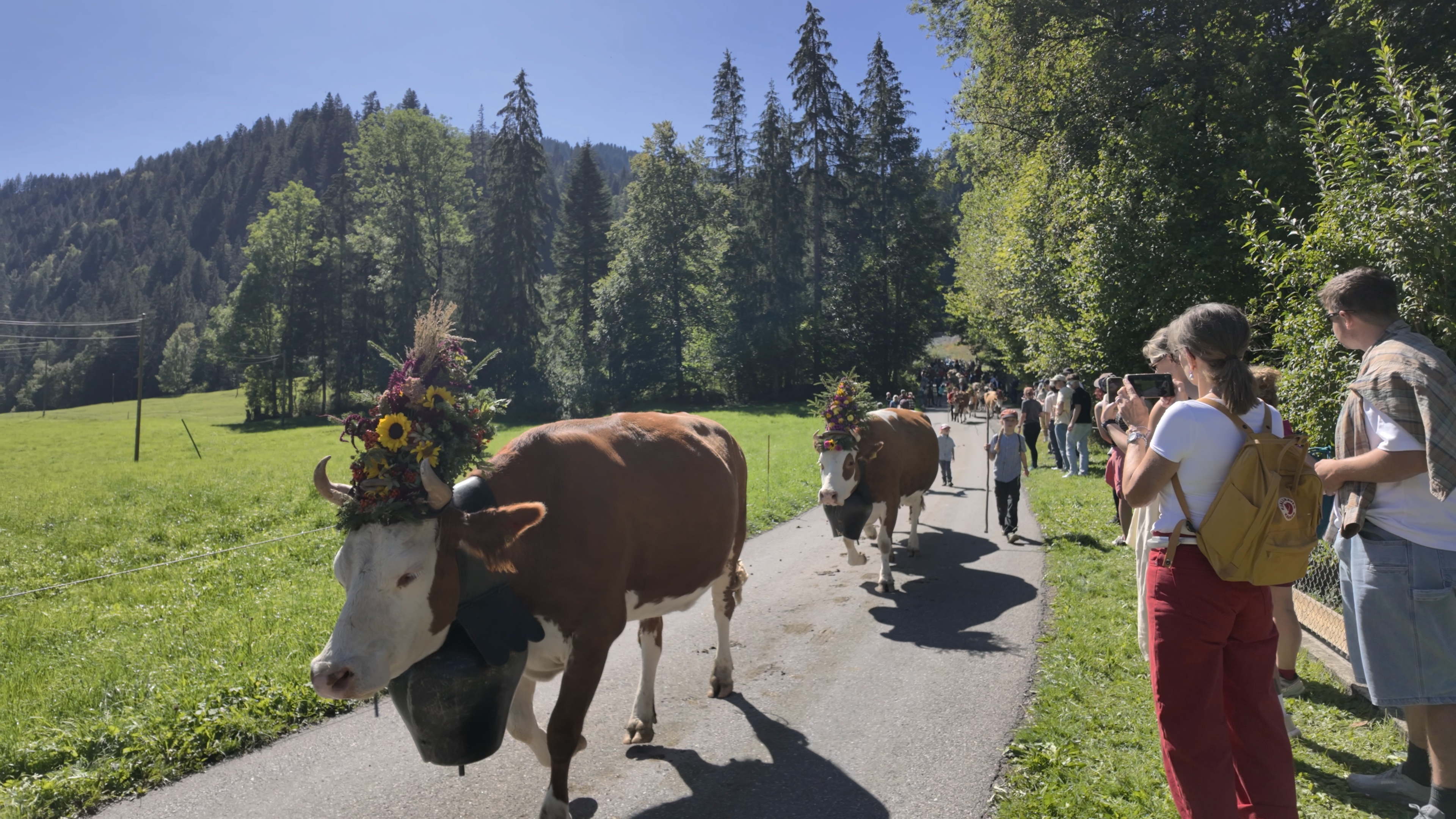
Every September, a small village in the Bernese Oberland fills up with people who came for one reason: to watch cows walk home. It sounds almost too simple to be worth the trip, until you actually stand at the roadside in St. Stephan and see the first herd round the corner, horns wrapped in ribbon, flowers piled on their foreheads, bells clanging in a rhythm no drummer could ever fake. This is Alpabfahrt, and in St. Stephan it has grown from a quiet farming custom into one of the most loved autumn festivals in the Simmental valley, now well into its fifth decade as an organized event.
What makes St. Stephan worth singling out among Switzerland’s many alp descents is not spectacle for its own sake. It is the setting. This is cattle country in the most literal sense, the valley that gave its name to one of the most widely bred cattle breeds on earth, and the animals coming down the mountain that day are, in a very real way, walking through their own history.
What Alpabfahrt Actually Is
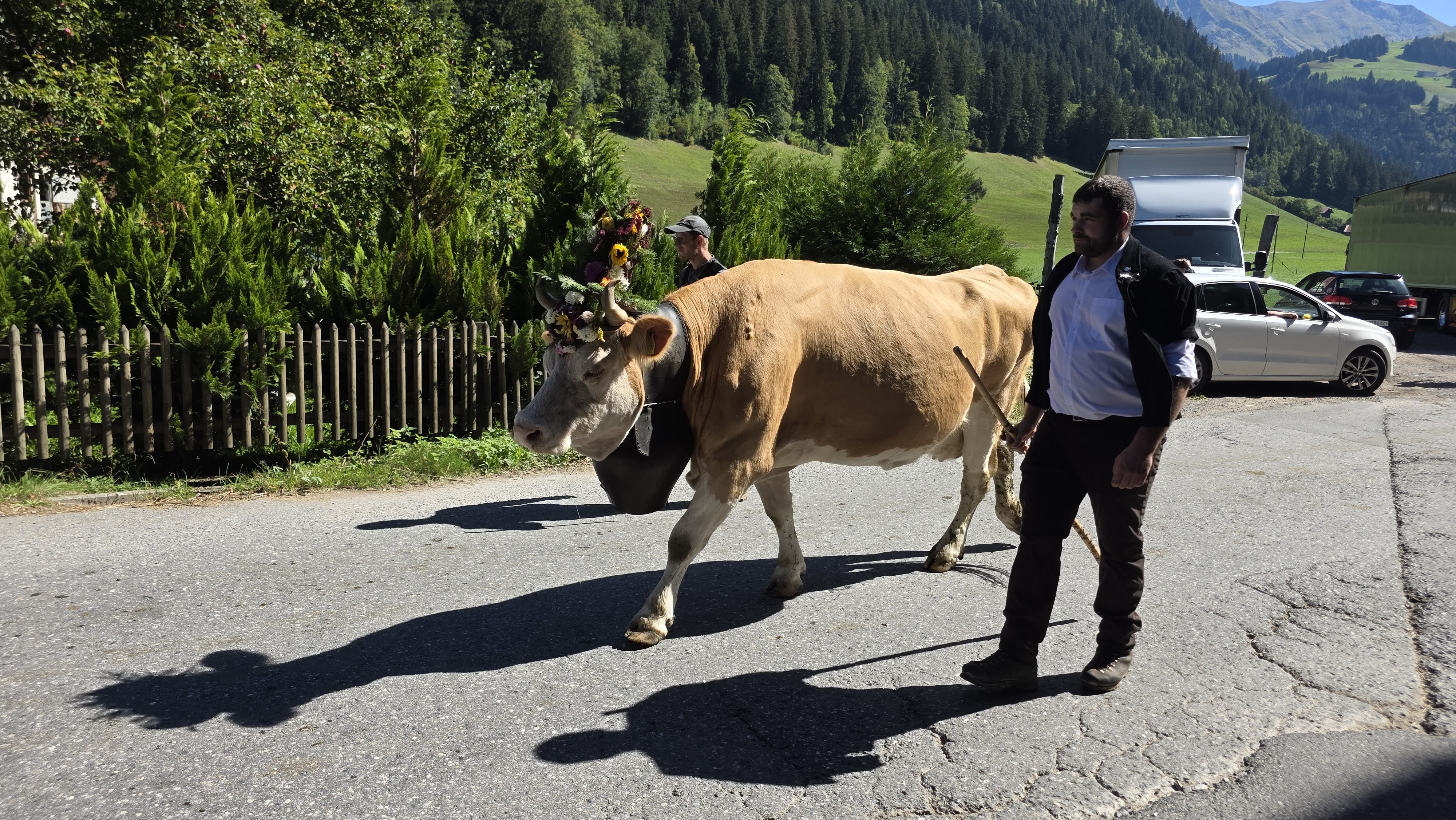
Alpabfahrt goes by several names depending on which part of the Alps you are standing in. In the Bernese dialect it is Alpabfahrt or Alpabzug, in German-speaking regions further north it becomes Almabtrieb, and in French-speaking Switzerland people call it la désalpe. All of it describes the same seasonal ritual: the return of cattle, sheep, and goats from the high alpine pastures down to the valley floor once the summer grazing season ends.
The counterpart happens in reverse each June, when herds are driven up to the alp for the summer, a much less celebrated event called the Alpaufzug. The descent gets the bigger party, and for good reason. It marks the successful end of roughly 80 days on the mountain, a stretch during which farmers, hired herders, and their animals live largely cut off from the valley, dependent on the weather, the grass, and a fair amount of luck. Coming home without losing an animal to a cliff edge, a storm, or disease has historically been something worth genuinely celebrating, not just marking on a calendar.
Why This Tradition Exists at All
The roots of Alpabfahrt sit inside a much older practice called transhumance, the seasonal movement of livestock between low winter pastures and high summer ones. In the Alps this pattern goes back centuries, shaped by simple geography: valley meadows cannot support herds year-round, but the high alps burst with grass, herbs, and wildflowers for a few short months each summer. Sending cattle up there let farmers rest their home fields, produce alpine cheese from milk that had grazed on exceptionally rich pasture, and make use of land that would otherwise sit idle.
None of this was ever purely practical, though. Herders spent the summer largely isolated, and the descent back into the community carried real emotional weight long before anyone thought to sell tickets or set up a market stall. Decorating the animals was originally an act of thanks rather than decoration for its own sake, a way of marking that the herd had made it through the season whole. Over generations that private gesture turned into a public one, and villages began greeting the returning herds with music, food, and a proper welcome rather than a quiet nod from the barn door.
The Meaning Behind the Flowers and Bells
The most photographed part of any Alpabfahrt is also the part with the most history packed into it. The lead cow of each herd, chosen for being the strongest, calmest, or simply the best milker of the season, wears the largest and most elaborate headdress, often a tall crown of flowers and foliage called a Tschäppel in some regions. The rest of the herd gets its own share of ribbons, garlands, and bells, though nothing quite matches what the lead animal carries.
The bells themselves are not incidental either. Many are genuine working alp bells, some passed down through families, with hand-embroidered leather straps that take real skill to make. Historically the sound served a practical purpose, helping herders track animals grazing out of sight on open terrain, but today the noise of dozens of bells moving as one is as much a part of the atmosphere as the flowers are. Alphorn music and yodelling round out the sound of the day, both of which trace back to the same herding culture that produced the bells in the first place: tools and traditions built by people who spent their working lives on steep, open ground.
The Simmental Valley and Its Famous Cattle
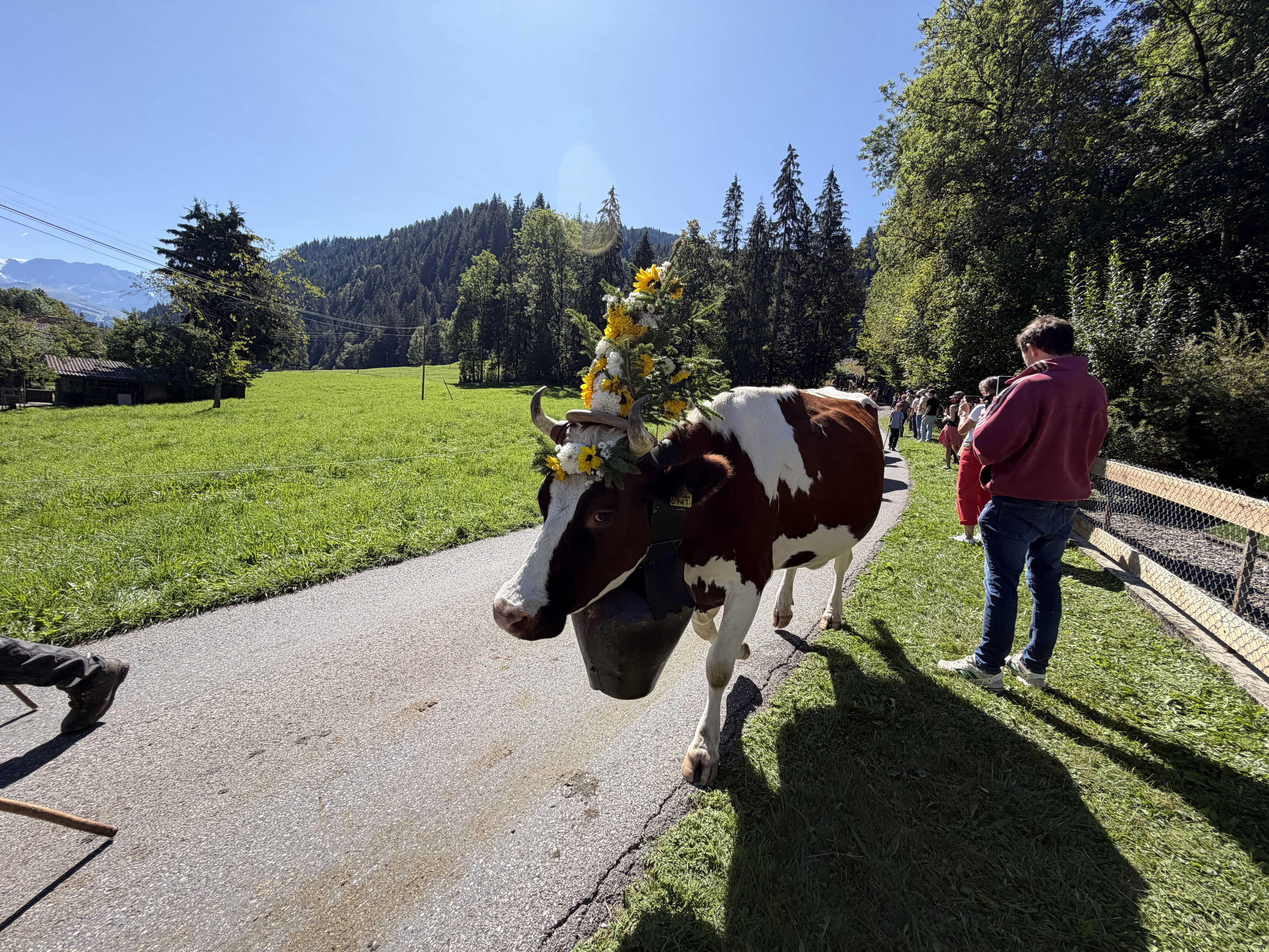
St. Stephan sits inside the Simmental, the valley carved by the Simme river through the Bernese Oberland, and this particular stretch of land has a claim to fame that goes well beyond one autumn festival. The Simmental is where the Simmental breed of cattle takes its name, one of the oldest and most widely distributed cattle breeds in the world today.
The breed’s roots go back to the Middle Ages, developing from crosses between large German cattle and a smaller type native to Switzerland. Farmers in the region bred for an animal that could do almost everything at once: produce good milk, put on meat efficiently, and still work as a draft animal when needed. The results were red-and-white cattle, calm-tempered and physically substantial, so useful that the Swiss parliament restricted their export as early as 1785 simply to keep enough animals at home. The first official herdbook followed in the canton of Bern in 1806.
From that single valley, the breed spread to nearly every cattle-producing country on the planet. It appears in Germany and Austria under the name Fleckvieh, in France as Pie Rouge, and under Simmental or Simmentaler in dozens of countries from Namibia to the United States, where the breed reappeared commercially in the late 1960s after some largely forgotten early imports decades earlier. Estimates put the worldwide Simmental population somewhere between 40 and 60 million animals, an almost absurd number for a breed that started in one narrow Alpine valley. The original horned Swiss type, sometimes marketed today as Original Simmentaler, is now treated as something closer to a heritage breed at home, even as its descendants dominate cattle industries on six continents. Watching a herd of them walk down into St. Stephan is, in a strange way, watching the source material for a huge share of the world’s dairy and beef cattle come home for the winter.
Alpabfahrt in St. Stephan Today
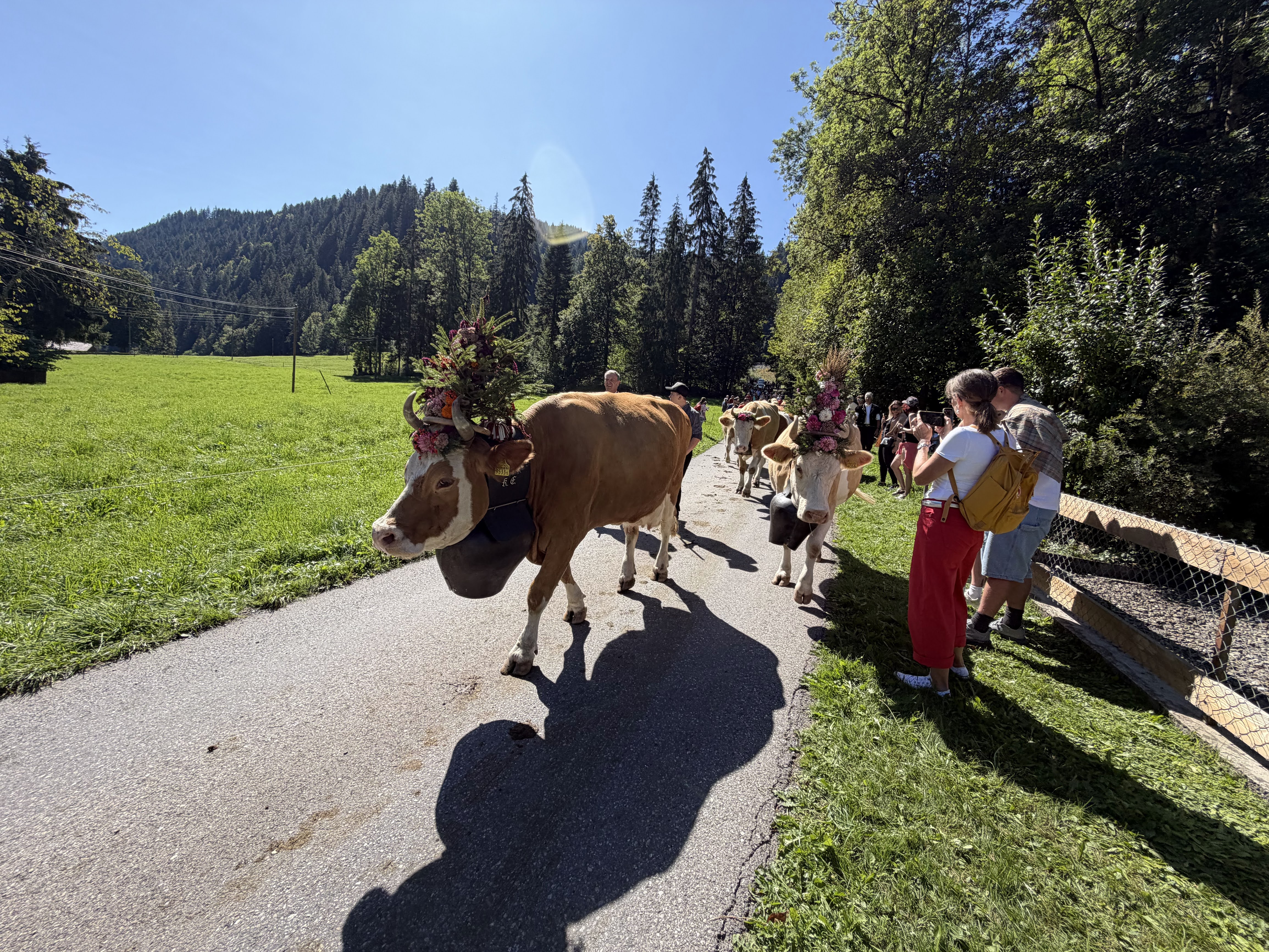
The St. Stephan event has been running as an organized festival since the late 1980s, and the anniversary numbering has become part of its identity locally, with each edition counted and celebrated in its own right. The animals themselves spend roughly 80 days grazing on Dürrenwald, the alp above the village, before making their way down along routes that pass Alp Flösch and cross the Simme on the way into the valley.
What sets St. Stephan apart from some of the more staged alp festivals elsewhere in Switzerland is that the descent itself is not performed for an audience. The animals and their herders come down the mountain the way they always have, on the schedule the terrain and the weather dictate, and the festival simply gathers around that reality rather than the other way round. Three separate processions typically arrive within the same window during late morning, each bringing its own herd, its own herders, and often its own mix of animals, since goats make the trip alongside the cattle in several of the local herds.
Once the animals reach the festival grounds, the day turns into a proper village fair. Regional producers set up market stalls, there are cheese-making demonstrations for visitors who want to see how alpine cheese actually gets made rather than just eat it, and children’s activities keep the event from being purely a spectacle for adults. Local musical groups, from yodel clubs to Schwyzerörgeli quartets and alphorn ensembles, provide the soundtrack through the afternoon, and on anniversary years the celebration extends into the evening with a heated festival tent, further music, and formal recognition from the municipality for the farmers and herders behind the season.
What to Expect if You Go
Arriving early is worth it if you want a clear view of the processions coming in, since the roadside near the arrival point fills up quickly once word spreads that the first herd has been spotted. The festivities generally open mid-morning with the market and food stalls already running, well before any cattle appear, which gives visitors time to get settled and grab something to eat without missing the main event.
Admission to the daytime program is free, funded instead through the market stalls, the festival restaurant, and small keepsakes like commemorative badges sold on site. Food and drink are handled through a proper festival restaurant rather than scattered food trucks, so expect hearty regional fare rather than festival junk food. Bring layers regardless of the forecast. September in the Bernese Oberland can swing from warm sunshine to a genuinely cold wind once the afternoon wears on, especially standing around outdoors for a few hours.
Getting to St. Stephan
St. Stephan sits in the Obersimmental, close to Lenk and not far from the better-known resort town of Gstaad, making it an easy stop if you are already spending time in that part of the Bernese Oberland. The village is reachable by train via the regional line running through the Simmental, with connections from Spiez and Zweisimmen, and the walk from the station into the village center is short. If you are driving, the valley road through the Simmental gives you a scenic route in either from the Thun side or over from Gstaad, both worth building extra time into your schedule for simply because the drive itself is part of the appeal.
Other Alpabzüge Worth Knowing About
St. Stephan is far from the only place in Switzerland doing this. The tradition plays out in dozens of villages between early September and mid October, under a different name depending on which language region you are standing in: Alpabzug or Alpabfahrt in German-speaking Switzerland, Züglete around Gstaad and the Simmental, désalpe in French-speaking areas, and Scargada or S-chargiada d’Alp in the Romansh valleys of Graubünden. If the St. Stephan date does not line up with your travel plans, there is almost certainly another one that does.
Bernese Oberland
This is the region St. Stephan sits in, and it has more than one Alpabzug worth planning around. The Gstaad Züglete opens the season in early September with decorated herds walking straight down the resort town’s main promenade. Lauterbrunnen hosts several smaller, particularly scenic descents through the same valley made famous by its waterfalls, including ones from Mäderalp, Winteregg, and the Schiltalp above Mürren. Innertkirchen near Meiringen and Hofstetten bei Brienz, close to the Ballenberg Open-Air Museum, both pair their cattle descent with a proper village festival. The Justistal above Lake Thun adds a Chästeilet into the mix, the ceremonial division of the summer’s cheese among the alp’s farmers, using milk from more than 250 cows. Lenk, just up the valley from St. Stephan, closes out the regional season in October with its own Älplerfest and a “Miss Lenk” cow competition.
Fribourg and Vaud
The French-speaking side of the Alps runs some of the country’s largest désalpes. Charmey in La Gruyère has built an international reputation for its flower-decorated herds and craft market, and nearby Plaffeien in the Schwarzsee-Senseland region brings in up to a thousand animals over the course of a single day. Albeuve holds its own major désalpe across a full weekend. In the Vaud Alps, Saint-Cergue draws crowds of over 15,000 for what is often called the largest Alpine descent festival in the Lake Geneva region, while L’Etivaz times its désalpe to the start of its famous AOP cheese season, and smaller versions run in Gryon, Blonay, and above Montreux at Caux.
Valais
Valais adds a distinct character to the tradition through the Hérens, or Eringer, cattle breed, a naturally combative animal historically used in ritualised cow fights, whose homecoming gets crowned with an Alpine Queen title at some festivals. Blatten-Belalp and Grimentz both build their désalpes around Hérens herds. The Val d’Anniviers alone holds several, in St-Luc, Chandolin, Ayer, and Vercorin, and Saas-Fee runs a smaller, distinctive version built around goats rather than cattle.
Graubünden
In the Romansh-speaking valleys, Brigels and Breil hold a Scargada that brings together five separate herds and around 600 animals descending from different alps on the same day. Müstair welcomes its cattle in front of the UNESCO-listed Convent of St John, and further Alpabzüge take place in Flims, Klosters-Monbiel, Celerina, and several villages of the Lower Engadin including Guarda, Sent, Ftan, and Ardez.
Central Switzerland and the Emmental
The Entlebuch region in canton Lucerne runs one of the country’s biggest and most attended descents through Schüpfheim, drawing thousands of spectators for its market and folklore groups. Engelberg in Obwalden pairs its Alpabzug with an autumn market, and the Emmental holds its own smaller descents around Sumiswald and Eggiwil, alongside the Sichlete, an agricultural harvest festival held right on Bundesplatz in the city of Bern.
Appenzell and Eastern Switzerland
Appenzellerland treats its Alpabfahrten, known locally as Öberefahre, as a slower-moving, more spread-out tradition rather than a single event, with individual farming families bringing their herds down to villages like Urnäsch over several days depending entirely on the weather and the grass. The wider region also holds a long calendar of Viehschauen, cattle shows where farmers present and judge their animals rather than parade them, running through Herisau, Trogen, Teufen, and several other villages well into October. Further along, Elm in canton Glarus combines its Alpabzug with an Alpine cheese and Schabziger market each autumn.
None of these festivals run on a fixed date every year, and several are only confirmed a season or even a week ahead. Weather, grazing conditions, and drought can shift or cancel an alp descent entirely, since the animals’ welfare always comes before the festival calendar. Checking directly with the relevant local tourism office before planning a trip around any specific Alpabfahrt is always worth the extra step.
If you are building a longer trip around this part of Switzerland, our Switzerland travel guide is a good starting point for planning, and our guide to Thun covers the closest larger town if you want a base with more accommodation options. For another angle on Bernese Oberland day trips, see our Niederhorn to Lake Thun guide, or stay in the same corner of the Oberland with our guides to Oeschinensee and Blausee, both an easy detour from Kandersteg. If you want to see where a lot of these traditions, tools, and farm buildings actually come from, our Ballenberg Open-Air Museum guide walks through reconstructed Swiss farmhouses and the country’s rural history in one place, Simmental cattle included. And if alpine villages and their own herding stories interest you beyond the Bernese Oberland, hiking to Heidi’s Alp above Maienfeld covers the Graubünden side of that same culture.
Author

Get My Personal Travel Maps
Keep Reading: More Articles You’ll Love
 Ballenberg Open-Air Museum: A Journey Through Swiss History
  Tateyama Kurobe Alpine Route Guide: Snow Wall, Tickets & Toyama Day Trip
 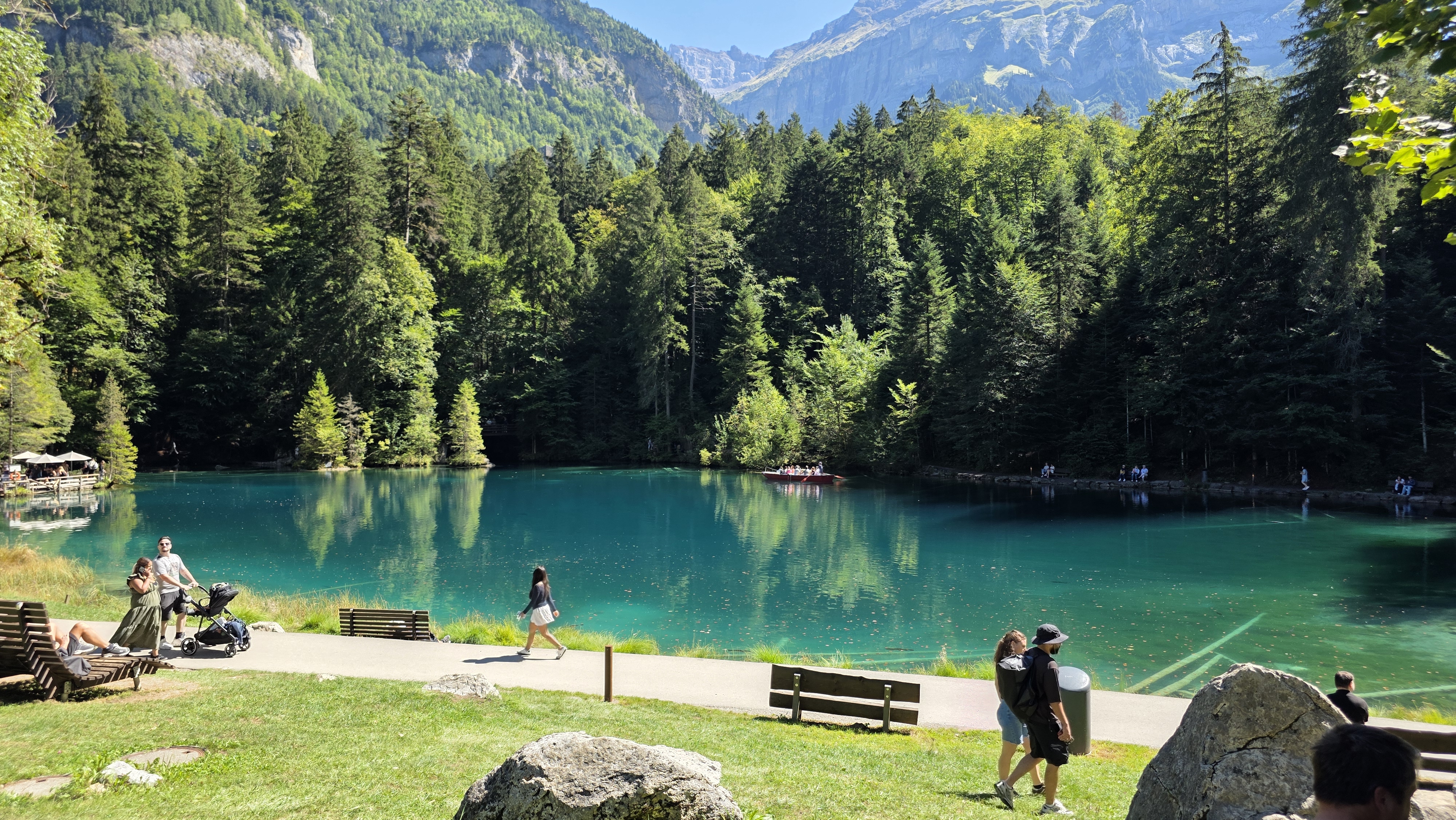 Blausee Switzerland: My Complete Guide
  Thun, Switzerland: Castle, Aare Surfing, Riverside Food and How Long to Stay
  Hiking to Heidi’s Alp Above Maienfeld: The Real Village Behind the Story
 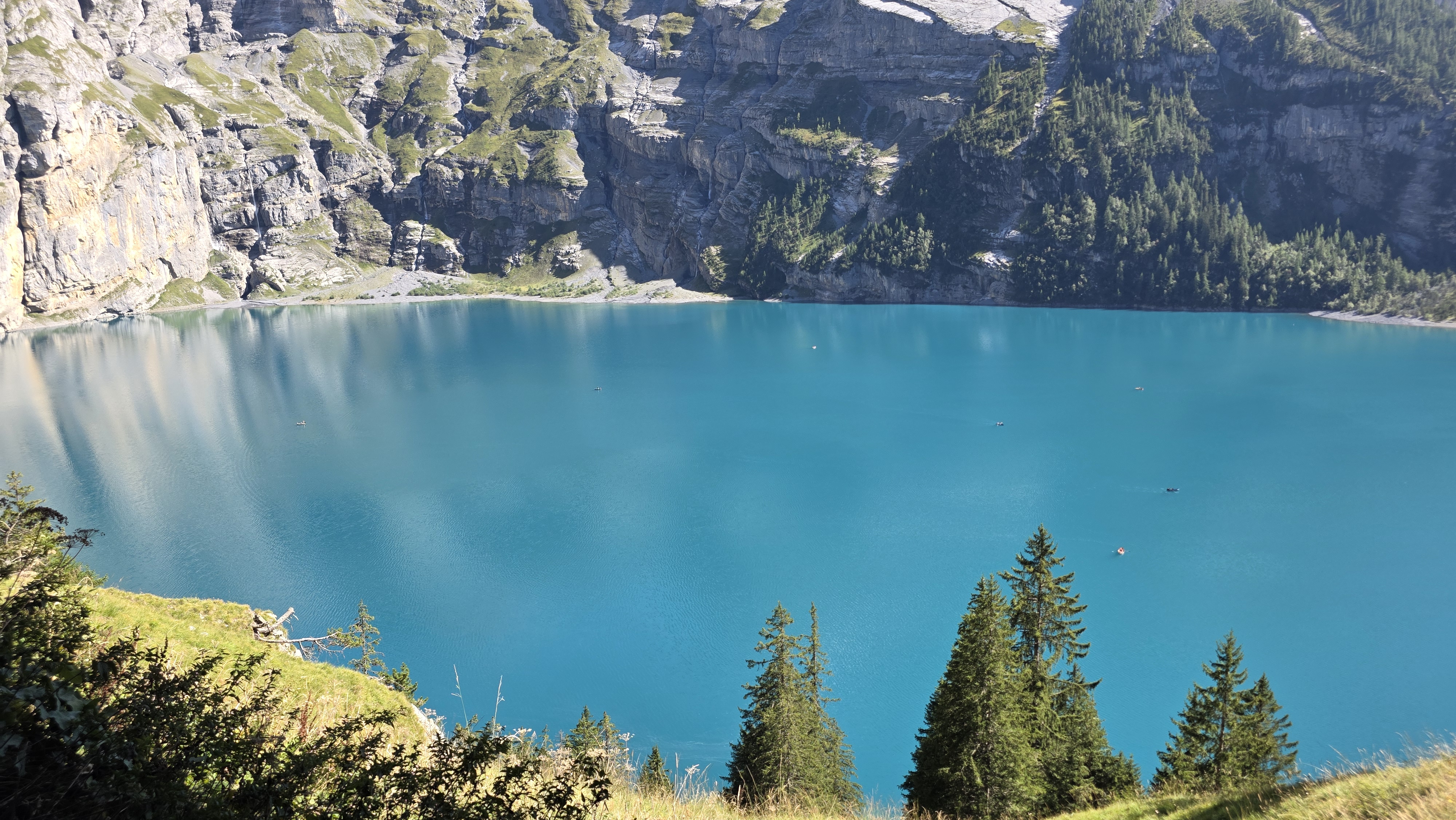 Oeschinensee Switzerland: My Complete Guide
  Why I Don’t Recommend Kobe Beef – The Overpriced Hype and Common Kobe Beef Scams Exposed


Leave a Reply