
Introduction: More Than Just Makeup
I’ve spent over three years living in Tokyo, and if you search for “gyaru meaning,” most results will give you the same surface- level answer: a Japanese fashion trend with dramatic makeup. Technically correct. But it barely scratches the surface of what gyaru actually was—or why it mattered. Because gyaru was never just about makeup. Walk through Shibuya or Harajuku today, and you’ll still spot fragments of it in how people dress, how they apply eyeliner, the way they move. But most people don’t understand what they’re looking at. They see the aesthetics and miss the entire point. Gyaru was a way of standing out in a society built on blending in. It was a visual language designed to challenge expectations—and for a crucial period in the early 2000s, it became one of Japan’s most visible youth movements. Young women didn’t just change how they looked. They changed how they lived, how they spoke, who they spent time with. To understand gyaru properly, you have to look beyond the tutorials and the makeup techniques. You have to understand why it existed in the first place. And once you do, you’ll see that gyaru wasn’t just a trend. It was a form of quiet resistance. This guide walks through all of it—the history, the culture, the meaning, and why gyaru is relevant again in 2026.
What Is Gyaru? A Tokyo Resident’s Deep Dive
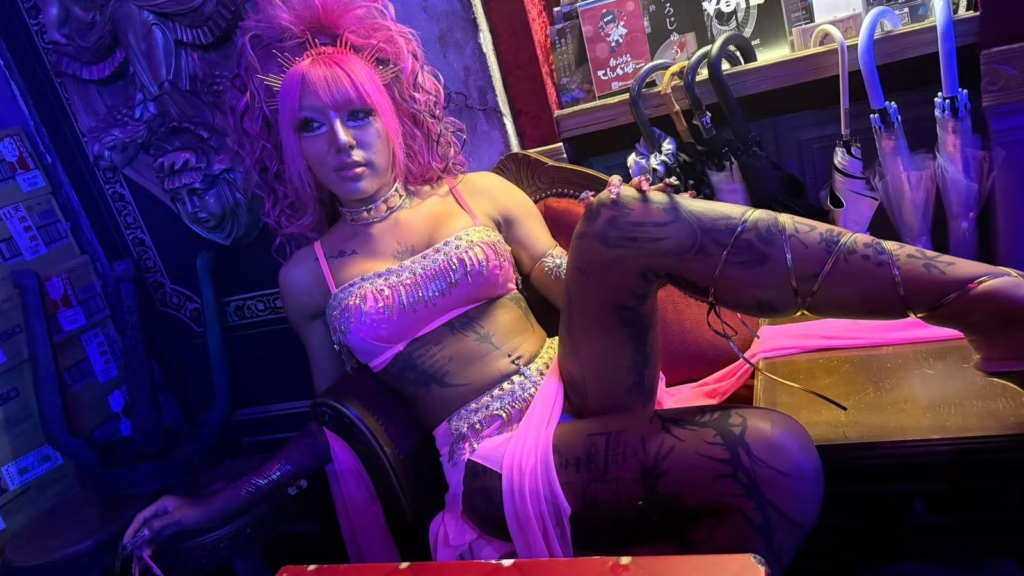
Gyaru is a Japanese youth subculture that emerged in the late 1990s and reached its peak in the early 2000s, developing primarily among young women in urban centers, especially Tokyo, where fashion districts became testing grounds for new identities and styles. The word itself comes from the English “gal,” but in Japan it evolved into something far more specific—it no longer referred simply to a girl, but to a distinct type of attitude and appearance that stood in contrast to mainstream expectations. More precisely, gyaru is defined by bold fashion, highly stylized makeup, and a conscious rejection of traditional beauty standards and social norms. But what makes gyaru interesting isn’t just how it looks. It’s why it looks that way. Gyaru emerged during a time when Japanese society placed strong emphasis on uniformity, modesty, and restraint, especially for women. Beauty ideals were centered around natural appearance, pale skin, and subtle expression. Gyaru deliberately challenged these norms by embracing visibility, exaggeration, and individuality—creating a form of social expression that allowed its followers to construct new identities that were more independent, more playful, and often more influenced by global trends, particularly Western fashion and media. What began as a reaction to cultural expectations gradually developed into a fully formed aesthetic system with its own rules, variations, and communities. Over time, gyaru became one of the most recognizable and influential subcultures in modern Japanese fashion history.
The Real Gyaru Meaning
To understand gyaru’s true meaning, you need to look at what came before it. For decades, mainstream beauty in Japan followed a quiet and predictable ideal centered on natural appearance, restrained makeup, pale skin, and an overall sense of subtlety. Beauty was meant to blend in, not stand out. Gyaru completely shattered that framework. Instead of enhancing what was already there, it embraced the idea of constructing an entirely new look. Makeup became visible rather than invisible, styling became bold rather than understated, and individuality took priority over social conformity. Where traditional beauty aimed for harmony and restraint, gyaru leaned into contrast, exaggeration, and presence. This is precisely why gyaru makeup appears so dramatic—it isn’t designed to look effortless or natural. It’s designed to be noticed.
Gyaru as a Subculture, Not Just a Look
This is where many guides fall short.
Gyaru Subculture is often reduced to gyaru makeup, but historically, it was only one part of a much larger system. The subculture extended far beyond appearance and shaped how people presented themselves in everyday life.
It influenced fashion choices, from bold outfits to specific brands, and it defined hairstyles that were just as expressive as the makeup itself. Even the way people spoke, the slang they used, and the social circles they moved in were part of their identity. Gyaru was not something you put on for a moment. It was something you lived.
In the early 2000s Tokyo, especially in areas like Shibuya, being gyaru meant belonging to a distinct cultural space. It came with shared references, habits, and a recognizable way of interacting with the world.
Makeup was simply the most visible layer of that identity, the part that could be seen instantly. But underneath it was a much deeper expression of lifestyle and attitude.
Gyaru History: Shibuya 109, Egg Magazine & Origins
The movement took shape in Shibuya, particularly around Shibuya 109—a shopping center that became far more than retail space. It functioned as an informal laboratory where trends weren’t just displayed, they were actively invented. Every day, young women gathered there to observe what others were wearing, experiment with their own looks, and constantly test the boundaries of what was considered acceptable style. If you walk through Shibuya today, you can still feel the echo of that energy—it’s why the district remains the epicenter of Tokyo youth culture.
Magazines like Egg played an equally crucial role, but they worked differently than traditional fashion media. They didn’t simply document what was happening on the streets—they amplified it, curated it, and gave it structure and legitimacy. By featuring real girls instead of distant professional models, they transformed everyday participants into trendsetters. A girl wearing gyaru on Shibuya’s streets could appear in Egg Magazine, and suddenly her look became the standard that thousands of others copied. That feedback loop—street to magazine to street—standardized what “gyaru” meant across the entire country.
What began as scattered, individual expressions of rebellion gradually crystallized into something far more organized. Gyaru developed its own visual codes, distinct substyles like Ganguro and Hime Gyaru, and tight-knit communities. What started as a loose collection of ideas transformed into one of the most iconic subcultures in modern Japanese fashion history. And unlike many trends that fade completely, elements of gyaru never disappeared—they simply went dormant, waiting to resurface.
How Gyaru Makeup Works: Technique & Philosophy
Makeup as Transformation
Unlike most modern beauty trends, gyaru makeup isn’t about enhancing your natural features—it’s about transforming them entirely. And if you’ve ever tried to recreate the look, you’ll quickly realize that this distinction matters. The core goal is straightforward but radical: change how the face is perceived. In traditional Japanese beauty, the ideal was subtle—minimal makeup that enhanced what was already there. Gyaru does the opposite. The makeup is designed to restructure the face, to make eyes appear larger and more doll-like, to create sharper contours, and to build stronger contrast between features. It’s reconstructive rather than additive. This is precisely why the look feels so distinctive and, honestly, intimidating to people who first encounter it. You’re not looking at a girl with better makeup. You’re looking at a girl who has deliberately reconstructed how her face reads. The transformation is intentional, visible, and unapologetic. And that visibility—the fact that you can see the process, the construction, the technique—is actually the point. Gyaru makeup embraces its own artificiality. It doesn’t try to hide behind “natural looking” techniques. It says: “I made this choice. I constructed this look. Look at me.” That’s also why gyaru makeup became such a powerful form of self- expression. It wasn’t subtle resistance. It was loud, visible, impossible to ignore—which is exactly what made it so threatening to a society built on restraint.
How to Do Gyaru Makeup: The 3 Core Techniques
At the core of gyaru makeup is a deliberate restructuring of the face, built around three consistent principles that work together to create the signature look. The first is always about the eyes. They are the absolute focal point, and the entire technique is engineered to make them appear larger and more defined than they naturally are. This is achieved through a specific sequence: extending eyeliner slightly below the natural eye line, layering bold false lashes for volume and drama, and adding brightness beneath the eye to create depth and separation. The result isn’t subtle enhancement—it’s a noticeable shift in how the entire eye shape is perceived. If you watch someone apply it, you’ll see the eyes literally transform as each layer is added. The second principle is contrast, and this is where gyaru makeup becomes visually striking. The makeup plays with light and dark in a very intentional way: bright under-eyes paired with strong dark liner, defined lashes contrasted against a smoother, more neutral base, and lips kept relatively subtle so that all attention stays on the eyes. This controlled use of contrast doesn’t just make each feature stand out—it creates a kind of visual hierarchy that guides where someone’s eyes go when they look at your face. Everything points toward the eyes. But here’s what separates gyaru from most other makeup trends: it doesn’t try to hide the process. The lashes, the liner, the contour—all of it is visible by design. Instead of blending everything into a seamless, natural finish, gyaru makeup embraces its own construction. And this visibility isn’t a flaw or a limitation. It’s intentional. It’s part of the aesthetic. In fact, that transparency—the ability to see the technique, the work, the choice behind the look—is precisely what makes it feel so deliberate and powerful.
Ganguro vs Hime Gyaru vs Onee Gyaru Explained

Gyaru’s evolution can be understood as a spectrum—a shift from maximum provocation to wearable everyday style, with each substyle reflecting changing attitudes about what rebellion could look like. The most extreme expression was Ganguro, which emerged in the late 1990s as the most radical version of the subculture. Ganguro featured deep artificial tans, stark white lips and eyeliner, and an overall emphasis on maximum contrast. The look was intentionally shocking—designed to break every norm at once and demand immediate attention. If you wanted to stand out in Tokyo, Ganguro was the most aggressive way to do it. And that was the entire point. But as the movement evolved, something shifted. Young women still wanted to express individuality and reject conformity, but not all of them wanted to be visibly confrontational. Hime Gyaru, which translates to “princess gyaru,” moved in a completely different direction. Instead of harsh contrasts and aggressive aesthetics, it focused on lighter tones, voluminous hairstyles, and a more polished, almost luxurious aesthetic. The look was still bold, still unmistakably gyaru, but it felt refined and elegant rather than confrontational. You could wear Hime Gyaru and still navigate normal social spaces without the same level of resistance. Later, styles like Onee Gyaru took that evolution even further—introducing a genuinely mature approach to the subculture. This version toned down the intensity even more and made gyaru genuinely wearable for everyday life. The makeup became more subtle, the fashion more sophisticated, yet the core principles remained intact. Onee Gyaru still emphasized transformation and individuality. It still rejected traditional beauty standards. But it did so in a way that felt less like performance and more like personal choice. You could be Onee Gyaru and work in an office. You could be Onee Gyaru and blend into a crowd if you wanted to. The subculture had learned to adapt without losing itself. This evolution tells you something important: gyaru was never actually about the extreme look. It was always about the choice to look different. As society’s tolerance shifted slightly, gyaru shifted with it—proving that the real rebellion wasn’t the makeup or the fashion. It was the refusal to conform.
Is Gyaru Coming Back in 2026? The Comeback Explained
Gyaru is no longer dominant in Japan, but it hasn’t disappeared. Instead, it evolved into something different—something that’s harder to recognize because it stopped being a unified subculture and became a distributed set of influences scattered across modern fashion and beauty. Walk through Tokyo today and you won’t see many people wearing full gyaru looks. But you’ll see fragments everywhere. On TikTok and Instagram, beauty creators post gyaru-inspired eye makeup tutorials—the exaggerated eyeliner, the bright undereye, the layered lashes—and thousands of people recreate them without necessarily identifying as gyaru. In fashion, young women mix gyaru elements with other aesthetics: a bold eyeliner borrowed from gyaru paired with minimalist clothing, or gyaru-style hair with contemporary streetwear. It’s hybrid. It’s selective. It’s modern. What’s changed is that gyaru is no longer an all-or-nothing identity. In the early 2000s, being gyaru meant committing to the entire aesthetic, the entire lifestyle, the entire community. Today, people pick and choose. They take the eye makeup techniques, leave the rest. They embrace the philosophy of individuality and rejection of conformity without adopting the specific look. In a way, that’s a sign of how successful gyaru was—its principles became so influential that they entered mainstream culture. The subculture didn’t die. It dispersed. But here’s what matters: the core of gyaru—the idea that you can deliberately construct your identity, that you don’t have to follow the rules, that visibility and boldness are forms of power—that didn’t go away. It just found new expressions.
Why Gyaru Is Coming Back
Gyaru’s resurgence isn’t random. It’s the result of several forces colliding at exactly the right moment. The first is nostalgia. Early 2000s aesthetics have been cycling back into mainstream culture for years now—low-rise jeans, mini bags, specific music—and gyaru is inextricably linked to that era. Gen-Z, who weren’t alive during gyaru’s peak, discovered it through archived photos and videos, and there’s something compelling about adopting the aesthetic of a time you only know through digital fragments. It feels both retro and rebellious. But nostalgia alone wouldn’t be enough. What really accelerated the comeback is algorithmic visibility. TikTok, Instagram, and YouTube have made it trivially easy to find gyaru makeup tutorials, gyaru fashion inspiration, and gyaru subculture content. If you watch one video about gyaru eyeliner, the algorithm will show you dozens more. The platform essentially manufactures interest by making certain content inescapable. A 16-year-old in rural America can now access more gyaru content in a day than someone living in Tokyo could in 2005. There’s also a broader renewed interest in Japanese subcultures more generally—anime, manga, fashion, beauty—as part of a global shift toward non-Western aesthetic influences. Japan’s youth culture, which was once dismissed or exoticized in the West, is now genuinely cool. And gyaru, as one of Japan’s most visually distinctive subcultures, benefits from that legitimacy. But perhaps most importantly, gyaru resurfaces at a moment when beauty culture globally is shifting away from the “natural looking” aesthetic that dominated the 2010s. For years, the ideal was dewy skin, subtle makeup, “enhancing what you have.” That philosophy has exhausted itself. Now, there’s growing interest in makeup as transformation, in beauty as creative expression, in the idea that you don’t have to look natural to look good. Gyaru, which was always about construction and visibility, fits perfectly into that moment. It’s not just a trend coming back. It’s a philosophy whose time has come around again.
Gyaru vs Modern Beauty
| Modern Beauty | Gyaru |
|---|---|
| natural finish | constructed look |
| minimal makeup | dramatic styling |
| subtle contour | defined shaping |
| skin-focused | eye-focused |
This fundamental contrast—between natural and constructed, between blending in and standing out, between what beauty was supposed to be and what gyaru chose to make it—is precisely why gyaru still feels unique today, even as elements of it have been absorbed into mainstream culture. Most modern beauty trends are ultimately about refinement or optimization. Gyaru is about rupture. It’s not trying to be better at looking natural. It’s rejecting the entire premise that you should look natural at all. That philosophy—the willingness to be visibly artificial, deliberately constructed, unapologetically bold—hasn’t really gone out of style. If anything, it’s becoming more relevant.
Gyaru in Tokyo Today: Where You Still See It
Living in Tokyo, you rarely see full gyaru looks in everyday life anymore. But you still notice fragments of it everywhere if you know what to look for. You’ll spot a specific eyeliner technique on a girl at the train station, exaggerated lashes on someone walking through Harajuku, bold fashion combinations that mix aesthetic rules in ways that feel deliberate and intentional. The influence is there, quietly woven into how people present themselves, but it’s no longer unified or recognizable as “gyaru” at first glance. That shift is significant. Gyaru moved from being a dominant subculture with clear markers and community boundaries to being a diffuse aesthetic influence that shapes modern beauty and fashion without announcing itself. In some ways, that’s a sign of success. When a subculture’s core ideas become so widespread that they stop being subversive, it means those ideas won. The philosophy of deliberate self-construction, of rejecting conformity through visibility and boldness, is no longer radical because it’s become normal. It’s embedded in how people think about beauty and identity now. But here’s what’s interesting: that normalization hasn’t made gyaru invisible. It just made it quieter. The eyeliner technique that would have identified you as explicitly gyaru in 2005 is now just one tool in a larger aesthetic toolkit. The boldness is still there. The refusal to blend in is still there. It’s just expressed in subtler, more adaptable ways.
Why Gyaru Matters: Beauty, Identity & Resistance
Understanding what gyaru really means requires looking beyond makeup techniques and fashion choices. It offers insight into something much larger: how beauty standards can be systematically challenged, how subcultures influence and eventually reshape mainstream culture, and how identity can be constructed and expressed visually as a form of agency. In that sense, gyaru functions as a kind of informal cultural feminism, though that term requires careful explanation because it’s easy to oversimplify. Gyaru emerged in a specific context where expectations for women in Japan were deeply tied to modesty, restraint, and conformity. The beauty ideal was about blending in, about being subtle and controlled, about fulfilling a predetermined role. Gyaru pushed directly against that. By embracing visibility, boldness, and personal choice, it created space for young women to construct their own identities instead of fitting into predefined roles. That act of construction—the decision to look visibly different, to reject what you’re “supposed” to look like—is inherently political, even if it doesn’t announce itself as such. But it’s important not to label gyaru too narrowly or impose meanings that weren’t necessarily there. It was not a traditional political movement, and most gyaru participants would not have described themselves as feminists. They were just young women making choices about how they wanted to look and who they wanted to be. Yet those personal choices, accumulated across thousands of people, functioned as a form of everyday resistance. Resistance expressed through eyeliner and fashion, through attitude and lifestyle, through the simple act of refusing to conform. That’s ultimately what gyaru was about. It was never just about looking different. It was about choosing to be different on your own terms. And that choice, that agency, that refusal to accept someone else’s definition of who you should be or how you should look, is what made it powerful then. And it’s what makes it worth understanding now.
Author

Get My Personal Travel Maps
Keep Reading: More Articles You’ll Love
 Is Japanese Food Actually Chinese? The Surprising Origins of Japanese Cuisine
  Living in Tokyo vs Zurich – The Ultimate Expat Guide
  The Ultimate Guide to Tokyo Fashion: From Streetwear to High-End Luxury
  The Ultimate Guide to the Best Furniture Stores in Tokyo: MUJI vs. Nitori vs. IKEA
  Halloween in Tokyo: From Shibuya to Shinjuku and Beyond
  Tattoos in Japan: Rules, Culture, Onsen & Changing Attitudes
  Kabukicho Tokyo: The Ultimate Insider Guide to Shinjuku’s Wildest District


Leave a Reply