
Shinjuku is the Tokyo most people picture: the busiest station in the world, skyscrapers on one side, neon and tiny bars on the other, and a huge quiet garden in between. It is also the best all round base for a first trip. When I lived in Koenji, Shinjuku was just 7 to 10 minutes away on the JR Chuo Line.
Shinjuku is also much more than its station and its nightlife. The ward reaches north to Waseda, where I studied for my master’s degree, to Koreatown in Shin-Okubo and east to the old stone lanes of Kagurazaka. This guide is my overview of the whole area: how Shinjuku is laid out, what to do by day, the neighbourhoods beyond the station, where to eat, how to go out at night without getting ripped off, and where to stay. Each section links to my detailed guide for that part of Shinjuku.

Shinjuku at a Glance: The Areas
Shinjuku Station splits the district in two. The west side is skyscrapers, big hotels and offices. The east side is restaurants, department stores and nightlife. Knowing which exit you need saves a lot of time.
| Area | What you find there | My guide |
|---|---|---|
| West Exit (Nishi Shinjuku) | Skyscrapers, the free observation floors of the Tokyo Metropolitan Government Building, Omoide Yokocho next to the station | Omoide Yokocho |
| East Exit and Kabukicho | Neon, the Godzilla head, Kabukicho Tower, izakaya, karaoke, standing bars | Kabukicho |
| Golden Gai | Six narrow alleys with around 200 tiny bars next to Hanazono Shrine | Golden Gai |
| Shinjuku Sanchome and 2-chome | Restaurants and bars, Japan’s biggest concentration of gay bars | Nightlife guide |
| South: Shinjuku Gyoen | A 58 hectare garden with three garden styles and about a thousand cherry trees | Shinjuku Gyoen |
| North: Shin-Okubo | Tokyo’s Koreatown, about 10 minutes north of Kabukicho, with Korean BBQ and food stalls | Kabukicho |
| Shin-Okubo (Koreatown) | Korean BBQ, food stalls and Korean shops, a ten minute walk north of Kabukicho | Kabukicho |
| Waseda | Waseda University, the Okuma Auditorium and the Wasedasai student festival in November | Tokyo festivals by month |
| Kagurazaka | Stone lanes, old restaurants and the Bakeneko cat festival in October | Bakeneko Festival |
Getting to and Around Shinjuku
Shinjuku Station connects JR lines, three subway lines and private railways that run all the way to Hakone and Mount Fuji. The highway bus terminal Busta Shinjuku sits on top of the station. Shibuya is about 7 minutes away on the Yamanote Line and Tokyo Station under 15 minutes on the JR Chuo Rapid Line.
- The station is a maze. Follow the signs for the exit you want (East, West, South) before you leave the gates, not after.
- For Kabukicho and Golden Gai use the East Exit. Shinjuku-Sanchome Station is also close: exit E2 is about 2 minutes from Golden Gai, exit C8 reaches the southern edge of Kabukicho.
- For Omoide Yokocho use the West Exit, the alley is one minute away along the tracks.
- Avoid rush hour with suitcases. Weekday mornings from about 7:30 to 9:30 are packed.
An IC card like Suica makes all of this easy. Here is how Suica works for visitors.
Things to Do in Shinjuku by Day
See Tokyo for free from the Government Building
The Tokyo Metropolitan Government Building has free observation rooms on the 45th floor, about 200 metres up, with Mount Fuji on clear days. In the evening the facade turns into a free projection mapping show, Tokyo Night and Light. Of all the observation decks in Tokyo, this is my personal favourite. Compare it with the paid ones in my guide to Tokyo observation decks.

Walk through Shinjuku Gyoen
Shinjuku Gyoen is a 58 hectare garden that mixes three garden styles, with wide English lawns for picnics. Entry is 500 yen. In spring it is my favourite all round cherry blossom spot: about a thousand trees of many varieties, including late bloomers that carry the season into mid April. Alcohol is not allowed and bags are checked at the gates.

If the Shinjuku Gate is busy, use the Sendagaya Gate or the Shinjuku-gyoemmae Gate, and reserve entry online on peak blossom weekends. More in my Shinjuku Gyoen guide and the Tokyo cherry blossom guide.
Visit Hanazono Shrine
On the western edge of Kabukicho, right next to Golden Gai, Hanazono Shrine dates from the Edo period. It is a calm stop before the bars open, and a good meeting point for the evening.
Walk in from Harajuku
Harajuku to Shinjuku is only 25 to 30 minutes on foot. My favourite day in Tokyo starts in Harajuku, goes through Meiji Jingu and Shibuya, and ends in Shinjuku at night. Here is the full one day walking route.
Beyond the Station: Shinjuku’s Other Neighbourhoods
Most visitors only see the few streets around Shinjuku Station. But Shinjuku is a whole city ward, and some of my favourite corners of Tokyo are inside it, a short ride or walk away from the neon.
Waseda: my university neighbourhood
I spent my years in Tokyo studying for my master’s degree at Waseda University, so this is the part of Shinjuku I know from everyday life rather than from nights out. The main campus is the heart of the area, with the Okuma Auditorium as its landmark. You reach it from Waseda Station on the Tokyo Metro Tozai Line, or on foot from Takadanobaba on the JR Yamanote Line.
Once a year, in early November, the campus hosts the Waseda Festival (Wasedasai), one of the largest campus festivals in Japan, with around 200,000 visitors over one weekend at the Waseda and Toyama campuses. Clubs run food stalls, there are dance and band stages everywhere, and the cheering squads and choirs perform in front of the Okuma Auditorium. Entry is free. I explain more in my guide to Tokyo festivals by month, and if you are thinking about studying or working in Tokyo yourself, read my Swiss expat guide to Waseda and Tokyo.
Shin-Okubo: Tokyo’s Koreatown
A ten minute walk north of Kabukicho, Shin-Okubo is one of the most interesting detours in Shinjuku, and one that most first time visitors skip. The Korean community began forming here in the 1950s, when Lotte opened a factory near Shin-Okubo Station and drew Korean workers into the neighbourhood. Today it is the place for Korean BBQ, street food and Korean shops. It works best as an early evening stop: Korean BBQ for dinner, a food stall or two, then walk back south into Kabukicho as it wakes up. Away from the main streets it is a quiet residential area, but avoid the touts and Okubo Park late at night, as I explain in my Kabukicho guide.
Kagurazaka: old Tokyo on stone lanes
Kagurazaka, on the eastern edge of Shinjuku, feels like a different city. Its stone lanes and old restaurants are a calm contrast to the station area. In October it hosts the Bakeneko Festival, a Halloween style parade where everyone dresses up as a spooky or cute cat. Bakeneko are shapeshifting cats from Japanese folklore, anyone can join the parade, and there is usually a make up corner if you arrive without a costume. Read my Bakeneko Festival guide before you go.
Where to Eat in Shinjuku
Shinjuku has every kind of food at every price. These are the places and styles I recommend most.
- Gyukatsu: a beef cutlet fried so it stays rare, finished by you on a hot stone. Gyukatsu Aona, about 5 minutes on foot from Shinjuku Station, is my number one and the place I suggest first to anyone. A meal costs about 1,500 to 2,500 yen. More in my gyukatsu guide.
- Standing bars: the cheapest good food and drink in the area, with drinks for 300 to 500 yen and skewers from about 120 yen. See the next section.
- Cheap izakaya chains: at Torikizoku every item costs 350 yen, and a meal is under 2,000 yen.
- Late night ramen: inside Golden Gai, Ramen Nagi serves a dried sardine broth for about 900 to 1,000 yen, with a queue even at 11 pm.
- Nishi Shinjuku lunch: the basements of the office towers on the west side have good value lunch spots, including udon.

Cheap places in Shinjuku are often upstairs, in basements and in side alleys, with handwritten signs and plastic food in the window. If you see salarymen inside, it is usually a good sign.
Shinjuku Nightlife
Shinjuku has the biggest and most varied nightlife in Tokyo. A good night here moves through phases: a cheap start, small bars, maybe a club, and karaoke until the first train.
Start at a standing bar
Japanese friends showed me this. Leave the station by exit B12 and walk toward Kabukicho: before you cross the big street there is a stretch of packed standing bars full of salarymen. My go to is Shinjuku Haruta-ya, with drinks for 300 to 500 yen, skewers from about 120 yen and no table charge. I order a highball, salted ginkgo nuts and a few skewers. Read my guide to standing bars in Shinjuku.

Golden Gai
Six narrow alleys with around 200 tiny bars, many with only 4 to 8 seats. Most open around 8 pm. Cover charges run from 500 to 2,000 yen and are posted at the door, so plan about 2,000 to 4,000 yen per bar. About half of the bars are for regulars only; if the master waves you off, try the next door. The best nights are Tuesday and Wednesday from 8 to 9 pm. In one bar full of vintage Japanese records we sang Heidi songs for an hour. Everything else is in my Golden Gai guide.

Omoide Yokocho
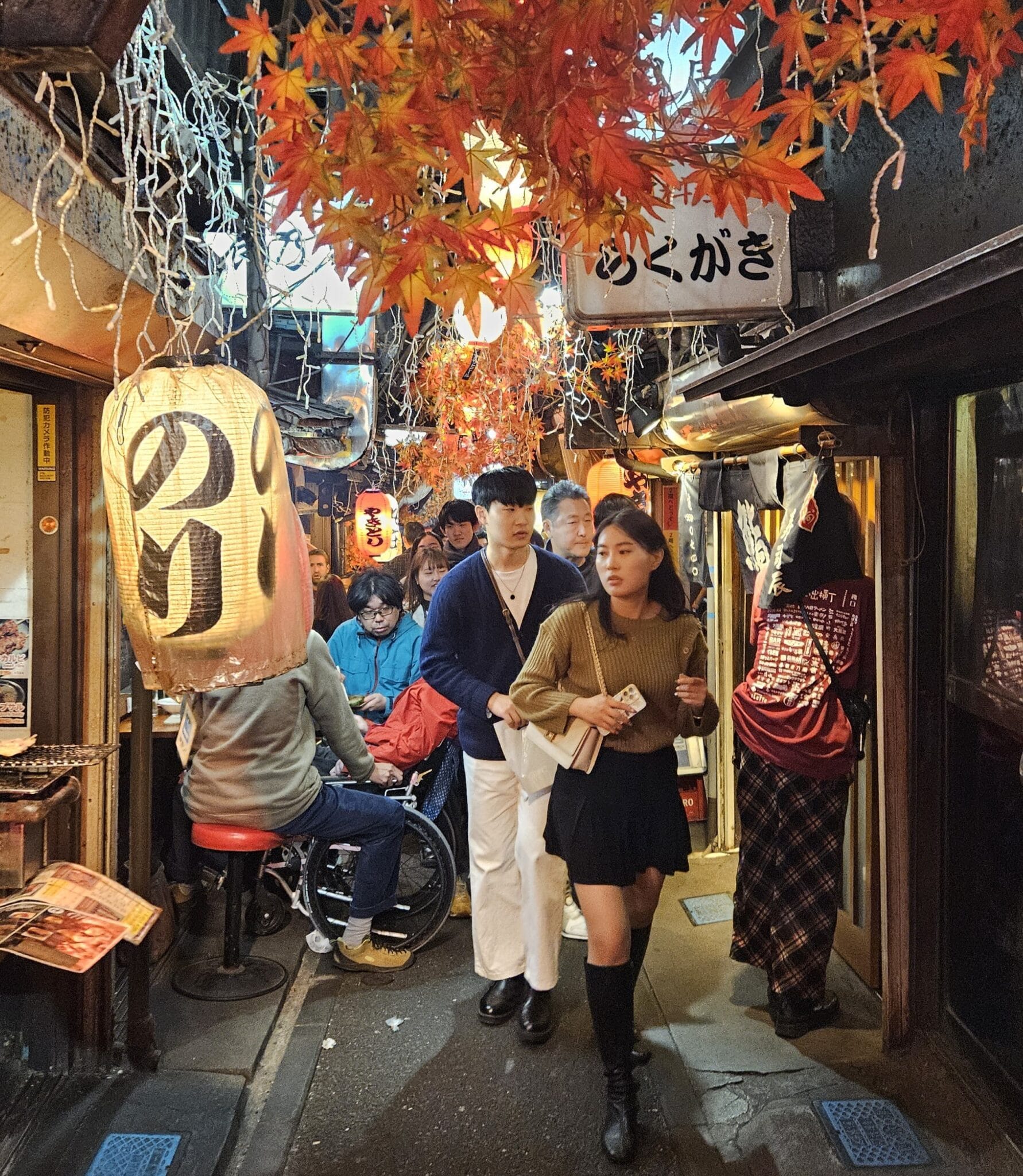
The lantern alley next to the West Exit dates back to the late 1940s and has about 60 tiny yakitori stalls. It looks like a film set, especially between 6 and 8 pm. My honest take: bring your camera, skip the meal. A yakitori set costs about double what you pay in a local shopping street. Walk through for photos, then eat somewhere else. Details in my Omoide Yokocho guide.
Kabukicho
Kabukicho is active 24 hours, with the peak from 9 pm to 3 am, Thursday to Saturday. The Godzilla head watches from the Toho building and the Tokyo Kabukicho Tower, opened in 2023, holds a cinema, live venues and restaurants. A realistic evening of standing bars, an izakaya and late ramen costs about 3,000 to 5,000 yen. Read my full Kabukicho guide.
Clubs, karaoke and 2-chome
- Clubs: Zero Tokyo inside the Kabukicho Tower has an excellent sound system, and Warp is the mainstream option. Some places that call themselves “club” are hostess bars, so stick to real dance clubs.
- Karaoke: the karaoke towers in Kabukicho mostly stay open until 6 am. After midnight ask for “free time”, a flat rate until morning.
- Shinjuku 2-chome: just south of Kabukicho, Japan’s largest concentration of gay bars, many tiny and welcoming all year.
For the rest of Tokyo after dark, see my Tokyo nightlife guide.
Is Shinjuku Safe?
Yes. Walking around Shinjuku, including Kabukicho, is safe, and violent crime is rare. The one real risk is touts. They speak good English and invite you into a bar or club with a “free first drink”, and the night ends with a bill of 30,000 to 80,000 yen. Three friends of mine followed one, in Kabukicho and in Roppongi, and all three ended with huge bills.
- Never follow anyone who approaches you on the street.
- Choose bars yourself and confirm prices before you sit down.
- Skip bars that wave a special foreigner menu at you.
- Never leave your drink alone and carry only the cash you need.
- Police: 110. Tokyo Metropolitan Police foreign language line: 03-3503-8484.
Read the full stories in Is Tokyo safe for tourists?
Where to Stay in Shinjuku
Shinjuku is the best all round base for a first trip: great connections, lots of hotels at every price, nightlife on the doorstep and direct trains to Hakone and Mount Fuji. The downside is the station maze and noise near Kabukicho.
- Stay a few minutes from the south or west exits for quieter streets.
- Check the walking time to the platform, not only the name: some “Shinjuku” hotels are 15 minutes from the trains.
- Business hotel rooms are often only 12 to 15 square metres, so check the size if you have big suitcases.
- Shinjuku Gyoen is perfect for a morning walk before the city wakes up.
Compare Shinjuku with Shibuya, Ueno and the other areas in my guide on where to stay in Tokyo.
Day Trips from Shinjuku
- Hakone: about 80 minutes by Odakyu Romancecar. One night in a ryokan makes it special.
- Lake Kawaguchiko: about 1 hour 45 minutes by highway bus from Busta Shinjuku, for the classic Mount Fuji view.
- Kamakura and Enoshima: the Odakyu Enoshima-Kamakura Freepass from Shinjuku costs around 1,640 yen.
All options with prices are in my guide to the best day trips from Tokyo.
A Day in Shinjuku: My Plan
| Time | What to do |
|---|---|
| Morning | Shinjuku Gyoen when it opens |
| Lunch | Gyukatsu, or lunch in the Nishi Shinjuku office basements |
| Afternoon | Free view from the Government Building, then Hanazono Shrine |
| 6 to 8 pm | Photos in Omoide Yokocho, then a standing bar near exit B12 |
| From 8 pm | Golden Gai, two or three tiny bars |
| Late | Ramen, then karaoke or a club until the first train |
Frequently Asked Questions
Is Shinjuku a good place to stay in Tokyo?
Yes. Shinjuku is the best all round base for a first trip, with JR, subway and private lines, many hotels at every price, nightlife nearby and direct trains to Hakone and Mount Fuji. Stay near the south or west exits for quieter streets.
What is there to do in Shinjuku besides nightlife?
A lot. By day you can see Tokyo for free from the Tokyo Metropolitan Government Building, walk through Shinjuku Gyoen and visit Hanazono Shrine. Further out, the ward includes Waseda with its university and the Wasedasai festival in November, Koreatown in Shin-Okubo and the old stone lanes of Kagurazaka.
Is Kabukicho safe at night?
Walking around Kabukicho is safe and violent crime is rare. The real risk is touts who lead you into bars with surprise bills of 30,000 to 80,000 yen. Never follow anyone from the street and check prices before you sit down.
Is there a free observation deck in Shinjuku?
Yes. The Tokyo Metropolitan Government Building has free observation rooms on the 45th floor, about 200 metres up, with Mount Fuji on clear days and a free projection mapping show on the facade in the evening.
How much does a night in Golden Gai cost?
Most bars charge a cover of 500 to 2,000 yen, and drinks cost about 700 to 1,500 yen. Plan about 2,000 to 4,000 yen per bar, or 6,000 to 12,000 yen for three bars.
When is the best time to visit Golden Gai?
Tuesday or Wednesday from about 8 to 9 pm is the most relaxed. Friday and Saturday after 10 pm are the most crowded.
How much is entry to Shinjuku Gyoen?
Entry is 500 yen. The garden covers 58 hectares, alcohol is not allowed and bags are checked at the gates. On peak cherry blossom weekends, reserve entry online.
How far is Shinjuku from Shibuya?
About 7 minutes on the JR Yamanote Line. On foot, Harajuku to Shinjuku takes 25 to 30 minutes.
Shinjuku is only one side of Tokyo. For the rest of the city, start with my guide to things to do in Tokyo.
Get My Personal Travel Maps


Leave a Reply