Japan is one of the most talked-about travel destinations on Earth. Millions of people consume Japanese content every day through TikTok, YouTube, Instagram, and viral documentaries. But somewhere between anime edits, ragebait creators, and recycled “culture shock” videos, a huge number of false narratives about the country started spreading online.
Some of these Japan travel myths are harmless. Others completely distort reality and create unrealistic expectations for tourists visiting the country for the first time.
The truth is that Japan is neither a futuristic utopia nor a cultural fantasy world where every person follows every rule perfectly. Like every country, it is complex, contradictory, modern, traditional, beautiful, flawed, safe in some areas, dangerous in others, and filled with normal human behavior.
After living in Tokyo for years, traveling across the country, and seeing both the tourist side and the everyday local reality, I realized how many common misconceptions about Japan keep getting repeated online without context or evidence.
This article breaks down some of the biggest things tourists get wrong about Japan, compares stereotypes of Japan with reality, and explains the truth about traveling in Japan without romanticizing or blindly criticizing the country.
“Japanese People Turn Footsteps Into Electricity”

The origin of this myth comes from a real experimental technology called piezoelectric energy harvesting. Around the late 2000s and early 2010s, several Japanese companies and universities tested special floor tiles that could convert pressure from footsteps into tiny amounts of electricity.
One of the most famous demonstrations happened at JR East stations in Tokyo, where experimental tiles were temporarily installed inside busy train stations. The project was connected to research by Japanese technology companies and university engineering departments studying sustainable urban infrastructure.
The basic idea sounds futuristic: every time someone steps on the floor, the pressure slightly compresses piezoelectric materials, generating a very small electrical charge. In reality, however, the amount of electricity produced was tiny. The systems were mainly capable of powering:
- small LED displays
- sensors
- demonstration lighting
- data collection systems
Some universities in Japan, including researchers connected to institutions like Keio University and other engineering programs, explored how crowded urban environments could theoretically recover wasted kinetic energy from human movement.
This research was real science, not fake internet content. The problem is what happened afterward.
Online creators transformed a small-scale sustainability experiment into viral claims such as:
“Japan powers entire buildings using footsteps.”
That part is completely false.
The energy output from walking is nowhere near enough to meaningfully power large infrastructure. Even in extremely crowded stations like Shibuya Station or Shinjuku Station, the generated electricity was tiny compared to actual city power consumption.
The projects were primarily:
- research demonstrations
- eco-tech experiments
- public awareness campaigns
- symbolic sustainability showcases
This is one of the clearest examples of how Japan stereotypes vs reality become distorted online. A small experimental technology became exaggerated into the idea that Japan is somehow operating on sci-fi energy systems far beyond the rest of the world.
“Eating While Walking Is Forbidden in Japan”

This is one of the biggest Japan travel myths online.
People constantly repeat:
“In Japan, eating while walking is considered deeply disrespectful.”
That is massively exaggerated.
The reality is much simpler:
Some tourist areas discourage eating while walking because they want to keep the streets clean.
For example:
- Certain parts of the Higashi Chaya District in Kanazawa discourage it
- Some temple streets ask visitors not to drip sauce or leave trash
- Festival areas sometimes have local rules
But this does NOT mean the entire country follows a cultural law against walking while eating.
In Tokyo, Osaka, Yokohama, and other major cities, you constantly see:
- people drinking coffee while walking
- salarymen eating snacks
- teenagers with bubble tea
- commuters drinking canned drinks
The idea that “Japanese people never eat while walking” is one of those common misconceptions about Japan that spread because tourists visited one historic district and assumed it represented the entire country.
“Japan Has No Trash Bins Because of Terrorism”
This explanation is only partially true.
After the 1995 Tokyo subway sarin gas attack carried out by the cult Aum Shinrikyo, many public trash bins were removed for security reasons. At the time, the fear of hidden explosives or chemical devices inside bins was taken very seriously.
But that happened over 30 years ago.
Today, modern surveillance systems, police monitoring, and station security are completely different. The idea that Japan still lacks public trash bins primarily because of terrorism no longer fully explains reality.
The bigger reason today is cost reduction and responsibility shifting.
Japanese cities often expect:
- private businesses
- convenience stores
- train stations
- vending machine companies
to handle waste disposal instead of municipalities maintaining large public trash infrastructure themselves.
You can actually see this system everywhere in daily life. Many vending machines have their own small recycling bins, convenience stores handle customer trash, and train stations selectively provide disposal areas inside ticket gates instead of throughout the city.
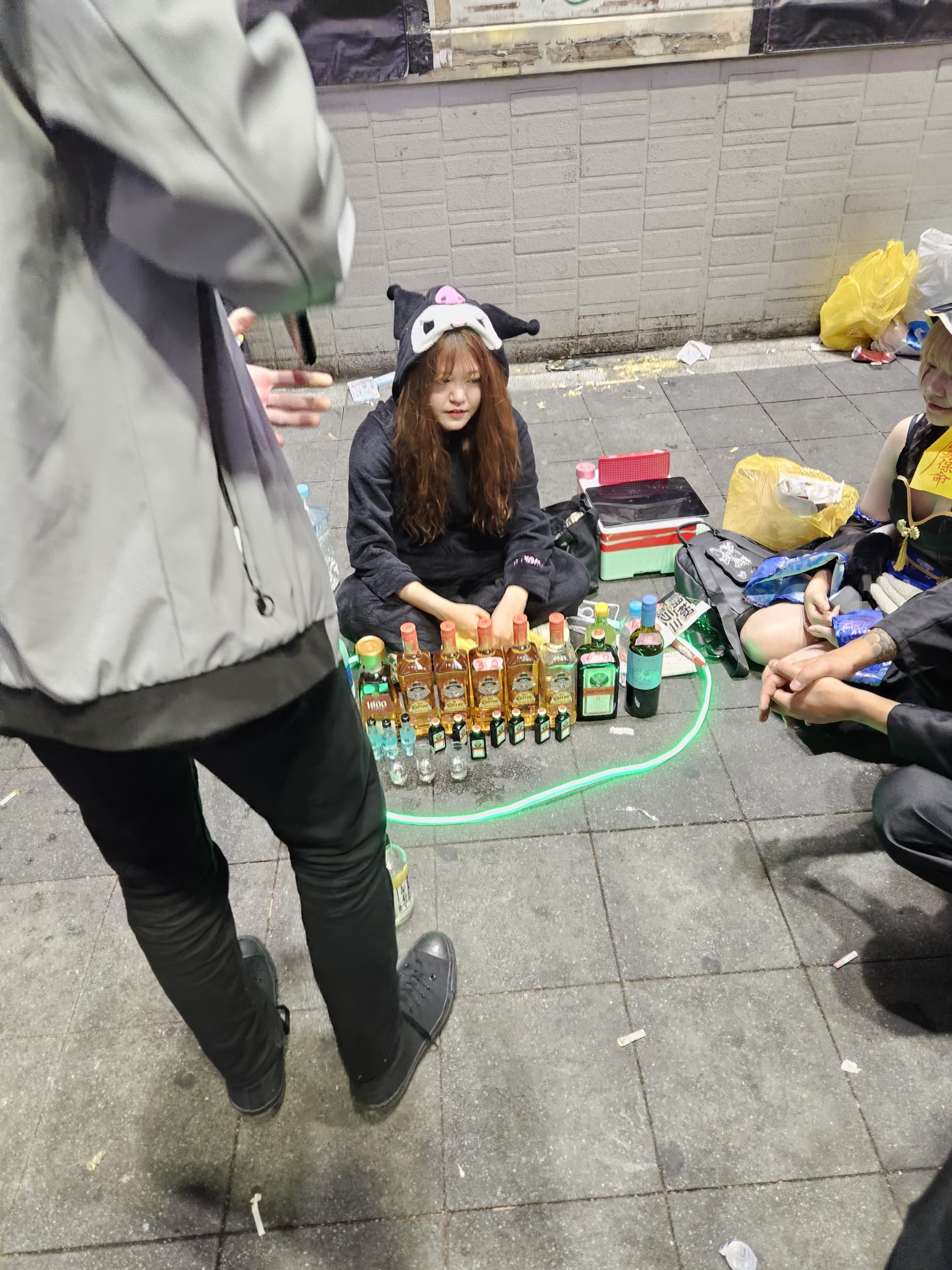
Ironically, despite the global image of Japan being perfectly clean, litter absolutely still exists. In nightlife districts, residential neighborhoods, and tourist-heavy areas, you can regularly find:
- cigarette butts
- plastic bottles
- food packaging
- overflowing bins
- illegal dumping in some rural areas
The internet often keeps repeating the terrorism explanation because it sounds dramatic and mysterious. At this point, however, it functions more as a simplified viral narrative than a complete explanation of modern reality.
If someone blindly repeats:
“Japan has no bins because of terrorism”
Without questioning why the situation remained unchanged for three decades despite modern security technology, it usually shows a lack of critical thinking and nuance rather than a real understanding of how Japanese cities actually operate today.
Do people really believe trash cans would still exist directly in massive crowded areas like Gion or outside busy FamilyMart stores if terrorism were truly still the main reason for their disappearance today?
“You Can’t Eat or Drink on Japanese Trains”

This is completely misleading.
On the Shinkansen, eating is extremely common.
Ekiben culture literally exists around train travel. Entire businesses inside major stations are built around selling beautifully packaged meals specifically designed for passengers to eat onboard during long-distance journeys.
You will constantly see:
- beer cans
- bento boxes
- snacks
- children drinking juice
- office workers drinking highballs
On routes between cities like Tokyo, Osaka, and Kyoto, eating and drinking on the train is completely normalized.
Even on regular JR commuter trains, there is no nationwide ban on drinking alcohol. People mainly avoid messy meals during crowded rush hour because it is inconvenient and inconsiderate in packed spaces, not because it is illegal or culturally forbidden. This is another example of how many Japan travel myths online confuse social etiquette with actual rules or laws.
The internet often turns ordinary Japanese social etiquette into imaginary strict laws.
In reality, Tokyo’s late-night train culture can become surprisingly chaotic, especially around the last trains after midnight on Fridays and weekends.
If you regularly take the final trains around entertainment districts like Shibuya Station, Shinjuku Station, or Ikebukuro Station, you will quickly realize this fantasy of “perfectly disciplined silent passengers” falls apart very fast.
You can regularly encounter:
- heavily drunk salarymen
- people sleeping across seats
- strong zero cans everywhere
- passengers vomiting
- loud arguments
- drunken fights
- people aggressively hitting train doors or station walls
Japanese nightlife culture is deeply connected to alcohol, and the last train often becomes the moment where the extremely polite daytime version of Tokyo temporarily collapses into total exhaustion and chaos.
That reality simply does not fit the overly sanitized version of Japan many tourists imagine online.
“Tourists Don’t Respect Japan”
The internet massively exaggerates this issue.
Yes, disrespectful tourists exist.
Yes, some people behave terribly.
But mathematically, the scale is tiny.
Japan receives tens of millions of tourists per year. Yet most viral outrage content recycles the same 100 to 200 videos repeatedly, creating a distorted image that fuels common misconceptions about Japan and makes disrespectful tourism appear far more widespread than it actually is.
Those clips get reposted every few months, making people believe disrespect is everywhere.
If even 500 tourists behaved horribly out of 35 million annual visitors, that would still represent an incredibly tiny percentage.
Every tourist destination on Earth has:
- drunk visitors
- rude influencers
- scammers
- disrespectful behavior
Japan is not unique here.
The algorithm simply amplifies outrage because anger generates clicks.
“Foreigners Cause Most Crime in Japan”
The actual crime statistics do not support this narrative.
Foreign residents make up a noticeable percentage of the population in Tokyo and other major cities, yet crime data does not show foreigners dominating crime rates.
In reality:
- most crimes in Japan are committed by Japanese nationals
- Organized fraud cases are often domestic
- Japan overall still has relatively low violent crime rates internationally
Like in many countries, loud nationalist accounts online often blame foreigners disproportionately, reinforcing Japan stereotypes vs reality narratives that are far more extreme online than what most people experience in daily life.
This is another case where Japan stereotypes vs reality become very different once actual statistics are examined.
“Japan’s Age of Consent Was 13 Until 2023”
This statement is technically incomplete and highly misleading.
Japan’s national penal code historically listed 13 as the federal minimum age. However, almost all prefectures already had local ordinances and youth protection laws that effectively made sexual activity with minors illegal, far above that age.
In practice, adults could not legally pursue 13-year-olds in ordinary society.
The 2023 reform mainly standardized the national law closer to what local regulations had already enforced for years.
That said, there is another side of the discussion that many people online either ignore completely or oversimplify.
After living in Tokyo for years, I personally noticed that discussions involving attraction toward very young-looking girls, school uniforms, or “barely legal” themes are far more normalized publicly than in many European countries. Whether in certain manga genres, hostess marketing, idol culture, or nightlife conversations, the topic appears far more visible than many tourists expect before coming to Japan.
That does not mean Japanese society universally accepts predatory behavior. Most normal Japanese people obviously do not support crimes against minors.
But pretending there is zero social issue around this topic would also be dishonest, especially considering the long-running debates in Japan surrounding compensated dating, exploitative idol culture, vulnerable runaway teenagers, and the highly publicized Toyoko Kids phenomenon in Tokyo.
Areas connected to the so-called “Toyoko Kids” phenomenon near Kabukicho exposed serious youth protection problems involving vulnerable teenagers, unstable housing situations, exploitation, grooming, and, in some cases, underage girls offering sexual services or being targeted by older men.
The existence of these issues is one reason why the government has increasingly tightened regulations in recent years.
So the reality is more nuanced than either side online claims:
- No, Japan was not a country where adults could legally date 13-year-olds freely.
- But yes, Japan does have real societal issues involving the sexualization of youth, vulnerable minors, and exploitative subcultures that continue to generate criticism both domestically and internationally.
This is exactly why the topic became so controversial online in the first place.
“Japan Has the Highest Suicide Rate in the World”
This is false.
Japan historically struggled with suicide, especially during the economic crises of the 1990s and early 2000s. During that era, rising unemployment, financial instability, and intense work pressure pushed suicide numbers above 30,000 cases annually for many consecutive years, creating the global image that Japan was uniquely associated with suicide and mental health struggles.
But today, Japan is nowhere near the highest in the world.
Several countries regularly report higher suicide rates than Japan, including South Korea and Russia.
Approximate Suicide Rates per 100,000 People
| Country | Suicide Rate |
|---|---|
| South Korea | ~24 |
| Russia | ~21 |
| United States | ~14 |
| Japan | ~12 |
| Switzerland | ~9–10 |
Japan’s visibility comes mainly from:
- media coverage
- overwork culture discussions
- famous locations like Aokigahara
- historical reputation
Mental health issues absolutely exist in Japan, including loneliness, social pressure, and overwork. However, the internet often portrays Japan as uniquely suicidal, which is inaccurate.
The country has also invested heavily in suicide prevention programs over the past two decades through crisis hotlines, workplace reforms, school counseling initiatives, and mental health awareness campaigns, leading to a significant decline in suicide numbers compared to the peak years of the early 2000s and challenging many outdated Japan stereotypes vs reality narratives still spreading online.
“Japan’s ‘Breeding Visa’ for Foreign Men”

One of the strangest Japan travel myths online came from a viral fake article claiming Japan would introduce “Breeding Visas” for foreign men to solve the country’s declining birth rate.
The image spread massively across Facebook, Reddit, TikTok, and meme pages, and many people actually believed it was real news.
In reality, the story originated from an April Fool’s parody website and had absolutely nothing to do with official Japanese government policy.
Yes, Japan faces a real demographic crisis involving:
- low birth rates
- an aging population
- fewer marriages
But there is no national movement trying to “import foreign men” to save Japanese women.
International relationships and marriages absolutely exist in cities like Tokyo and Osaka. However, most Japanese women date exactly like women anywhere else:
- based on personality
- attraction
- emotional compatibility
- lifestyle
- financial stability
The internet often fetishizes international relationships in Japan in very strange ways, fueling common misconceptions about Japan by turning completely normal dating preferences into bizarre online theories about “saving Japan” or “Japanese women preferring foreign men over Japanese men.”
Reality is far less dramatic.
Most people in Japan are simply living normal lives, dating normally, and dealing with the same relationship struggles modern societies face worldwide.
“Fruit in Japan Is Unaffordably Expensive”

This claim is half true.
Luxury fruits in Japan ARE extremely expensive.
Gift melons, premium strawberries, and luxury grapes can cost absurd amounts.
But tourists often confuse luxury gift culture with normal grocery shopping.
Regular supermarkets still sell:
- bananas
- apples
- oranges
- cheaper strawberries
Yes, fruit is generally more expensive than in many European countries. Even compared to Switzerland, some prices can feel surprisingly high, which is why luxury fruit culture became one of the more surprising things tourists get wrong about Japan when they first visit Japanese department stores and supermarkets.
But normal residents still buy fruit regularly.
Japan is not a country where ordinary people survive without producing.
“Prostitution Is Illegal, So It Doesn’t Exist”
Prostitution exists everywhere in Japan.
The legal system simply defines prostitution very narrowly.
The result is a huge gray-zone industry involving:
- hostess clubs
- soaplands
- delivery health services
- massage businesses
- compensated dating
- nightlife entertainment districts
Kabukicho alone makes this impossible to deny.
Ironically, critics argue that the legal structure sometimes punishes workers more than it protects them, making Japan stereotypes vs reality far more complicated than the simplistic online claim that “prostitution does not exist in Japan because it is illegal.”
Pretending the industry does not exist because of legal wording ignores the obvious reality.
“Japan Is Completely Safe”
Japan is generally very safe, especially regarding street robbery and gun violence.
But the internet often romanticizes Japan as a crime-free utopia.
For men, daily life is usually extremely safe.
For women, the situation can be very different.
Issues include:
- stalking
- groping on trains
- sexual harassment
- nightlife drugging incidents
In Kabukicho, Nigerian tout scams targeting tourists are widely known. Some victims have reported being drugged, overcharged, or robbed after being lured into bars, showing that the truth about traveling in Japan is more nuanced than the internet fantasy that the country is completely crime-free.
There have also been disturbing, violent cases in public areas.
Examples include several highly publicized violent incidents that shocked both locals and foreigners living in Tokyo.
One case involved a woman working at a Pokémon card shop in Ikebukuro who was murdered by a stalker-like customer obsessed with her. The case deeply disturbed many residents because it happened in one of Tokyo’s busiest anime and shopping districts, an area many tourists associate with being completely safe and harmless.
Another major case was the Takadanobaba streamer murder near Takadanobaba Station. The incident involved a female livestreamer who was killed in public by a man reportedly connected to obsession and personal grievances. The case reignited discussions in Japan around stalking, parasocial relationships, and the risks female creators face online.
These incidents are still statistically rare compared to many countries. Japan remains one of the safer countries globally regarding violent street crime.
However, cases like these demonstrate an important point:
Japan is not a fantasy world completely free of violence, stalking, or dangerous individuals. Tourists sometimes romanticize the country so heavily that they ignore basic personal safety awareness, especially in nightlife districts or around strangers offering drinks, bars, or “special deals.”
Both happened in Tokyo.
Japan is safer than many countries in several categories, but tourists should not abandon common sense just because viral Japan travel myths portray the country as a completely crime-free utopia where dangerous situations never happen.
“Japanese People Hate Foreigners”
This is another internet exaggeration.
Extremely nationalist accounts online are loud, but they do not represent average daily life.
Most foreigners living in Japan experience:
- curiosity
- politeness
- occasional awkwardness
- normal human interactions
Yes, discrimination exists in some housing or nightlife situations.
Yes, some people dislike foreigners.
But the idea that Japanese society universally hates outsiders is false, and in daily life most foreigners experience normal interactions, curiosity, politeness, and hospitality rather than the extreme anti-foreigner attitudes often amplified online through common misconceptions about Japan.
Most people are simply busy living their own lives.
“Japan Is Futuristic”
This depends entirely on what you compare it to.
If someone comes from a developing country, Japan can feel extremely advanced.
But compared with places like:
- South Korea
- Singapore
- parts of China
Japan often feels surprisingly outdated digitally, which shocks many first-time visitors because Japan travel myths online usually focus only on neon lights, robots, and futuristic aesthetics instead of the country’s slower digitization, fax machine usage, paperwork-heavy systems, and cash-based bureaucracy.
Examples:
- Fax machines still existThe
- paperwork culture remains massive
- Government digitization is slow
- Many systems still rely on cash or physical forms
Neon signs and robots do not automatically mean futuristic infrastructure.
This is one of the biggest things tourists get wrong about Japan because viral media aesthetics often replaced actual technological analysis, creating the false impression that neon signs, robots, and anime visuals automatically mean the country is more digitally advanced than places like South Korea or China.
“Japan Is Super Clean Everywhere”

This depends heavily on your standards and location.
Yes, many areas are clean.
But the internet creates an unrealistic image where every Japanese street supposedly looks spotless 24/7.
Reality:
- Cigarette butts are common
- nightlife areas can be filthy
- illegal dumping exists
- parks sometimes contain trash
In Koenji, I regularly saw litter on the streets.
In Okinawa, including Ishigaki, I saw dumped tires and roadside garbage.
Kabukicho after a weekend night can look chaotic.
Rural areas often appear cleaner partly because far fewer people live there, while heavily populated urban districts like Kabukicho, Shibuya Crossing, or parts of Osaka can become surprisingly dirty, challenging the common misconceptions about Japan being perfectly spotless everywhere.
“Japanese People Only Work and Never Have Fun”
Overwork culture absolutely exists in Japan.
You can see exhausted salarymen everywhere in Tokyo.
But the internet sometimes portrays Japanese people as robotic workers with no personalities outside the office, even though Japan also has massive nightlife scenes, festival culture, hobby communities, travel culture, and some of the loudest drinking environments you will ever experience, especially inside crowded izakayas late at night.
That is nonsense.
Japan also has:
- huge drinking culture
- festivals
- nightlife
- hobbies
- travel culture
- music scenes
- sports communities
Some of the loudest izakayas I have ever experienced were in Japan.
Like every country, there are workaholics and relaxed people, which makes the truth about traveling in Japan far more balanced and human than the online stereotype that every Japanese person lives only for work and never enjoys life outside the office.
“There Are No Homeless People in Japan”
There are homeless people in Japan.
The government definition is simply narrower than many foreigners expect.
People living in:
- manga cafes
- tiny room rentals
- unstable temporary housing
are often excluded from official homelessness statistics.
In Tokyo, you can still visibly find homelessness in places like:
- Shinjuku underpasses
- river areas
- around major stations
The Toyoko Kids phenomenon near Kabukicho also exposed serious youth housing instability issues, revealing that the common misconception about Japan having “no homelessness” often ignores vulnerable teenagers living in unstable conditions, internet cafés, temporary rooms, or surviving around nightlife districts without proper support systems.
“Japan Is Tiny”
Japan is much larger than many tourists realize.
When compared geographically across Europe, Japan stretches an unexpectedly long distance from north to south, which is why climate, food culture, landscapes, and even daily lifestyle can feel completely different between regions like snowy Hokkaido and subtropical southern Japan, challenging the common misconception about Japan being a “small country” that tourists can fully understand after only visiting Tokyo, Kyoto, and Osaka.
Climate differences alone prove this:
- Hokkaido has snowstorms
- Okinawa is subtropical
The country feels “small” mainly because tourist itineraries usually focus only on Tokyo, Kyoto, and Osaka.
“Convenience Store Food Is Amazing and Healthy”
Convenience stores are convenient.
That is the entire point.
But tourists often romanticize convenience store food as if it were premium nutrition.
Reality:
- Many items are highly processed
- Sodium levels are high
- Meals are often microwave-heavy
- Nutritional balance varies massively
And economically, the savings are sometimes tiny.
If a conbini meal costs 560 yen and a real restaurant meal starts around 800 yen, many travelers on expensive international trips are barely saving money, which makes the internet obsession with convenience store food one of the more exaggerated Japan travel myths and things tourists get wrong about Japan.
Japan has fantastic restaurants almost everywhere.
Many tourists underestimate how affordable regular restaurants actually are.
“Japanese People Never Break Rules”
Completely false.
People jaywalk constantly in Tokyo.
Illegal nightlife activity exists openly.
Street racing and drifting culture exists.
Underage drinking happens.
Illegal gambling exists.
Prostitution exists despite restrictions.
Japan has rules.
Japanese people are human.
Humans break rules everywhere.
The difference is simply that public order is generally higher than in many countries, even though common misconceptions about Japan often falsely portray Japanese society as a place where nobody breaks rules, drinks underage, jaywalks, or participates in illegal nightlife culture.
“Japanese Food Is Always Healthy”
Some Japanese food is extremely healthy.
Examples:
- traditional fish-based meals
- certain sushi styles
- kaiseki cuisine
But tourists selectively ignore:
- fried karaage
- mayonnaise-heavy dishes
- ramen with massive sodium content
- tempura
- fatty wagyu meals
- late-night drinking food
Many restaurants also serve surprisingly few vegetables compared with the healthy image foreigners imagine.
Japanese cuisine contains both healthy and unhealthy categories like every major food culture, which is why the idea that all Japanese food is automatically nutritious remains one of the most widespread Japan stereotypes vs reality misconceptions among first-time visitors.
Did you know that most Japanese food has its origin in China?
“Japan Has No Diversity”
In rural areas, diversity is limited.
But Tokyo is far more international than many tourists expect, challenging common misconceptions about Japan and proving that daily life in the capital is far more multicultural, globalized, and diverse than many viral internet narratives suggest.
Among younger generations, especially, foreigners are increasingly common in:
- universities
- tech companies
- nightlife
- fashion scenes
- restaurants
Entire neighborhoods contain large Korean, Chinese, Vietnamese, Nepali, and international communities.
Daily life in Tokyo is far more multicultural than the stereotype suggests.
“Japanese People Are Always Silent”
On trains?
Often yes.
Inside elevators?
Usually yes.
Inside izakayas?
Absolutely not.
Japanese nightlife can become extremely loud.
Some restaurants in Tokyo are noisier than places I visited in Europe, which surprises many first-time visitors because Japan travel myths often portray the entire country as permanently silent, calm, and socially restrained.
Context matters.
Japan has quiet spaces and loud spaces, like everywhere else. They are just diffrent.
“Tipping Is Offensive in Japan”
Tipping is not “offensive.”
It is simply not traditionally expected.
Many workers may politely refuse tips because the system is unfamiliar, which is why the claim that “tipping is offensive in Japan” became one of the more exaggerated common misconceptions about Japan repeated online by tourists and influencers.
But tipping jars absolutely exist in some places.
Meanwhile, many upscale restaurants already add:
- service charges
- seating fees
- mandatory percentages
In districts like Nihonbashi and luxury dining areas, you can effectively pay something very similar to Western-style tipping anyway.
“Japan Perfectly Preserved Its Ancient Architecture”
This is another huge myth tourists believe.
Many famous Japanese castles are reconstructions.
Examples of rebuilt castles:
- Osaka Castle
- Odawara Castle
- Shuri Castle
- Hiroshima Castle
One of the most famous surviving original castles is:
- Matsumoto Castle
Japan suffered:
- wars (they are responsible for them)
- earthquakes
- fires
- bombings
- modernization waves
Much of what tourists see today was carefully reconstructed.
That does not make it fake.
But it does change the narrative that “everything survived untouched for centuries.”
Final Thoughts on Japan Travel Myths and Reality
The biggest truth about traveling in Japan is that the country is neither paradise nor dystopia.
Japan is simply real.
It is modern and outdated.
Safe and risky.
Polite and chaotic.
Clean and dirty.
Traditional and heavily commercialized.
Many Japanese travel myths exist because people reduce a complex society into viral one-sentence TikTok explanations.
The best way to understand Japan is not through ragebait clips or exaggerated influencer content. It is through long-term observation, real conversations, and seeing both the beautiful and uncomfortable sides of the country.
That is where the real Japan begins.
Author

Get My Personal Travel Maps
Keep Reading: More Articles You'll Love
 Is Japanese Food Actually Chinese? The Surprising Origins of Japanese Cuisine
  Living in Tokyo vs Zurich – The Ultimate Expat Guide
  Living in Japan vs Korea – The Ultimate Expat Guide
  Tattoos in Japan: Rules, Culture, Onsen & Changing Attitudes
  My First 30 Days in Tokyo: Essential Administrative Steps for International Students
  Matsumoto Itinerary: The Perfect 3-Day Guide Including Kamikochi
  Halloween in Tokyo: From Shibuya to Shinjuku and Beyond