Bon Odori is one of Japan’s most beloved summer traditions, bringing together communities across the country to celebrate Obon, the Buddhist period dedicated to honoring ancestors and remembering loved ones who have passed away. While many international visitors encounter Bon Odori as a colorful festival filled with music, food stalls, lanterns, and dancing, its roots stretch back centuries and are deeply connected to Japanese spiritual and cultural life.
At the heart of every Bon Odori festival stands a raised platform known as a yagura, around which participants perform traditional dances accompanied by taiko drums, folk songs, and regional melodies. Although the choreography is intentionally simple so that anyone can join, the meaning behind the event is profound. Bon Odori serves as both a celebration of life and a symbolic welcome for ancestral spirits believed to return during the Obon season.
What makes Bon Odori particularly fascinating is that no two festivals are exactly alike. Different regions have developed their own dances, music, costumes, and customs over generations. Through attending Bon Odori festivals in Koenji, Ebisu, Nakano, and Saitama over multiple summers, I experienced firsthand how each community adds its own character to the celebration. The massive crowds and energetic atmosphere of Koenji differ greatly from the more intimate neighborhood gatherings found elsewhere, yet the sense of community and cultural continuity remains remarkably consistent.
In this guide, you’ll learn what Bon Odori is, why it plays such an important role in Japanese culture, how the festival evolved from Buddhist traditions, what visitors should expect when attending, and how different regions across Japan celebrate this iconic summer event.
The Origins of Bon Odori in Japan
Bon Odori in Japan traces its origins to the Obon Festival, a Buddhist tradition that has been observed for more than five centuries. Obon itself is rooted in the Buddhist story of Mokuren (Maudgalyayana), a disciple of the Buddha who sought to relieve the suffering of his deceased mother. According to tradition, his joyful dance upon learning that her spirit had been saved became the foundation of Bon Odori. Over time, this act of gratitude evolved into a communal ritual performed to welcome, honor, and send off the spirits of ancestors believed to return to the world of the living during the Obon season.
Historically, Bon Odori was far more than entertainment. In rural Japan, it served as an important spiritual and social event that reinforced family ties, community identity, and the connection between generations. Villagers gathered in temple grounds, shrine precincts, and public squares to dance through the evening, accompanied by drums, folk songs, and lantern light. The repetitive circular movements symbolized unity and continuity, reflecting the Buddhist belief that life, death, and remembrance are interconnected rather than separate experiences.
As the tradition spread throughout the country, regional communities adapted Bon Odori to their own customs and histories. Some areas developed energetic dances celebrating local industries such as fishing, mining, or farming, while others preserved slower, more ceremonial styles. Famous examples include Awa Odori in Tokushima, Gujo Odori in Gifu, and Nishimonai Bon Odori in Akita, each recognized as an important expression of local cultural heritage. These regional variations transformed Bon Odori into one of Japan’s most diverse folk traditions, with thousands of unique dances performed across the country every summer.
Today, Bon Odori remains a living tradition that bridges Japan’s past and present. While its spiritual significance endures, it has also become a celebration of community, culture, and seasonal joy. Elderly residents dance alongside children, local families welcome newcomers, and visitors are often encouraged to join the circle regardless of their experience. This combination of ancestral remembrance, cultural preservation, and social participation is what makes Bon Odori one of the most meaningful and enduring summer festivals in Japan.
Koenji: The Grand Bon Odori Festival
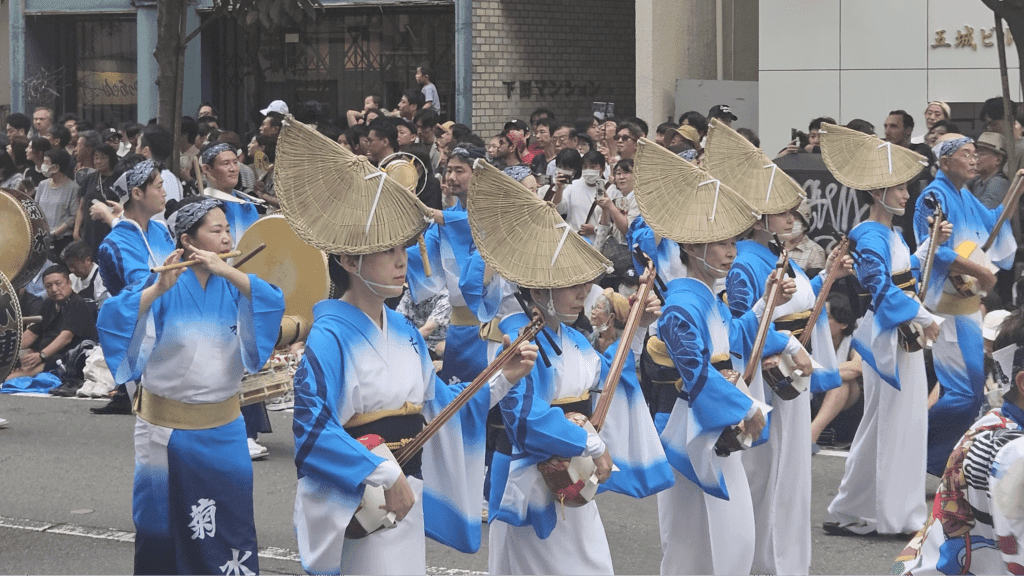
Koenji, located in the western part of Tokyo, hosts one of the largest and most energetic Bon Odori festivals in Japan. The scale of the event becomes clear as soon as you arrive. The festival takes place along the wide main road beside the local shoutengai (a traditional covered shopping street lined with independent shops, eateries, and small businesses). During Bon Odori, the entire road is closed to traffic, creating a massive open space filled with food stalls, performers, and crowds moving in every direction.
From my own experience attending the Koenji festival, the atmosphere feels both intense and welcoming. Stalls selling takoyaki, yakitori, and taiyaki line the streets, while a large raised stage sits at the center of the blocked-off road. As the sun sets, dancers gather in circles around the stage and begin performing to the steady rhythm of drums and festival music. What stood out to me was how diverse the performers were. Some groups travel from faraway regions such as Okinawa or other provinces specifically to take part, which adds a wide variety of dance styles and costumes to the event.
Even though the festival attracts skilled performers, Koenji maintains a warm and inclusive spirit. Spectators gather along the edges of the dance circles, and it is easy to appreciate the flow of movement, the colorful yukata, and the dedication of each group. Watching the dancers move together down the large, closed-off road created a memorable sense of unity and celebration. Observing the performances from the sidelines made it clear why Koenji’s Bon Odori is considered one of the most impressive in Tokyo.
Ebisu: Traditional and Heartfelt

The Bon Odori festival in Ebisu, a neighborhood in central Tokyo, offers a noticeably different experience from the large-scale celebrations found in places like Koenji. While the dancing, music, and lanterns remain familiar, the atmosphere feels more closely connected to the original purpose of Obon: remembering ancestors, strengthening community bonds, and reflecting on the passage of time. Held in a local park surrounded by residential streets, the festival feels less like a public spectacle and more like a gathering of neighbors who have returned year after year to preserve a shared tradition.
During my visit, what stood out most was the slower pace and the strong presence of local residents. Unlike larger festivals that attract tourists from across Tokyo, many attendees appeared to know one another. Elderly participants danced alongside young children, creating a visible connection between generations that reflects one of the central themes of Obon itself. The festival was not merely about entertainment but about passing cultural memory from parents and grandparents to the next generation.
The music, broadcast throughout the park, followed the familiar rhythms of traditional Bon Odori songs. Watching the dancers move in synchronized circles, I was reminded that these repetitive movements carry symbolic meaning. Historically, Bon Odori dances were performed as acts of gratitude and remembrance for ancestors. Even today, the circular formations can be seen as a representation of continuity between past and present, linking those who came before with those who are living today.
As evening approached, the lanterns surrounding the dance area began to glow softly against the Tokyo skyline. This contrast between one of the world’s largest modern cities and a centuries-old Buddhist tradition was particularly striking. Just beyond the festival grounds stood office towers, restaurants, and busy roads, yet within the circle of dancers the atmosphere felt timeless. For a few hours, the pace of urban life seemed to slow as people gathered to celebrate a custom that has connected Japanese communities for generations.
The smaller scale of the Ebisu Bon Odori also allowed me to observe details that can easily be missed at larger festivals. The concentration on dancers’ faces, the respectful participation of spectators, and the interactions between families revealed a side of Japanese culture that is often hidden beneath Tokyo’s fast-moving image. Rather than focusing on spectacle, Ebisu emphasizes the values at the heart of Obon: remembrance, gratitude, and community. For visitors seeking a deeper understanding of Japanese cultural traditions, it offers one of the most authentic and meaningful Bon Odori experiences in Tokyo.
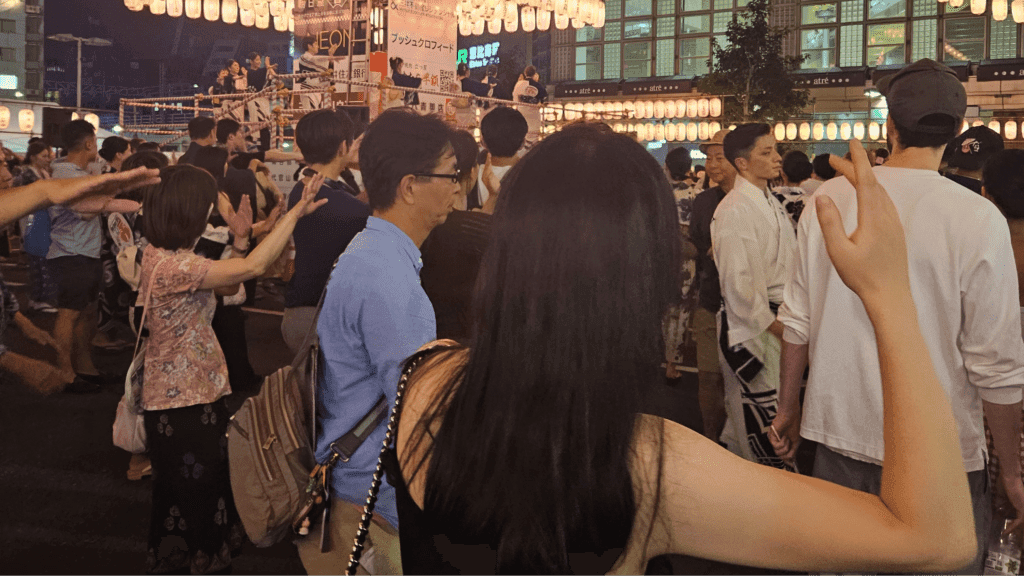
At the Ebisu festival, the music is played through speakers rather than live instruments, yet the atmosphere still carries the familiar charm of traditional Bon Odori melodies. The dances performed follow regional traditions, with slower and more graceful movements that highlight the festival’s focus on respect and remembrance. Many participants wear classic yukata, which adds to the nostalgic and traditional feel of the event. The setting remains calm and intimate, offering visitors a chance to appreciate the cultural meaning behind Obon without the large crowds found at bigger festivals. For those seeking an authentic and serene Bon Odori experience in Tokyo, Ebisu provides an ideal environment.
Nakano: Modern Twists on Tradition
While the Bon Odori festivals in Koenji and Ebisu highlight the traditional side of Obon, the events we attended in Nakano offered a noticeably modern twist. Nakano is known for embracing contemporary culture, and its Bon Odori reflects that spirit. The festival combines classic dance movements with updated music choices, creating a blend of past and present that feels both familiar and fresh.
When my friend and I visited, the first thing we noticed was how different the atmosphere felt compared to other neighborhoods. Instead of relying solely on traditional Bon Odori songs, the organizers incorporated electronic beats and contemporary rhythms that gave the dances a lively, youthful energy. Traditional steps remained at the core, but the music pushed the event into a more modern, playful direction.
One of the most memorable moments was an unexpected tribute to Michael Jackson. A group of performers mixed his signature dance moves with classic Bon Odori choreography, creating a performance that was entertaining and surprisingly fitting for the festival setting. The crowd responded with enthusiasm, and the mix of tourists, families, and younger locals made the entire experience feel inclusive and dynamic.
Being there with my friend added to the sense of enjoyment. We were able to watch how each performance bridged cultural eras, showing that Bon Odori can evolve without losing its foundation. Nakano’s festival demonstrated how adaptable the tradition is, appealing to new generations while still honoring the spirit of community and remembrance that defines Obon.
Conclusion
Bon Odori is far more than a seasonal dance festival. At its core, it is a living expression of how Japan understands community, memory, and the relationship between past and present. While many visitors initially see colorful yukata, food stalls, lanterns, and traditional dances, these visible elements are only the surface of a tradition that has helped communities preserve their identity for generations. Whether experienced at the massive Koenji celebration, the intimate gathering in Ebisu, or the modern interpretations found in Saitama and Nakano, each festival reveals a different facet of the same cultural foundation: the belief that remembering those who came before us strengthens the bonds between those who are here today.
One of the most fascinating aspects of Bon Odori is how it continues to thrive in a country that is simultaneously one of the most technologically advanced and one of the most tradition-conscious societies in the world. Japan’s cities are filled with skyscrapers, digital billboards, and high-speed trains, yet every summer millions of people gather to perform dances whose origins stretch back centuries. Watching office workers, school children, retirees, and young families move together in the same circle demonstrates how cultural traditions can remain relevant even as society changes around them.
Looking back on the festivals I attended, what impressed me most was not the dancing itself but the role the festivals play in maintaining community life. In an era where many countries struggle with social isolation and weakening local ties, Bon Odori continues to create opportunities for neighbors to meet, families to spend time together, and different generations to share experiences. The festivals are organized by local communities, supported by volunteers, and sustained by people who genuinely care about preserving their heritage. This collective effort is perhaps the most important reason why Bon Odori remains meaningful today.
Beyond Bon Odori itself, these summer celebrations provide a window into broader Japanese festival culture. The powerful rhythm of taiko drums, the glow of lanterns after sunset, the smell of festival food, and the sound of laughter from traditional games all contribute to an atmosphere that is difficult to replicate elsewhere. One of my personal favorites remains Kingyo Sukui, the traditional goldfish scooping game. While it may appear simple, watching children and adults carefully balance patience, skill, and luck over a paper scoop reflects the same community spirit that defines the festival itself. These small moments often reveal more about daily life and cultural values than any museum or guidebook ever could.
For travelers, Bon Odori offers something increasingly rare in modern tourism: an opportunity to participate in a living tradition rather than simply observe a historical artifact. You do not need to wear a yukata, know the dances, or even speak Japanese to join. During one festival, my fiancée participated while dressed in Gothic Lolita fashion, demonstrating something many first-time visitors do not realize: Bon Odori is remarkably inclusive. The goal is not perfection but participation. The circle welcomes everyone, whether they are lifelong residents, newcomers to the neighborhood, or travelers experiencing the festival for the first time.
Perhaps this is the true reason Bon Odori has endured for more than 500 years. It successfully balances remembrance and celebration, spirituality and entertainment, tradition and adaptation. Every generation adds its own interpretation while preserving the core values that give the festival meaning. In a rapidly changing world, Bon Odori remains a reminder that communities are strengthened not only through innovation and progress but also through shared rituals, collective memory, and the willingness to come together for something larger than ourselves. Long after the lanterns are extinguished and the music fades, that sense of connection is what remains.
If you are looking for more things to do in Tokyo and other neighborhoods worth exploring, I share my recommendations and personal experiences in my Tokyo Travel Guide.
Author

Get My Personal Travel Maps
Keep Reading: More Articles You’ll Love
 Is Japanese Food Actually Chinese? The Surprising Origins of Japanese Cuisine
  Koenji Tokyo Guide: The Ultimate Hub for Vintage, Vinyl, and Local Eats
  Living in Tokyo vs Zurich – The Ultimate Expat Guide
  Living in Japan vs Korea – The Ultimate Expat Guide
  Japan Travel Myths vs Reality: What Tourists Still Get Wrong About Japan
  My First 30 Days in Tokyo: Essential Administrative Steps for International Students
  Koenji Street Performer Festival 2025: Chinese Acrobats, Cosplay, and Hidden Gems in Tokyo


Leave a Reply