
Japanese whisky is one of the best things to drink in Japan, and you do not need a distillery tour or a big budget to enjoy it. During my three years in Tokyo, when I studied for my master’s at Waseda, I drank it everywhere: as a highball with dinner, neat in the tiny bars of Golden Gai and from cold cans out of the konbini fridge. I also bought bottles to take home, and now that I live in Switzerland I know exactly where I would buy them again.
This guide covers what makes Japanese whisky different, the short history, the brands worth knowing, how to order in a bar, where to try it and what to buy. I have not visited a distillery myself, so the tour section only points you to the official booking pages.
Japanese Whisky at a Glance
- Style: clean, balanced and very drinkable, often made for food and for mixing with water or soda.
- Big names: Suntory (Yamazaki, Hakushu, Hibiki, Toki, Kakubin), Nikka (Yoichi, Miyagikyo, From the Barrel) and Kirin (Fuji).
- Best way to start: a highball in an izakaya or bar, then a neat single malt.
- Where to drink: small bars like Golden Gai in Shinjuku, izakaya, hotel bars, and the konbini for highball cans.
- Where to buy: airport duty free for famous bottles, liquor shops and department stores for everyday ones.

What Makes Japanese Whisky Different?
Japanese whisky was modelled on Scotch, and the big styles are the same: single malt from malted barley in pot stills, grain whisky from column stills, and blends of the two. What makes it different is how it is made and how it is drunk.
- Each company makes its own blends. In Scotland, distilleries trade casks with each other. Japanese producers traditionally do not, so a company like Suntory or Nikka makes many different styles inside its own distilleries to have enough variety for its blends.
- Climate. Hot summers and cold winters mean whisky interacts quickly with the wood, from the humid area near Kyoto to the cold coast of Hokkaido.
- Japanese oak. Some whiskies are aged in mizunara, a rare Japanese oak that many people say gives notes of sandalwood and incense.
- Made for food. Much Japanese whisky is drunk with water or soda during a meal, so balance matters more than power.
In practice this means Japanese whisky is easy to like. Even if you think you do not enjoy whisky, a highball with yakitori might change your mind.
A Short History of Japanese Whisky
The story starts with two men. Shinjiro Torii, the founder of the company that later became Suntory, built the Yamazaki Distillery between Kyoto and Osaka in 1923, the first malt whisky distillery in Japan. To run it he hired Masataka Taketsuru, a chemist who had studied in Glasgow and worked at Scottish distilleries.
Suntory released its first whisky, Shirofuda, in 1929. Taketsuru wanted a climate closer to Scotland, so in 1934 he left and built his own distillery in Yoichi on the coast of Hokkaido. His company became Nikka. Suntory’s square bottle Kakubin followed in 1937 and is still one of the best selling whiskies in Japan.
Japanese whisky was mostly drunk at home until international awards in the early 2000s made it famous. Demand then grew faster than the aged stock, which is why some age statement bottles are still so hard to find.
The Main Distilleries and Brands
Suntory
- Yamazaki: single malt from the oldest distillery, south of Kyoto. Rich and fruity, often with sherry and mizunara notes.
- Hakushu: single malt from the forest distillery in the Southern Japanese Alps of Yamanashi, opened in 1973. Fresh, green and lightly smoky. In a highball with a sprig of mint it is a classic.
- Hibiki: Suntory’s premium blend, first released in 1989, in the 24 sided bottle. Smooth and layered.
- Toki: a light blend made with malt from Yamazaki and Hakushu and grain whisky from the Chita distillery, built for highballs.
- Kakubin (Kaku): the yellow square bottle behind almost every bar counter, and the whisky in most highballs you will drink.
Nikka
- Yoichi: single malt from Hokkaido, where the stills are still heated directly with coal. Bold, oily and gently peaty.
- Miyagikyo: Nikka’s second distillery, opened in 1969 in a valley near Sendai. Softer and fruitier than Yoichi.
- From the Barrel: a strong, small square bottle blend at 51.4 percent with great value for its price.
- Coffey Grain and Coffey Malt: made in old Coffey column stills, sweet and smooth.
- Black Nikka: the everyday blend you will see in supermarkets and highballs.
Kirin Fuji
Kirin, better known for beer, makes whisky at the Fuji Gotemba Distillery at the foot of Mount Fuji in Shizuoka. Its flagship is Kirin Single Grain Japanese Whisky Fuji, sold abroad as Fuji Single Grain. It is unusual because grain whisky is normally a blending ingredient, but here it is the star: light, creamy and fruity. Kirin also releases aged and limited versions.
Chichibu and the Craft Distilleries
Chichibu in Saitama was founded by Ichiro Akuto and started distilling in 2008. Its small releases, sold as Ichiro’s Malt, are among the most collected in the world, and the entry level Ichiro’s Malt and Grain is the one you are most likely to find. Since then many small distilleries have opened, from Nagahama in Shiga to Akkeshi in Hokkaido and Mars in Nagano, so a good bar will always have something new to try.

What Can Be Called Japanese Whisky?
For a long time Japanese tax law had no real definition of Japanese whisky. Some bottles labelled Japanese contained imported whisky or even neutral spirit. To fix this, the Japan Spirits and Liqueurs Makers Association (JSLMA) published a labelling standard in February 2021. It took effect on 1 April 2021, with a transition period, and fully applies to products from 1 April 2024. Under the standard, Japanese whisky must:
- use malted grain, with other cereal grains allowed, and water taken in Japan
- be saccharified, fermented and distilled at a distillery in Japan
- be aged in wooden casks in Japan for at least three years
- be bottled in Japan at a strength of at least 40 percent
- use only plain caramel for colouring
The standard is voluntary and applies to members of the association, which include the big producers. Other bottles can still use Japanese sounding names, so if a cheap bottle with a samurai on the label seems too good to be true, read the back label and look up the maker.
Highball Culture and the Kaku Highball
If you drink one whisky drink in Japan, make it a highball: whisky, lots of ice and very cold soda water in a tall glass, sometimes with a twist of lemon. In Japan it is not a cocktail but an everyday drink, the same way people order a beer. From the late 2000s, Suntory’s campaigns made the Kaku highball fashionable again, and today you see the yellow Kaku sign outside izakaya all over the country.
A highball goes with almost everything, from karaage to sushi, and it does not fill you up like beer. Many bars have a highball tap or a special machine that keeps the soda extra fizzy, and some make a premium version with Hakushu or Yamazaki. A Kaku highball in an izakaya usually costs about 400 to 700 yen, but prices vary a lot, so check the menu.
How to Order Whisky in a Japanese Bar
Ordering is easy if you know four words. Name the whisky first, then the style.
| Style | Say | What you get |
|---|---|---|
| Neat | Sutoreeto (straight) | Whisky on its own, often with a glass of water (chaser) on the side |
| On the rocks | Rokku | Whisky over ice, often one big hand cut ice ball or cube |
| With water | Mizuwari | Whisky with cold water and ice, a very Japanese way to drink it with food |
| Highball | Haibooru | Whisky with ice and soda in a tall glass |
| With hot water | Oyuwari | Whisky with hot water, popular in winter |
In small bars, expect two extra things on the bill. Many charge a seat or cover charge, and many serve an otoshi, a small snack you did not order. In an izakaya the otoshi often costs about 300 to 500 yen, while a Golden Gai bar may charge 500 to 1,500 yen to sit down. It is normal, not a scam, and you do not need to tip. Read my guide to tipping in Japan if you are unsure.
Whisky by the glass is often priced per 30 ml shot. A common single malt may cost less than 1,000 yen, while rare or aged bottles can cost several thousand yen for one glass. If there is no menu, it is completely fine to ask the price before you order.
Golden Gai: Whisky in a Tiny Bar
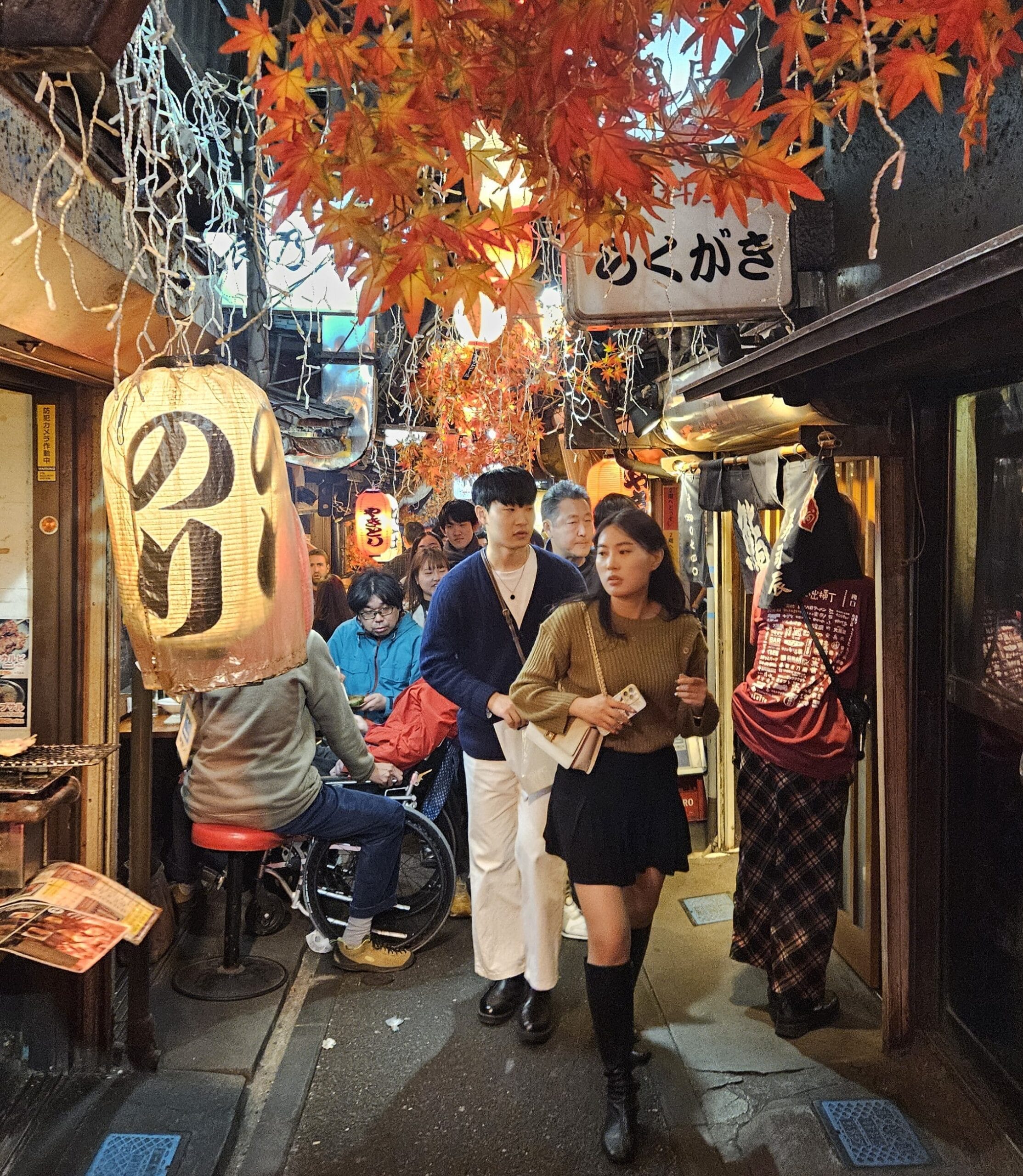
One of the places where I drank Japanese whisky most often is Golden Gai in Shinjuku. It is a block of narrow alleys packed with around 200 tiny bars, many with only five to ten seats. Each bar has its own theme, from punk to film to jazz, and many have an impressive shelf of Japanese whisky behind a counter you can almost touch from the door.
I drank a lot of Japanese whisky there, sometimes neat, sometimes as a highball. My tip is simple: try a lot of different brands in different bars, and trust the bartender. Tell them what you like, sweet, smoky or light, and let them choose. Bartenders in small bars know their shelf, and many are happy to pour you something you have never heard of.

Some bars welcome visitors and show their cover charge on the door, while others are for regulars only. Read my honest guide to Golden Gai before you go, and if you want to keep going, nearby Omoide Yokocho and the standing bars of Shinjuku are good for cheaper drinks.
Konbini Whisky: Highball Cans and Small Bottles
You do not need a bar to drink good whisky in Japan. Every convenience store sells ready made highball cans, and I drank them often. The classic is the Kaku highball can from Suntory, and you will also find stronger versions, lemon versions and premium cans made with better whisky. A can usually costs about 200 to 300 yen.
Konbini also sell small bottles of Kakubin, Black Nikka and other blends, which are perfect for trying a few brands without buying a full bottle. You must be 20 to buy alcohol in Japan, and the till asks you to confirm your age on the screen. Read my Japan convenience store guide for what else to buy, and if you want to see how far konbini drinking goes, visit the Family Mart bar in Shibuya.
What to Buy and Where
I bought bottles of Yamazaki, Hibiki and the Fuji whisky from Kirin to bring home, and for me the best place to buy them was the duty free shop at the airport. Here is why, and what else to know.
Why the Airport Duty Free Works
- No Japanese tax on the spot. Shops after passport control sell without consumption tax and liquor tax, and there is no refund paperwork. In city shops, tax free shopping for visitors now works as a refund system, so you pay the full price first and claim the tax back when you leave.
- Good stock of the famous names. Big international airports often have Yamazaki, Hakushu, Hibiki and exclusive travel retail bottles that are hard to find in town. Stock changes daily, and limits per person are common.
- No liquid problem. You buy after security, so the bottles go straight into your hand luggage. If you change planes, keep the bottles in the sealed duty free bag with the receipt, because the transfer airport may screen liquids again.
For everyday bottles like Kakubin, Black Nikka or Toki, the supermarket or liquor shop in town is usually cheaper. Department store food halls and big electronics stores with a drinks floor are good for a wider range and gift boxes. See my list of the best souvenirs from Japan for more ideas.
Allowances and Limits
What you can bring home depends on your country, not on Japan. As a rough guide, Switzerland allows 1 litre of spirits over 18 percent duty free, the EU allows 1 litre of spirits over 22 percent when you arrive from outside the EU, and the UK allows 4 litres of spirits. Above that you usually pay duty, so check your customs website before you buy. If you are flying into Japan, the duty free allowance is three bottles of 760 ml for adults aged 20 or over.
Rough Prices
Prices change often, and the big producers raised their prices a lot in recent years, so treat these as rough ranges and check before you buy.
| Bottle | Rough price in Japan | Notes |
|---|---|---|
| Suntory Kakubin (700 ml) | about 1,800 to 2,500 yen | Everywhere, from konbini to supermarkets |
| Black Nikka Clear (700 ml) | about 1,000 to 1,500 yen | Budget blend for highballs |
| Suntory Toki (700 ml) | about 2,500 to 3,500 yen | Liquor shops and duty free |
| Nikka From the Barrel (500 ml) | about 3,000 to 4,000 yen | Great value, small bottle |
| Kirin Fuji Single Grain (700 ml) | about 5,000 to 7,000 yen | Liquor shops, department stores, duty free |
| Yamazaki or Hakushu without age statement (700 ml) | from about 7,000 yen | Often sold out or limited per person |
| Hibiki Japanese Harmony (700 ml) | from about 7,000 yen | Easier to find than aged Hibiki |
| Yamazaki 12, Hibiki 17 and older | from about 15,000 yen, often much more | Scarce, often above the official price |
Age statement bottles such as Yamazaki 12 and 18 or Hibiki 17 and 21 are scarce. Shops often limit them to one per customer or sell them above the official price, and some disappear for long periods. If you see one at a fair price, that is the moment to buy.
Can You Visit the Distilleries?
Yes, but plan ahead. Suntory’s Yamazaki and Hakushu distilleries, Nikka’s Yoichi and Miyagikyo, Kirin’s Fuji Gotemba and several craft distilleries offer tours with tastings. Places are limited, booking opens on fixed dates, and the popular tours at Yamazaki and Hakushu are often given out by lottery. Some distilleries have a museum or shop you can visit without a tour, but not all of them.
I have not done a distillery tour myself, so I cannot tell you which one is best. Check the official websites of Suntory, Nikka and Kirin for the current dates, prices and rules, and remember that whoever drives cannot join the tasting. My guide on what to book in advance in Japan has more tips for popular sights.
More Drinking in Japan
If you enjoy whisky, Japan has plenty more to try. Read my guide to craft beer in Japan, and if you travel south, Okinawa has its own spirit, awamori, and even habu sake with a snake in the bottle. For the dos and don’ts of eating and drinking out, see my Japan etiquette guide.
Japanese Whisky FAQ
What is the best Japanese whisky for beginners?
Start with a Kaku highball or a glass of Suntory Toki, Nikka From the Barrel or Kirin’s Fuji. They are easy to find, fairly priced and show the clean, balanced style Japanese whisky is known for. Then try a single malt like Yamazaki, Hakushu or Yoichi in a bar.
Is Japanese whisky cheaper in Japan?
Everyday bottles such as Kakubin, Toki and Black Nikka are much cheaper in Japan than abroad. Premium bottles like Yamazaki 12 or Hibiki 17 are scarce, and shops often sell them above the official price, so the saving is smaller or disappears.
Where is the best place to buy Japanese whisky?
For famous names such as Yamazaki and Hibiki, the duty free shops after passport control at the big international airports are often the easiest place. For everyday bottles, try department stores, liquor shops and big electronics stores with a drinks floor. Prices and stock change all the time, so compare before you buy.
What does Japanese whisky on a label mean?
Under the standard of the Japan Spirits and Liqueurs Makers Association, Japanese whisky must be made from malted grain and Japanese water, distilled, aged for at least three years and bottled in Japan. The rule is voluntary for member companies and fully applies to products from April 2024, so check the label and the maker.
How do you order whisky in a Japanese bar?
Name the whisky and the style: straight (neat), rokku (on the rocks), mizuwari (with water) or haibooru (highball). If you are unsure, ask for a highball and let the bartender choose the whisky.
Do you tip in Japanese whisky bars?
No. Tipping is not part of bar culture in Japan. Small bars often add a seat charge or a small snack called otoshi to the bill instead, and that is normal.
Can you visit Japanese whisky distilleries?
Yes. Suntory, Nikka, Kirin and several craft distilleries offer tours, but places are limited and the popular ones are booked weeks ahead, some by lottery. Check the official distillery website before you plan your day.
Final Thoughts
Japanese whisky is best enjoyed the way locals drink it: a cold highball with dinner, a neat dram in a tiny bar and a can from the konbini on the way home. Try as many brands as you can, let the bartender guide you, and save some room in your hand luggage for a bottle or two from the airport. Kanpai!
Author

Get My Personal Travel Maps



Leave a Reply